





Apple and Amazon both reported quarterly earnings yesterday.
Apple beat on essentially every line and the stock fell more than 4%. Amazon disclosed that trailing twelve-month free cash flow had gone negative and the stock went up.
Let me start with the numbers.
Apple did $109.4 billion in revenue, up 16%. iPhone grew 22% to $54.3 billion, Mac grew 29%, and diluted EPS came in at $2.02 against a street looking for roughly $1.88.
Every geographic segment set a June quarter record. Services grew 12% to $30.7 billion. The only weak product in terms of growth was iPad, down 6%.
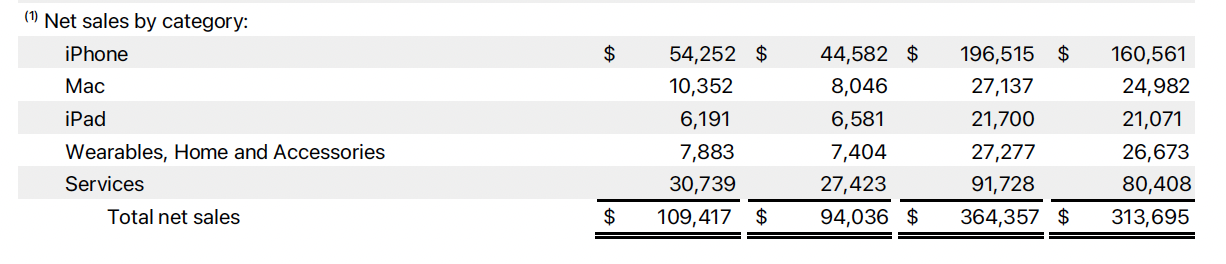
Source: Apple’s quarterly earnings report
Amazon did $200.6 billion, up 20%, with operating income of $27.5 billion, up 43%.
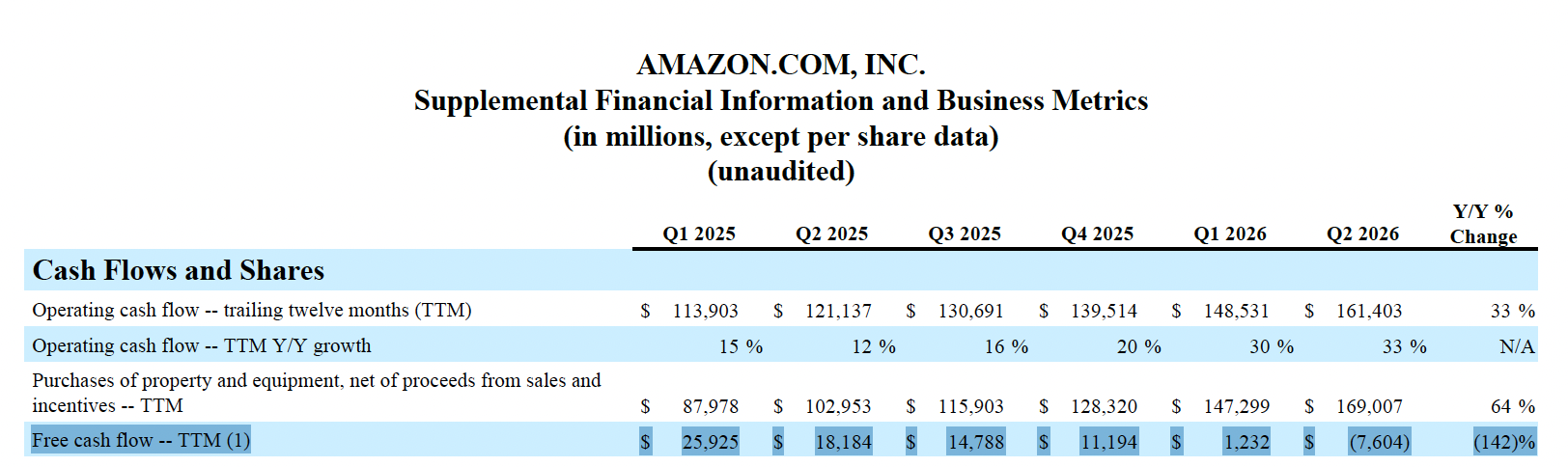
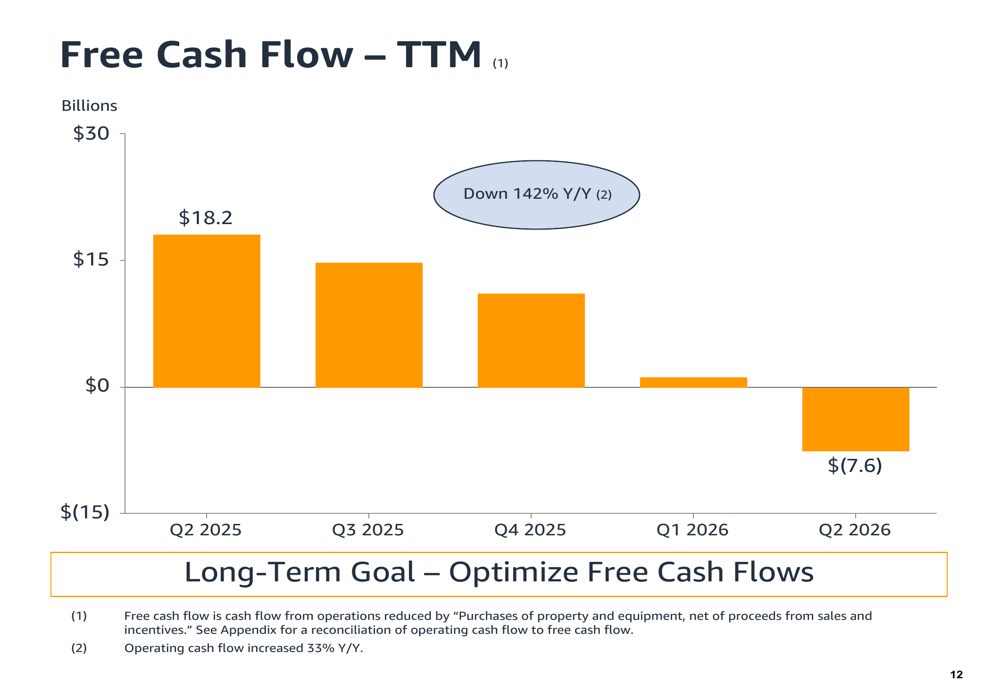
AWS grew 36.7% to $42.2 billion against consensus of about 31.6%, the fifth straight quarter of acceleration and the fastest growth in eighteen quarters. Backlog is $496 billion. Trailing twelve-month free cash flow was negative $7.6 billion, down from positive $18.2 billion a year ago, and 2026 capex guidance went from about $200 billion to about $220 billion.
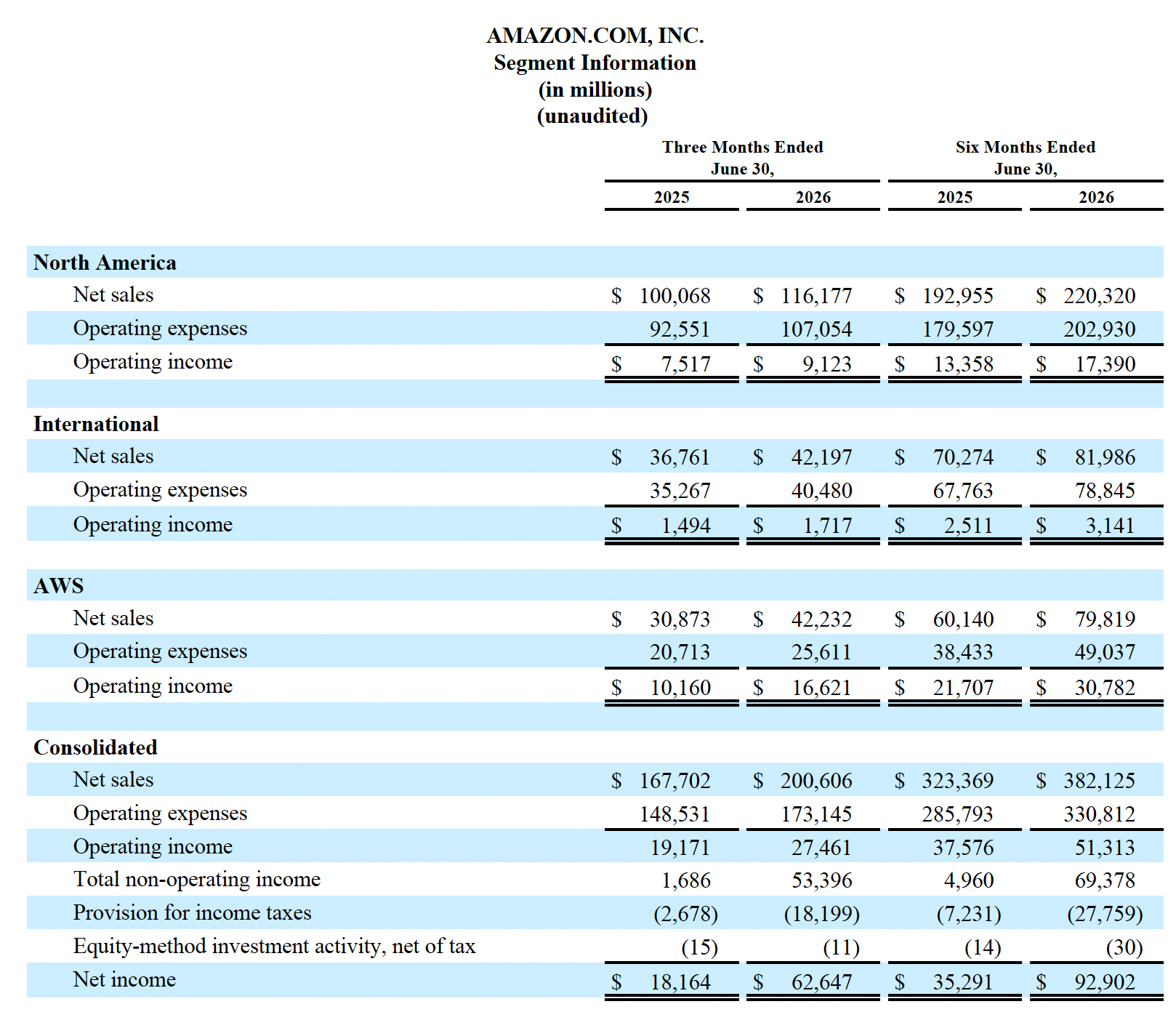
Source: Amazon’s quarterly earnings report
The easy part is that one of these is a growth company and the other is a mature hardware business getting squeezed. I don’t think that is quite right. Both companies are absorbing the same input shock from the same three suppliers. The difference is which one has to run it through the income statement this year.
Both companies are buying from the same three vendors
The thing driving both reports is the price of DRAM.
A word on where these numbers come from, since this article uses them throughout. TrendForce is a Taiwan-based research firm that surveys memory pricing each quarter and publishes the results. What it tracks is contract pricing, which is what large buyers like Apple and Amazon actually negotiate with suppliers, usually on a quarterly cycle. That is different from spot pricing, which reflects whatever is available on the open market on a given day. Contract pricing is the number that turns up in a company’s cost of goods sold a quarter or two later.
Memory is a cyclical business and quarterly moves of 10 or 20% in either direction are normal. What has happened since late 2025 is not.
TrendForce has conventional DRAM contract prices up 90 to 95% quarter over quarter in 1Q26, the largest single-quarter increase it has on record. Then another 58 to 63% in 2Q26. Then 13 to 18% in 3Q26.
Low-power DRAM, which is what goes into phones, rose about 90% in 1Q26 alone. You can see the same thing from the supply side: DRAM industry revenue was roughly $97 billion in 1Q26, up 81% sequentially, and Samsung’s DRAM revenue nearly doubled in a single quarter to $37.3 billion.
The cause is not complicated.
HBM for AI accelerators is built on the same wafers as the conventional DRAM that goes into laptops and handsets. Every wafer allocated to HBM is a wafer that doesn’t become a phone part. Samsung, SK hynix and Micron have been shifting capacity toward HBM and high-capacity server memory because those products earn far more per wafer, and between them those three are close to 90% of the market: roughly 38%, 29% and 22% in 1Q26.
So the supply of consumer memory is now being set by a decision that has very little to do with consumer demand.
It got dislocated enough that Counterpoint flagged DDR4 spot prices around $2.10 per gigabit running above HBM3e contract prices at roughly $1.70. Older commodity memory is more expensive per bit than the advanced product that displaced it.
None of this resolves quickly. Suppliers can now squeeze out some additional bits through process migration, but real capacity means new cleanrooms, and those take years to build. Meaningful new supply arrives in 2027 at the earliest, and Intel CEO Lip-Bu Tan has said there is no relief until 2028.
So Amazon’s $220 billion capex program is one of the direct causes of Apple’s gross margin problem. Apple is competing for wafer allocation against AWS server builds, and it is not winning that competition.
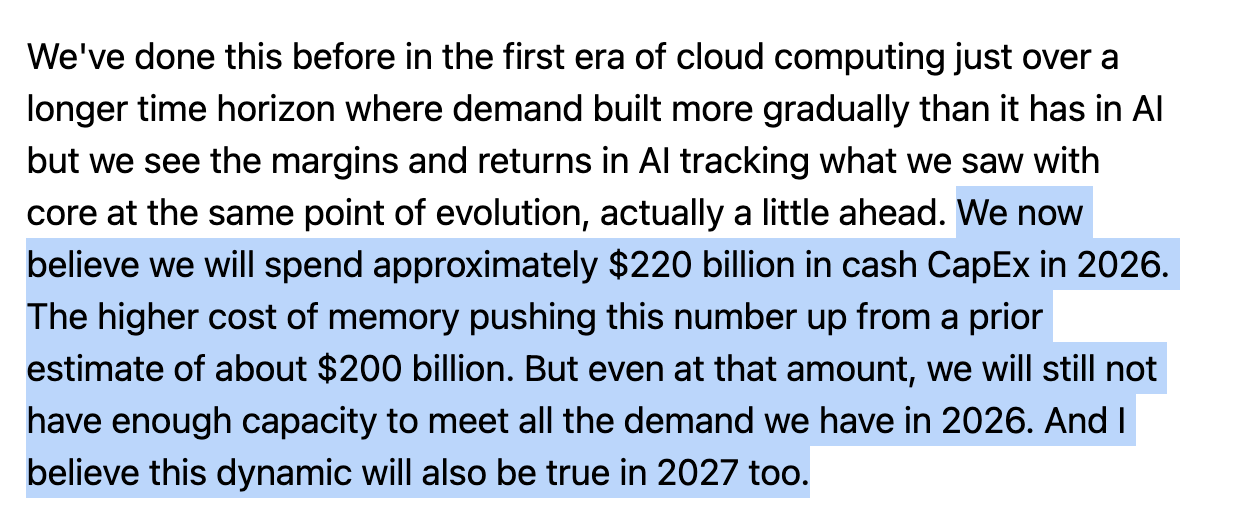
Source: Amazon’s earnings call transcript
Neither management was coy about it. Tim Cook, on his last call as CEO, described it as “a 100-year flood on the memory pricing with exponential increases in memory prices.” Andy Jassy, asked about supply chain inflation, said there are “inflated prices right now on some of the components like memory and hard drives.” Amazon then told the street that memory costs are what pushed capex guidance up by $20 billion.

Source: Apple’s earnings call transcript
Apple expenses memory in the quarter; Amazon capitalizes it
Apple buys memory, puts it in a phone, and sells the phone. The cost runs through cost of sales more or less immediately, so you can watch it happen in the reported numbers.
CFO Kevan Parekh gave the bridge on the call.
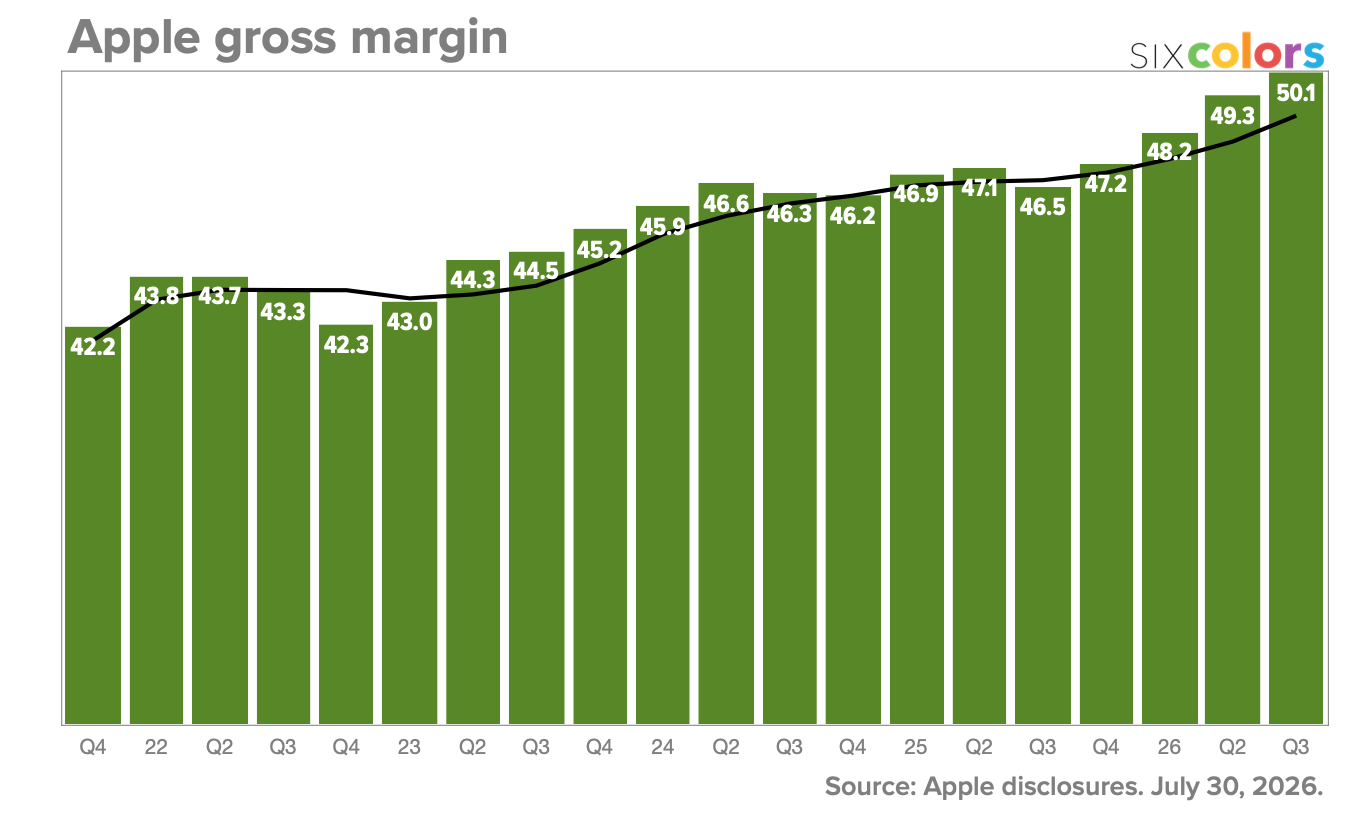
Company gross margin was 49.3% in the March quarter. June it is 50.1%, but that included about two points of tariff refunds, so 48.1% on a comparable basis. Of that 120 basis point decline, Parekh said “more than 100% of that can be explained by the memory cost change.”

Source: Apple’s earnings call transcript
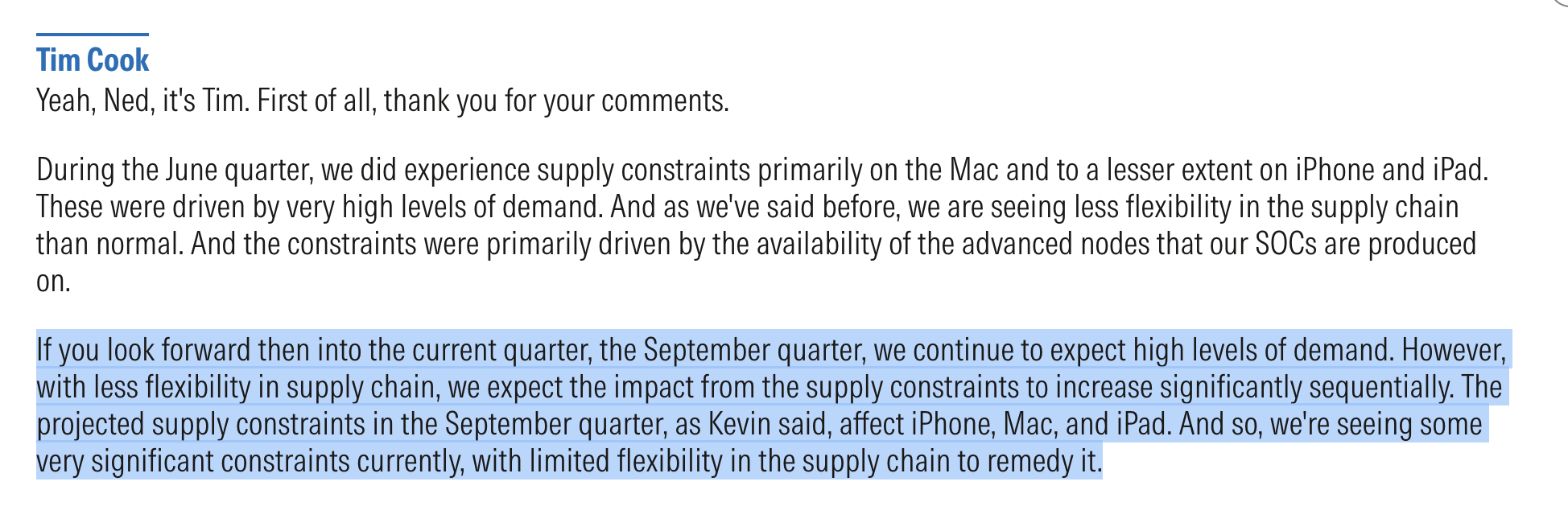
From 48.1% to the September guide, which strips to roughly 46.5% at the midpoint after removing a point of tariff benefit, you get another 160 basis points. Also more than fully explained by memory.
That’s about 280 basis points of gross margin in two quarters. The gross memory impact is bigger than that, because Parekh said it was partly offset by cheaper non-memory components, mix, and carry-in inventory.
Apply 280 basis points to a quarter the size of the one Apple just reported and you get about $3.1 billion of gross profit.
At the 16.5% tax rate Apple guided to, that is roughly $2.6 billion, or about $0.18 of quarterly EPS against the $2.02 Apple annouced. Call it 9% of earnings relative to a March quarter cost base. Cook said he expects memory prices to keep rising past September.
Source: Apple’s earnings call transcript
The inventory line is worth a look here. Apple carried $11.1 billion of inventory at 27 June against $5.7 billion at the end of September. This is a company that has been celebrated for two decades for holding almost nothing, and it has nearly doubled the stockpile.
That’s a hedge and it’s why June printed 48.1% rather than something worse. Cook was explicit that the benefit decreases after September.
Amazon does the same purchase and books it differently.
Memory goes into a server, the server is a capital asset, and none of the $220 billion touches this quarter’s income statement. It shows up as $53.1 billion of 2Q cash capex, trailing twelve-month equipment purchases of $169 billion (up 64%), and free cash flow of negative $7.6 billion. The cost then arrives as depreciation over the five to six year server life Jassy described.
Which is why AWS operating margin went up 650 basis points year over year to 39.4% in the same quarter Amazon said memory added $20 billion to the capital budget. The capacity earning revenue today was bought at older prices. The expensive gear is still being installed.
Source: Amazon’s quarterly earnings report
The cloud buyers signed long-term agreements and Apple apparently didn’t
The accounting explains the optics. It doesn’t explain the price, and the price gap is the more interesting part.
TrendForce noted in July that several US cloud providers have signed multi-year long-term agreements that restrict suppliers from raising prices for those clients. That is why server DRAM is up only 13 to 18% this quarter while legacy consumer DRAM is up another 35 to 40%. The hyperscalers locked pricing. Consumer buyers are absorbing the residual.
Erik Woodring of Morgan Stanley asked Apple about this directly, whether Apple intended to pursue “multi-year LTAs with your suppliers just to ensure access to supply at pre-agreed prices.”
Cook answered the second half of Woodring’s question, about pricing philosophy, and left the LTA half alone. The closest he came was later, on supplier concentration: “primarily the DRAM market has three suppliers.” He added that Apple is evaluating all options.
I could be reading too much into a non-answer on a busy call. But nobody followed up, and Apple has now guided to two consecutive quarters of memory-driven margin compression without saying anything about locking supply.
Apple’s procurement model was built for a component that got cheaper every year
Apple’s supply chain is the most admired in the industry and Cook built it. The logic is to avoid long fixed commitments, keep suppliers competing, negotiate frequently, and let component deflation accrue to Apple rather than the vendor.
For forty years that was the right call, because memory was a commodity with a reliable downward price curve. Locking a five-year price on a deflating input is a slow way to lose money.
Amazon behaves differently, and I don’t think it is because Amazon is smarter. Amazon doesn’t treat memory as a component. It is actually a part of a capital asset with a data center around it, so Amazon buys it the way you buy capital assets: long-dated, volume-committed, price-locked. Jassy spent a good chunk of the call on that framework, including thirty-plus year data center lives, five to six server generations per building, and most AI capacity contracted for at least five years.
When the input flipped from deflationary to inflationary, the model built for flexibility had no protection and the model built for commitment turned out to be a hedge.
You see the same split in spending. Apple’s capex for the first nine months of FY26 was $6.8 billion, down 28% from $9.5 billion. R&D was up 32%. Apple is the only company of its size cutting capex during this cycle, and it buys compute from third-party clouds to run Siri AI. So it pays at the memory counter without allocation priority, and again at the cloud counter at someone else’s margin.
Where I think the real uncertainty is
Two caveats before this reads as a verdict.
First, Amazon’s reported earnings this quarter are mostly not earnings.
Of $62.6 billion of net income, $53.4 billion was pre-tax non-operating income, primarily an unrealized markup on the Anthropic stake. Tax it at 25% and the mark contributed roughly $40 billion. Strip it out and diluted EPS is somewhere around $2.05 to $2.10 rather than $5.75.
Anthropic is also an AWS customer with multi-year, multi-gigawatt Trainium commitments. Outside rounds set that valuation, not Amazon, so I’m not suggesting anything improper. It’s still worth separating from the headline.
Second, the memory drag on Amazon, with assumptions stated.
Jassy attributed the $20 billion capex increase to memory. Assume all of it is server-side rather than data center shell, and assume the five to six year life he described. That’s roughly $3.6 billion of incremental annual depreciation from the 2026 vintage alone, arriving as capacity enters service. Against AWS trailing twelve-month operating income of $54.7 billion, about 7%. Against a 2028 AWS revenue base, somewhere between 150 and 200 basis points of segment margin. Not fatal. If the 2027 program carries a similar premium, it stacks.
So here is what I would actually watch. AWS margin at 39.4% is currently untouched by expensive memory because that memory isn’t in service yet. Track AWS segment margin through 2027 and 2028 as the 2026 and 2027 vintages depreciate. High thirties means the cost got absorbed by a faster-growing revenue base. Low thirties means it showed up.
On Apple, the open question is elasticity. Cook said it’s too early to judge how consumers respond to the price increases on Mac and iPad because channel inventory and consumer behavior both lag. iPad was already down 6%. I’d watch iPad and Mac in the December quarter, and whether Apple’s next CFO commentary mentions long-term agreements.
What I don’t think anyone can call from here is how long the shortage runs. Estimates cluster between late 2027 and 2028. If relief comes early, Apple’s margin recovers quickly and Amazon carries a fleet bought near the top. If it comes late, Amazon’s locked pricing looks like a very good decision and Apple keeps raising prices into softening demand. I don’t have high conviction either way, and I would be skeptical of anyone who says they do.