





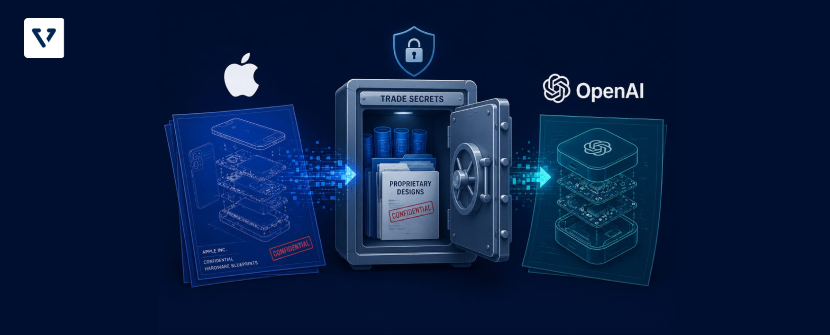
For two years, Apple and OpenAI have been the tech world’s most awkward couple.
Partners, technically. Apple lets ChatGPT plug into Siri. But underneath the partnership, both companies have been quietly chasing the same prize: whatever gadget replaces the smartphone.
Apple hasn’t had a genuinely new hardware hit since AirPods and the Watch. OpenAI wants to build the thing that finally does. Last year, it paid $6.5 billion for a startup called io, founded by Jony Ive, the man who designed the iPhone’s entire look, alongside Tang Tan, a 25-year Apple lifer who used to run Apple Watch design. OpenAI made Tan its Chief Hardware Officer. Since then, more than 400 former Apple employees have followed him out the door.
So when Apple filed a 40-page lawsuit against OpenAI last Friday, it wasn’t a bolt from the blue. Two companies had been circling the same future for a while, using a lot of the same people.
What turned that quiet rivalry into open legal war, though, was one text message.
The text that broke the internet
“LOL, I found out I can access the [network storage], so funny.”
That sentence sits at the heart of Apple’s complaint, a filing so sharply worded that Apple’s own lawyers called OpenAI’s hardware business “rotten to its core.” Turns out even a trillion-dollar fruit company can bruise easily.
Somewhere in the background, Elon Musk saw the headlines and couldn’t resist, spending the weekend calling Sam Altman a scammer on X.

Altman clapped back with a joke about Musk’s space data centers, then couldn’t resist a victory lap of his own, posting that the real proof his new model was winning wasn’t the benchmarks, it was that Elon was “obsessed” with him again. Classic internet. But it’s a sideshow.

The real story is about how one departing engineer’s bad joke became Apple’s star witness.
The door nobody remembered to lock
Meet Chang Liu. Eight years at Apple working on iPhone hardware, the unglamorous stuff, power converters, the circuitry that keeps a phone from overheating in your pocket.
In January, he resigned and joined OpenAI’s brand-new hardware team.
Standard practice when you leave Apple: return your equipment, sign some paperwork, lose your access. According to the lawsuit, Liu skipped most of that.
He kept an Apple-issued laptop. And weeks after starting at OpenAI, he discovered his old credentials still worked. He could still log into Apple’s internal file servers as if he’d never left.
Most people would quietly close the laptop and never speak of it again. Liu, allegedly, thought it was funny enough to text a friend still at Apple, Alyssa Peng, about it. Her reply wasn’t a laugh. It was two words: “I’m ready.”
That’s the moment a lucky login turns into, in Apple’s telling, a crime scene.
The lawsuit claims what followed was months of quiet extraction: engineering presentations, hardware schematics, manufacturing and testing procedures for products nobody outside Apple had heard of. All allegedly pulled while Liu sat at a desk at OpenAI, building the thing meant to compete with them.
Peng, still on Apple’s payroll, allegedly kept the pipeline flowing from the inside, grabbing files off her own laptop and pointing Liu to exactly which folders mattered. She joined OpenAI herself that April. In hindsight, an open and shut case of bad timing.
The job interview that was secretly an interrogation
The Liu-Peng story is the sharpest, most specific claim in the suit.
But Apple argues it wasn’t a one-off. It was a pattern. And the second thread reads less like office gossip, more like a recruiting playbook.
Apple accuses Tang Tan of turning job interviews into information-mining sessions.
The alleged method: ask candidates, while they’re still employed at Apple, to prepare a “Technical Deep Dive” walking through their current work.
One candidate, the suit claims, spent the hours before his interview screenshotting and downloading files tied to a confidential project. Then, in the interview itself, Tan allegedly zeroed in with questions about that exact project.
Apple doesn’t call this a coincidence. It calls it “an established pattern.”
There’s also a detail that made headlines on its own, mostly because it sounds too on-the-nose to be real: candidates allegedly told to bring actual pieces of Apple hardware to “show and tell” sessions.
Not slides. Not descriptions. Batteries, logic boards, and system-in-package components, physically carried out of Apple’s buildings and set down on a table for OpenAI’s interviewers.
One former Apple employee later said she was surprised anyone had brought unreleased hardware at all. She hadn’t realized anyone could just take it. Neither, apparently, had security.
The checklist
The most damning claim in the whole filing isn’t dramatic. It’s a document.
Apple alleges Tan put together a checklist quietly passed to new recruits, laying out how to leave Apple without tripping any alarms.
Don’t sign anything at your exit interview. Stall it if you can. Don’t confirm your devices were returned. Tell OpenAI immediately if HR asks you to sign something unexpected.
Apple says it noticed the pattern from the outside before it ever saw the checklist. Departures that felt oddly slippery. Employees dodging security reviews. Exit processes that used to take two weeks somehow evaporating overnight.
Four hundred-plus individual improvisations don’t usually look identical. A system does.
So why turn a leak into a war?
Here’s the awkward part: the strongest, most airtight piece of Apple’s case is basically one engineer who got caught bragging in writing. That’s a real problem for Chang Liu personally.
It’s a much thinner thread to hang an entire “institutional conspiracy” on. And Apple’s filing reaches well past Liu, alleging the misconduct runs “at every level,” all the way up through Tan.
So why go this loud, this fast, with language usually reserved for a company you’re trying to bury?
Zoom out and a few things line up.
This was never really about one laptop. It’s about whatever replaces the iPhone, and OpenAI is racing to build exactly that. Apple has also watched more than 400 of its own people, reportedly its “crème de la crème,” walk across the street to help build the device meant to dethrone it.
The timing lines up almost too well, too. This lawsuit landed right as OpenAI prepares for an IPO, exactly the moment a headline about stolen trade secrets does the most damage, forcing its executives to spend months fielding integrity questions instead of shipping product.
Apple has run this exact play before. Back in 2010, it sued Android phone makers, calling the operating system a “stolen product,” and dragged that fight out for years without landing a knockout blow. Android went on to take over most of the world anyway.
But Apple didn’t need to win. It needed to cost its rival time, money, and focus, at the exact moment it could least afford to lose any of the three.
The takeaway
Win or lose in court, Apple has already banked something real. Every future headline about OpenAI’s first hardware launch now comes with a footnote, a lingering question about whether the thing was built clean.
Sometimes a lawsuit isn’t really about the damages you might collect. It’s about making sure the other side never gets to bite into a clean launch.