





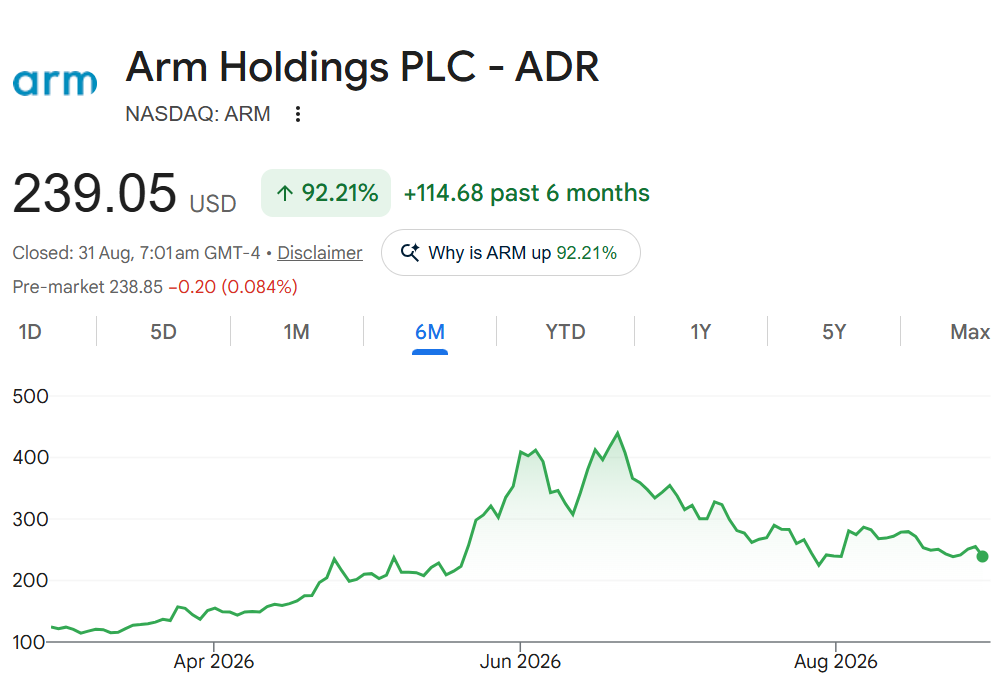
Six months ago, Arm Holdings was just another chip design company collecting royalty cheques. Today it is worth $255 billion, and the stock has nearly doubled since March. Here is what actually happened.
From licensor to chipmaker
For over three decades, Arm’s business model was simple. It designed the blueprints for processors, licensed those designs to companies like Apple, Qualcomm and Samsung, and collected a small royalty every time a chip using its architecture shipped. Arm itself never made a single chip. It just owned the plans.
That changed on March 25 this year. At an event called Arm Everywhere in San Francisco, CEO Rene Haas announced that Arm was building its own chip for the first time in the company’s history. It is called the AGI CPU, and it is designed specifically for one job, running AI agents inside data centres.
The stock was trading around $124 the day before the announcement. It jumped 16% the next day alone.
Why the market got so excited
The excitement was not just about Arm making a chip. It was about who signed up to use it.
Meta came on board as the lead partner and co-developer. OpenAI, Cloudflare and SAP followed as early customers. More than fifty other companies, including Microsoft, Nvidia and Samsung, said they would support the move in some form. For a company that had always stayed on the sidelines of actual chip manufacturing, landing Meta and OpenAI as day-one partners was a strong signal that this was not a science project.
Management backed the announcement with numbers. Arm said the AGI CPU alone could generate $15 billion in annual revenue by 2031, pushing total company revenue to $25 billion, more than five times what it made in 2025. Citi analysts called it the most significant shift in Arm’s history, and Raymond James upgraded the stock the same week.
From that $124 starting point, Arm ran hard. By late April, the stock had climbed past $235, a near vertical move in about a month. Some of that gain came back down after TSMC, one of Arm’s early backers, fully exited its stake, a reminder that even a strong story does not move in a straight line.
The earnings kept the story alive
The rally needed one more thing to hold up, actual financial results that matched the ambition. Arm delivered that in late July. The company posted a record quarter, crossing $1 billion in quarterly revenue for the second time running, with royalty revenue up 25% year on year.
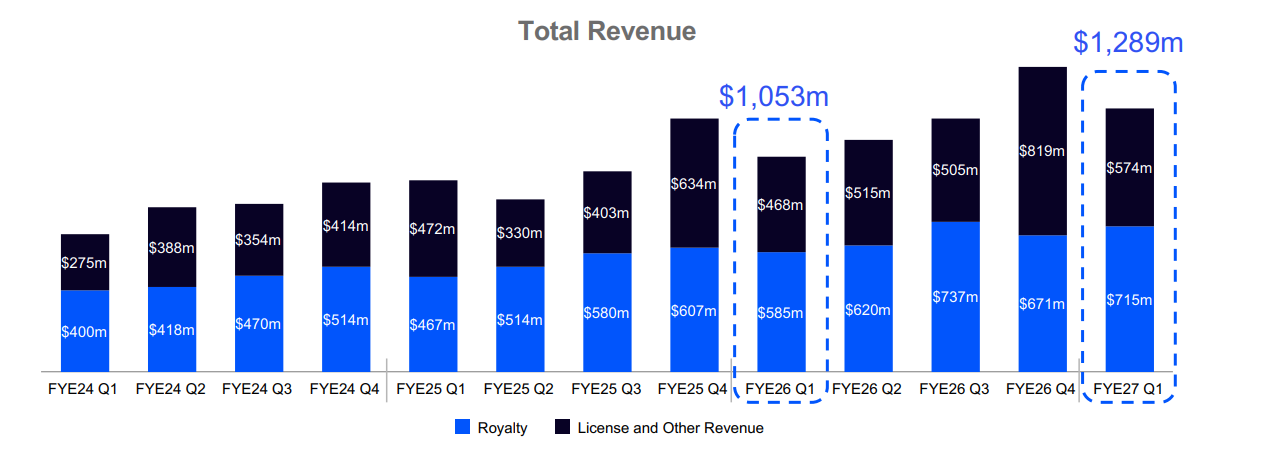
Haas told analysts on the call that demand for the product was great, and he was not just talking about smartphones anymore. Data centre royalties more than doubled during the quarter as cloud providers leaned harder into Arm-based chips.
Analyst price targets kept climbing through August. Mizuho, Raymond James and Bank of America all raised their targets, with the average twelve month estimate now sitting comfortably above where the stock trades today.
What the six month rally is actually pricing in
Here is where it gets tricky. Arm now trades at a valuation that assumes almost everything goes right. On a forward basis, the stock sits at roughly 60 times next year’s expected earnings, a multiple that leaves very little room for a bad quarter or a delayed product rollout. One research note this month was blunt about it, arguing that even a genuinely strong quarter cannot fully justify where the stock sits today.
Dig into the actual economics of the royalty business, and the gap between the AI hype and what Arm currently earns from it becomes clearer. On a licensing model, Arm collects a small fee every time a chip using its designs ships. Independent estimates put that blended royalty rate at less than 2% of the value of an Arm-based chip, and the rate on cloud AI chips specifically is even lower than that. In other words, for every $100 of Arm-powered AI infrastructure sold today, Arm itself is capturing less than two dollars of it.
Management’s own FY2031 targets assume that gap closes fast. To hit the $25 billion revenue and $9-plus earnings per share the company has guided to, Arm needs its royalty rate on cloud AI chips to roughly triple over the next five years, on top of AGI CPU sales scaling from zero to $15 billion. Independent modelling of that guidance, discounting future cash flows back to today, suggests the stock needs closer to $30 billion in FY2031 revenue, not $25 billion, before the current price starts to look justified. Anything short of that, and there is real downside built into today’s valuation rather than upside.
There is also a structural wrinkle worth understanding. By building its own chip, Arm is now competing directly with some of the same companies that pay it royalties, including Nvidia, which has already shifted its own newest CPU to a cheaper custom licence rather than paying Arm’s standard rate. That kind of channel conflict has sunk other companies that tried to move up the value chain too aggressively, and it has reportedly drawn early attention from US antitrust regulators looking into whether Arm’s licensing practices could restrict competitors’ access. Add in a smartphone market that analysts expect to shrink through 2026, still Arm’s largest single royalty source, and the case for caution gets a little stronger.
None of this means the story is over. Agentic AI genuinely does favour CPU-heavy workloads, and Arm’s power efficiency has always been its strongest card. But a 92% move in six months on the back of one product announcement and two good quarters is a lot to have already priced in. For anyone holding Arm through a Vested account or thinking about starting a position, the question is no longer whether the AGI CPU story is real. It clearly is. The question is whether the stock still has room to run once the price already reflects a best case outcome for the next five years.
