





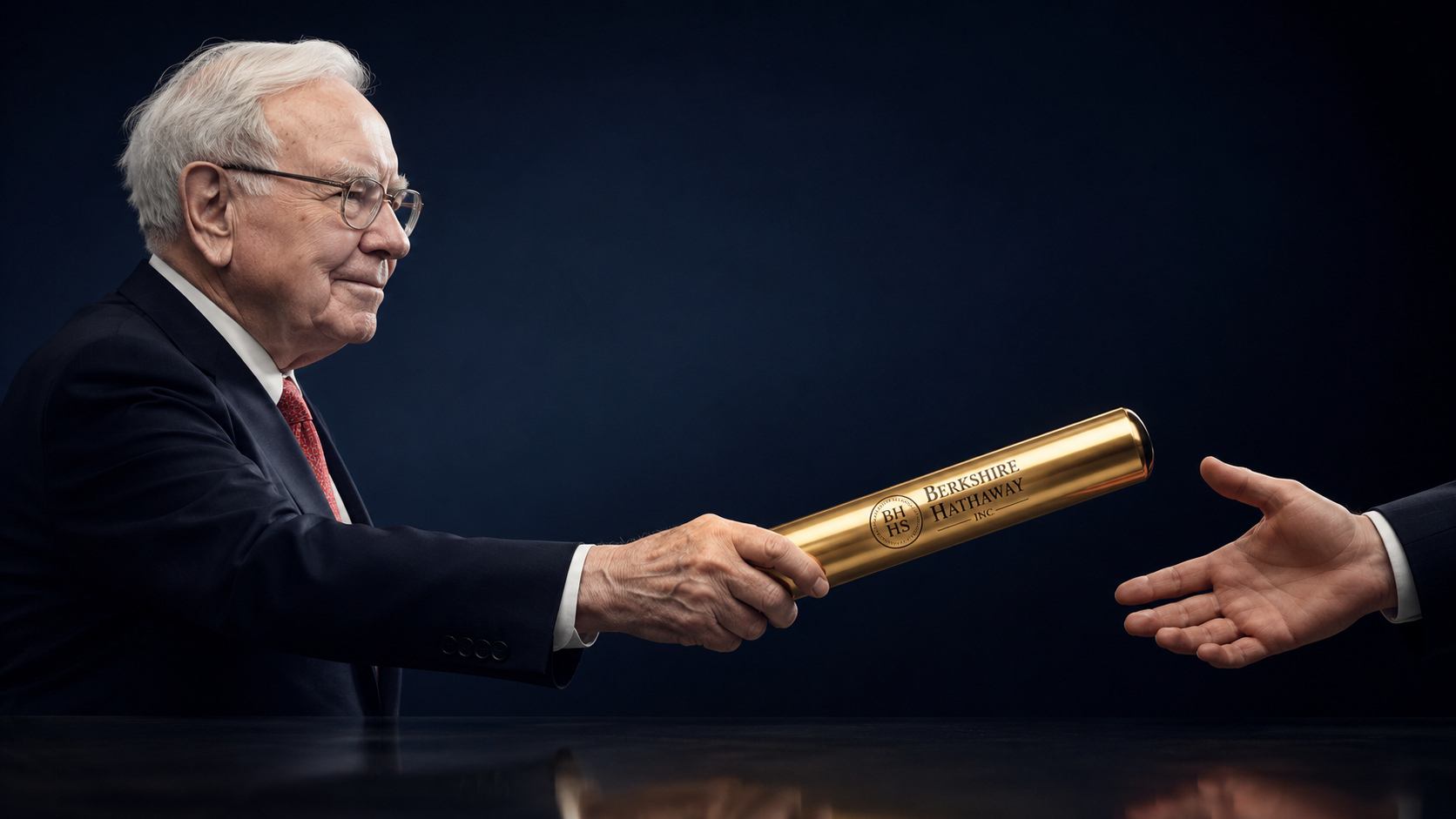
Companies tell you who they are by what they do with excess cash.
A company that hoards cash is telling you it cannot find anything worth buying at current prices. A company that deploys cash aggressively is telling you the opposite.
For three consecutive years, Berkshire Hathaway told investors it could not find much worth buying. Warren Buffett let the cash pile grow to a record $397.4 billion by March 2026. He sold more stocks than he bought for 14 quarters straight.
Then Greg Abel took over as CEO on January 1, 2026. In Q2 alone, Berkshire’s cash pile shrank by $32 billion.
The company bought $20 billion more in stocks than it sold, including a $10 billion private deal with Alphabet, and repurchased some of its own shares.
The message has changed. Let’s decode it.
The Alpha“bet”
The centrepiece of Abel’s spending is Alphabet, the parent company of Google.
Berkshire first took a position in Alphabet under Buffett in Q3 2025, reportedly worth around $4.3 billion.
Under Abel, the stake roughly tripled through open-market purchases in Q1 2026. Then in June, Abel negotiated a $10 billion private placement directly with Alphabet.
FYI, a private placement is not a market order. It is a structured deal between two boardrooms, with negotiated terms, specific pricing, and a stated purpose.
Alphabet reportedly used the proceeds to fund its AI infrastructure buildout. The company has since raised its 2026 capital expenditure guidance to $195 billion to $205 billion.
Berkshire’s total Alphabet stake is now reportedly worth approximately $31.5 billion, built across open-market purchases and the $10 billion private placement. That makes it the company’s fifth-largest holding at roughly 8.8% of the equity portfolio.
Berkshire Hathaway’s Top Holdings (Q2 2026)
| Rank | Company | % of Equity Portfolio |
| 1st | Apple | 20.0% |
| 2nd | American Express | 14.9% |
| 3rd | Coca-Cola | 9.8% |
| 4th | Bank of America | 9.1% |
| 5th | Alphabet | 8.8% |
Source: Yahoo Finance
Alphabet was not the only purchase. Across all stocks, Berkshire bought $23.5 billion and sold $3.7 billion in Q2, a net purchase of roughly $20 billion. Meaning, Abel was buying broadly.
Buffett reportedly confirmed that he initiated the Alphabet investment. The scale and pace of what followed, though, is Abel’s.
Berkshire’s Achilles heel
The Q2 earnings, reported on August 8, show the core businesses are in decent shape.
Operating earnings rose 16% to $12.98 billion.
Net income more than doubled to $25.67 billion, driven partly by $10.9 billion in unrealised investment gains on the equity portfolio, including the Alphabet stake.

Source: Berkshire Hathaway, Glenview Trust
The manufacturing, service, and retailing segment posted a 24% increase to $4.47 billion. Berkshire Hathaway Energy delivered $891 million in profit, up 27%. BNSF, the railroad, contributed $1.56 billion, a 6% increase.
The drag came from insurance.
Total insurance underwriting earnings fell 13% to $1.73 billion. The biggest reason was GEICO, the auto insurer, whose underwriting profit reportedly dropped 45% to $994 million.
Rising accident claims and higher marketing costs drove the decline, as GEICO spends to win back customers lost during a multi-year restructuring.
CFRA analyst Cathy Seifert reportedly called GEICO’s results “absolutely abysmal.”

Source: Berkshire Hathaway, Glenview Trust
Put your money where your mouth is
While the Alphabet position draws headlines, the buyback programme carries its own signal.
Berkshire repurchased $4.5 billion of its own shares in Q2, the highest quarterly total in five years.

Source: Berkshire Hathaway, Glenview Trust
It reportedly continued in July, adding another $3.3 billion.
A buyback says something specific:
The people running this company believe its stock is trading below what it is worth.
Abel is simultaneously telling the market that Alphabet is undervalued and that Berkshire itself is undervalued.
That is a double conviction call, backed by real capital.
The cash pile, after all of this, reportedly fell from $397.4 billion at the end of March to $365.5 billion at the end of June.
In percentage terms, that is about 8% of the war chest.
Can Berkshire outlive Buffett?
Buffett kept technology at arm’s length for six decades. His Apple investment was the lone exception, and he framed it as a consumer brand, not a technology wager. He openly called missing Google and Amazon a mistake.
Abel’s Alphabet position corrects that omission.
The $10 billion private placement alone was one of the largest single equity investments in Berkshire’s recent history.
Alphabet gives Berkshire exposure across the commercial infrastructure that AI runs on: from cloud computing to chips to the Gemini family of AI models, and billions of users across Search, YouTube, and Android.
Abel has credentials for the job.
He reportedly built Berkshire Hathaway Energy into one of the largest wind power producers in the US. Buffett himself has said Abel works harder than he ever did. Operating earnings in Q2 grew 16% under his watch. And he has shown he will act on capital allocation, something shareholders worried he would be too cautious to do.
But the stock has not agreed yet.
Over the past year, Berkshire has returned 8.51% while the S&P 500 has gained 19.51%. The gap widened sharply after Buffett stepped down.

Source: Alpha Spread
Morningstar analyst Greggory Warren has noted that Abel will be held to a different standard, with greater scrutiny on performance. And GEICO, one of Berkshire’s most important businesses, is struggling while competitors pull ahead.
Six months is not enough to answer the question in the heading.
But the early evidence suggests Abel is not trying to be Buffett. He is trying to build the version of Berkshire that intends to move faster.
And Buffett’s legacy has already handed him the firepower needed for it.
There is reportedly $365 billion still sitting in cash and Treasuries. That is more than the market capitalisation of all but about 20 companies on Earth.
At that pace, Berkshire remains one of the most conservatively capitalised companies in the world.

Source: Berkshire Hathaway, Glenview Trust
But the direction of travel is new.
Abel spent roughly 8% of the war chest in one quarter.
Where the next cheque goes, and how large it is, will tell investors whether Q2 was the start of a programme or a one-quarter burst.
Buffett built his reputation by waiting for the right pitch.
Abel, six months in, is swinging.
What this means for you
Berkshire’s Class B stock trades at roughly $529 as of August 11, at a trailing price-to-book ratio of about 1.4x.
It is up only about 8.51% in a year, lagging the S&P 500’s roughly 19.51% return.
Some of that gap reflects a “Buffett premium” that is still fading. Whether Abel earns his own premium is the question this story comes down to.
The answer will play out over the next few quarters as Abel deploys what remains of the $365 billion war chest.
Indian investors who want to track that answer have options.
You can own broad US exposure through ETFs like the Vanguard S&P 500 ETF (VOO), which already includes Berkshire.
You can also invest directly in Berkshire Hathaway or Alphabet through Vested.
