





A few weeks ago, the US government told Anthropic to switch off its two most powerful AI models, Claude Mythos and Claude Fable, for anyone outside the country.
The Commerce Department’s reasoning was straightforward. These models are unusually good at finding security flaws in software, and Washington did not want that capability sitting around unsupervised.
So Anthropic pulled the plug.
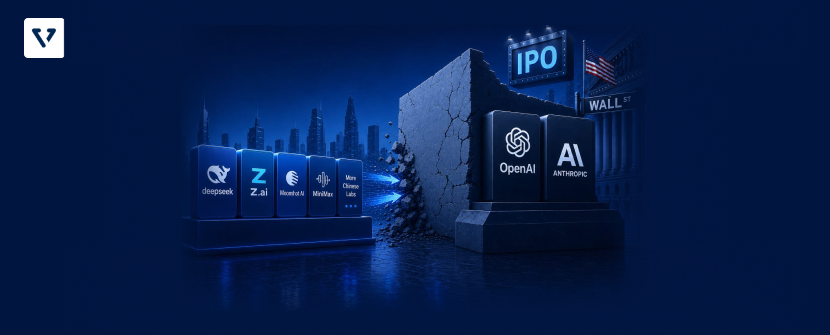
Here’s why the timing could not have been worse. Anthropic and OpenAI are both heading toward IPOs that investors are pricing north of 800 billion dollars each, right alongside SpaceX.
And those numbers rest on one quiet assumption, that enterprise customers will keep paying a premium because there is no real alternative. In the weeks since Mythos and Fable went dark, that assumption has started looking shaky.
Let’s get into it.
The bill just landed, and it’s bigger than anyone budgeted for
This earnings season, AI costs stopped being a rounding error. Meta, Shopify, Spotify and Pinterest all flagged rising AI and inference costs as a drag on margins. Shopify said its economies of scale were “partially offset by increased LLM costs.” That is corporate speak for we are spending more on AI than we planned to.
The numbers explain why. According to cloud cost firm CloudZero, 45 percent of companies surveyed spent more than 100,000 dollars a month on AI in 2025, up from just 20 percent the year before.
And where exactly that money goes has become a very uncomfortable question, because AI benchmarking firm Artificial Analysis ran every major model through the same ten evaluations and tracked the total cost of getting a lab’s most capable model through all of them.
Anthropic’s Claude came in at 4,811 dollars. OpenAI’s ChatGPT cost 3,357 dollars. DeepSeek cost 1,071 dollars. Kimi cost 948 dollars. Zhipu’s GLM cost 544 dollars.
Read that last comparison again. Claude is nearly nine times more expensive than the cheapest Chinese alternative for the exact same workload.


Chinese models went from a rounding error to the default option in about a year
On OpenRouter, the marketplace developers use to access hundreds of AI models through a single interface, Chinese models made up roughly one percent of usage in 2024. By May this year, that number had crossed 60 percent.
That is not a slow creep. That is a category of product getting replaced.
Part of the shift came from Z.ai’s GLM-5.2, released days after Anthropic’s Mythos and Fable shutdown. Security researchers found it performing on par with Mythos in some bug hunting benchmarks, and it beat Anthropic’s own Claude Opus 4.8 on certain tests run by the cybersecurity firm Semgrep.
Within days it became one of the ten most used AI models globally. Venture capitalist Marc Andreessen posted that “many smart people are saying GLM-5.2 is the first Chinese AI model to match and often beat the American big lab public AI models with no compromises.” Jefferies strategist Christopher Wood told clients it was “almost equal to Anthropic as a competitor for the corporate market and is just one quarter of the cost.”
But GLM-5.2 was not a one-off. DeepSeek, the lab that triggered a US tech selloff back in early 2025, released a preview of its next-generation model last month that matches or nearly matches the latest from OpenAI, Anthropic and Google on coding, agentic and knowledge benchmarks. Moonshot, Xiaomi and Zhipu have all shipped models at similar capability levels in just the past four months. This is not one lucky Chinese lab anymore, it is an entire ecosystem moving in formation.
Companies are already voting with their budgets. Flo Crivello, CEO of AI startup Lindy, switched his entire company off Claude models onto DeepSeek and told CNBC the cost curve simply crashed to the ground. Coinbase’s CEO Brian Armstrong said switching to GLM-5.2 and Kimi 2.7 cut the company’s AI spend nearly in half despite using more tokens than before. Even Google is leaning into the pressure rather than fighting it. At its I/O conference, CEO Sundar Pichai said “many companies are already blowing through their annual token budgets, and it’s only May,” and pitched Gemini 3.5 Flash as the fix, claiming its largest cloud customers could save over a billion dollars a year by shifting 80 percent of workloads to the cheaper model.
Enterprises found a workaround, and it quietly guts the pricing story
Databricks CEO Ali Ghodsi has a front row seat here, because the company’s AI gateway sits between thousands of enterprise customers and the models they use. He described a technique enterprises are now deploying called the advisor model. A cheap open source model handles the bulk of the work by default. Only when it hits something it cannot solve does it call out to a frontier model from OpenAI or Anthropic for help.
“You can curb costs really well this way,” Ghodsi said.
Figma CEO Dylan Field described enterprise AI adoption as moving through three phases. First, nobody uses it. Second, everyone has to, with some teams “literally holding competitions of who can spend the most with tokens.” Third, the realisation hits that everyone is spending too much, and the cutting begins. Field said many enterprises are now in that third phase, and Figma is selling features that cut customers’ token consumption by 20 to 30 percent.
Read between the lines here. The advisor model and Figma’s cost cutting tools both mean the same thing for OpenAI and Anthropic, frontier models increasingly get called in only for the hard 10 percent, while cheap Chinese or open source models soak up the easy 90 percent that used to be billed at frontier prices.
The one card American labs still hold
Cohere CEO Aidan Gomez, whose company sells AI models to banks, defence agencies and other regulated industries, says those buyers will not touch a Chinese model regardless of price. Cohere’s revenue grew sixfold last year selling precisely into that segment. That trust premium is real. But regulated industries are a narrow slice of the total enterprise market, and outside them, where compliance rules are looser, the case for paying nine times more per workload gets harder to defend by the quarter.
Even Anthropic is not pretending otherwise. In a policy paper released in May, the company admitted US models are only “several months ahead” of Chinese ones, and warned that Beijing is “winning in global adoption on cost.” OpenAI, for its part, sees it differently. A person familiar with the company’s thinking said every frontier release, including GPT-5.5, has driven a surge in usage, describing enterprise demand as hitting a “vertical wall,” and said pricing pressure isn’t on the company’s top ten list of concerns. An enterprise AI CEO who asked not to be named offered a more skeptical read on that optimism, saying growth is real, “but it would expand even faster for frontier if this technique wasn’t used.”
China is not just building cheaper models, it is building the exit ramp too
While the pricing war plays out, China has been quietly building the plumbing to cash in on it. The Shanghai Stock Exchange released draft guidance last month letting AI firms list on its tech-focused Star market under some of the most lenient standards going for sci-tech companies, requiring only that a firm has already deployed one large-scale AI model. China Securities Regulatory Commission chairman Wu Qing was candid about the motivation at the Lujiazui Forum, saying “China’s AI companies are at a critical juncture … and there is an urgent need to leverage the support of capital markets.” It is hard not to read that as a direct answer to the SpaceX IPO and the anticipated OpenAI and Anthropic listings on Wall Street.
Notably, Wu also promised regulators would “strictly crack down … on malpractices such as the illegal use of AI to recommend stocks, spread rumours, and engage in unlawful trading,” a level of explicit market conduct rhetoric that has been mostly absent from the US AI IPO conversation so far.
America’s answer is starting to take shape too
The response is not just handwringing. Nvidia, the company that has profited more than anyone from the AI boom, is now publicly pushing its own downloadable AI systems that any company can run on its own servers for free, positioning itself as a domestic alternative to both Chinese models and the locked down offerings from OpenAI and Anthropic. Reflection AI raised at a multibillion dollar valuation specifically to build American open source models for enterprises that want a domestic option without going anywhere near Chinese infrastructure. Both are chasing the exact same gap Chinese labs have already exploited, capable models, priced well below the frontier, running on infrastructure US enterprises already trust.
So what does this mean for the Anthropic and OpenAI IPOs
The national security argument against Chinese models is dissolving faster than the policy conversation admits. Even the US government’s own AI Safety Institute, which flagged DeepSeek’s models as lagging American ones on security and performance, documented that downloads of DeepSeek models have risen nearly 1,000 percent since the R1 release back in January 2025. Concerns did not stop adoption. They barely slowed it down.
That is the uncomfortable backdrop for the roughly 800 billion dollar valuations investors are being asked to underwrite. Those numbers assume Anthropic and OpenAI can hold their market share and pricing power, that competitors cannot easily catch up, and that enterprise customers will keep paying a premium because there is no real substitute. Nine months ago that assumption looked reasonable. Today it looks like the one line item in the prospectus that a sharp investor should be underlining twice.
