





The US stock market is behaving oddly right now.
The S&P 500 is sitting close to its all-time high. Yet if you picked a random stock from the index, odds are it’s having a pretty miserable year.
So who is actually throwing this party? And why does the bond market look like it’s quietly reaching for its coat?
In today’s story, we break down why a handful of AI giants are holding up the whole market, and why bond investors seem to be worried about it.
The Story
The S&P 500 is basically a list of 500 big American companies. But it isn’t an equal club. The bigger the company, the bigger its say in where the index goes.
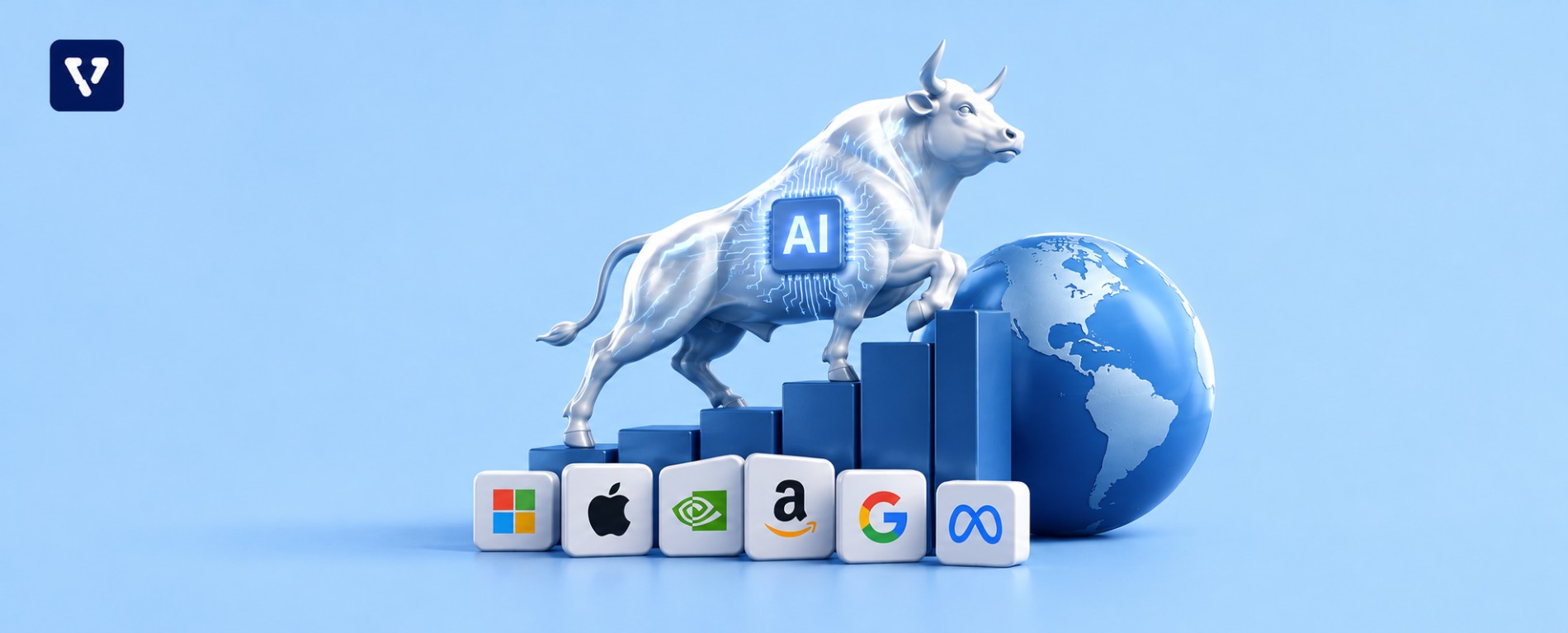
That’s usually fine. Except today, a few giants are doing almost all the heavy lifting. Nvidia, Apple and Microsoft alone make up over 21% of the index.
Analysts have a word for how many stocks join a rally: breadth. And breadth right now is awful. At the end of September, only about 20% of S&P 500 stocks traded above their 50-day average price. In midsummer, that number was 70%.

Breadth is now at its weakest since the dot-com bubble. The median stock sits 16% below its 52-week high. And nearly 38% of the index has fallen 20% or more, which is bear market territory for those companies.
The July to September quarter shows the gap clearly. The S&P 500 rose 2%, while the equal-weight version, where every company counts the same, fell 2%.
Think of a cricket team where two batters score 300 runs between them and the other nine walk back for ducks. The scoreboard looks great. The team, not so much.
One story to carry them all
So what are these few winners riding on? Artificial intelligence.
AI needs an enormous amount of money. Data centres, chips, power plants and transmission lines all cost a fortune to build.
How much exactly?
A recent Brookings paper by Columbia economist Stijn Van Nieuwerburgh pegs US AI infrastructure spending at $10.3 trillion between 2025 and 2032. That’s about 3.6% of US GDP, every single year. Relative to the economy, it’s bigger than the railroad, highway or telecom booms ever were.
How it’s being paid for matters even more. Big tech’s own cash isn’t enough anymore. So more of the money now flows through joint ventures, private credit, special purpose vehicles and lease deals. Much of this never shows up on a company’s balance sheet.

Even the profits run on AI
It isn’t only share prices that lean on AI. Profits do too.
S&P 500 earnings per share grew 51% year on year in the April to June quarter, according to Goldman Sachs. Over the past four quarters, growth was 26%. The 30-year average is about 7%.

Almost half of this year’s earnings growth is estimated to come from AI spending. The biggest US tech companies are on track to spend about $800 billion on capex in 2026, up 94% from 2025. That money shows up as revenue for chipmakers, hardware suppliers, industrial firms and utilities.
Some of this boost won’t repeat. Memory chipmakers are earning gross margins of about 80%, more than double their usual level. And big tech booked roughly $150 billion of paper gains on stakes in private companies in the June quarter. That alone equals about 12% of S&P 500 earnings.

The lift from AI spending is expected to fade and turn into a slight drag by 2028, as capex growth slows and depreciation on all that equipment keeps climbing. The numbers are touchy, though. A $250 billion surprise in capex next year, in either direction, would move S&P 500 earnings growth by about 6 percentage points.
So the AI trade is holding up profits as well as prices. If the spending slows, both will feel it.
Enter the bond market
AI isn’t the only big borrower, though. The US government is running huge deficits and needs to sell a mountain of Treasury bonds too.
When two giant borrowers compete for the same pool of savings, the price of money tends to go up.
On October 7, the 10-year US Treasury yield crossed 5.35%, its highest level since 2002. The 30-year bond touched 5.70%.
Part of this is the Fed’s doing. Oil shot past $100 a barrel after the Iran conflict disrupted shipping through the Strait of Hormuz. Inflation flared up again. So in September, the Fed raised rates for the first time in over three years.
But part of it is something called the term premium. That’s the extra return investors want for locking money away for 10 years instead of rolling it over every few months. A rising term premium suggests lenders are worried about the sheer amount of debt on offer, on top of inflation.
Higher yields also make borrowing pricier for the very AI companies propping up the stock market. The market’s biggest tailwind could slowly turn into a headwind.
Haven’t we seen this before?
Sort of. Bond markets have a habit of sniffing out trouble before stocks do.
In 2007, credit markets flashed red all summer while the S&P 500 kept climbing into October. Within a year, the world was in a financial crisis.
In 2018, bond volatility jumped as the Fed tightened. Stocks shrugged it off, then fell nearly 20% in the last quarter of the year.
In 2022, bonds cracked first as inflation surged. Stocks followed and dropped about 25% from peak to bottom.
Still, in each case, stocks kept rising for weeks, months, sometimes more than a year after bonds started worrying. Bonds have a poor record on timing, but a good one at spotting stress early.
Or as portfolio manager Martin Pelletier argued in the Financial Post, when bonds and stocks disagree, one of them eventually has to blink.
So is the party over?
Not necessarily. The bulls have a decent case too.
The S&P 500’s forward P/E has dropped from 23 a year ago to 19, matching its 10-year average, because prices haven’t kept pace with earnings. And the 493 companies outside the Magnificent Seven are expected to grow third-quarter earnings by 27%, faster than the giants. If the macro mess calms down, the laggards could play catch-up.
The warning sign is the cyclically adjusted P/E, which uses 10 years of earnings. It’s among the highest readings on record, below the 1999 to 2000 peak but above 2021. If today’s AI-fuelled profits don’t last, even an average-looking valuation could turn out to be expensive.
Also, a lot of today’s bond pain is tied to an oil shock. If the conflict eases and oil falls, yields could cool faster than many expect.
Why should you care in India?
Because the US bond market sets the price of money for the whole world.
When a US government bond pays over 5% with almost no risk, foreign funds start asking why they hold riskier emerging market stocks. That’s part of why foreign investors pulled about ₹3.05 lakh crore out of Indian equities in the first nine months of 2026, more than in any full year before.
Add a strong dollar, a weak rupee and costly crude, and you get the pressure Dalal Street has been feeling all year.
So the next time Indian markets wobble for no obvious reason, check what US yields did overnight.
Because when one market is partying and the other is worried, history says it usually pays to listen to the worried one.
