





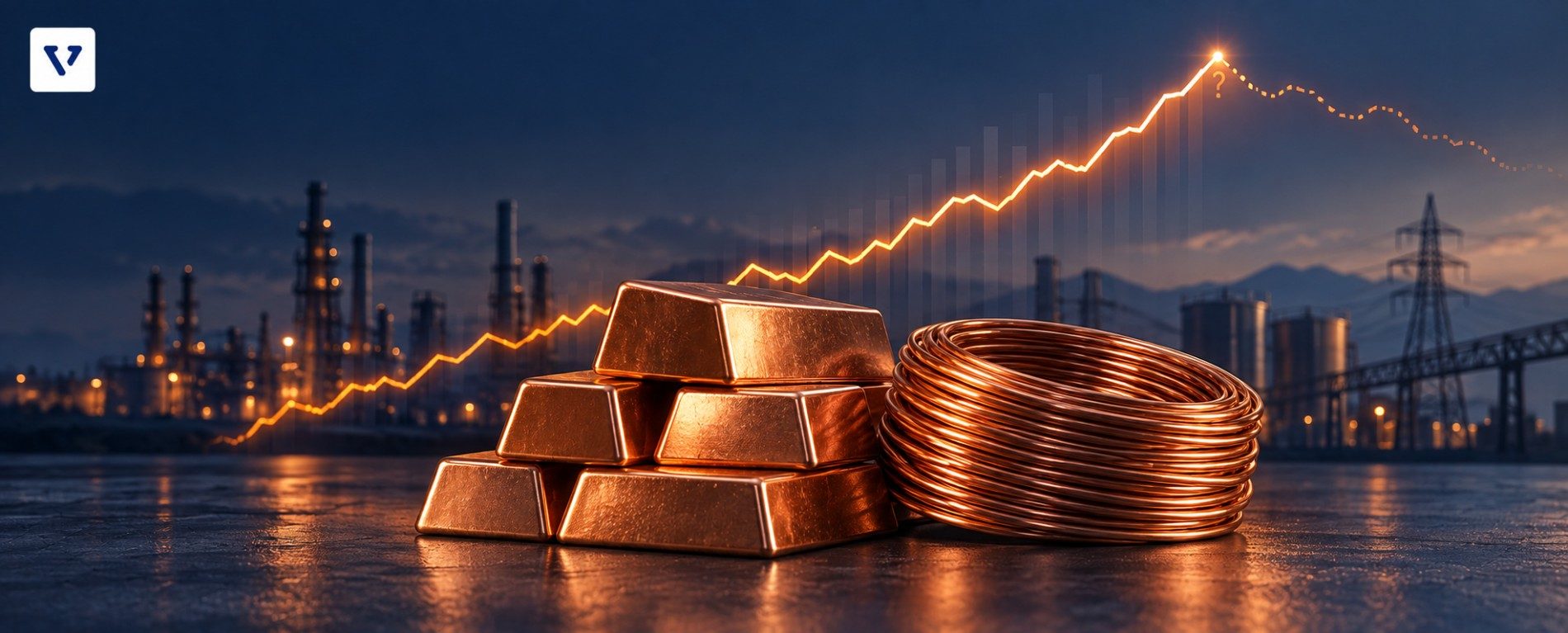
On September 10th, copper on the London Metal Exchange touched $14,858.50 a tonne.
An all time high. A few hours later, it fell more than 4% after Reuters reported that the White House hadn’t yet decided whether to extend tariffs to refined copper.
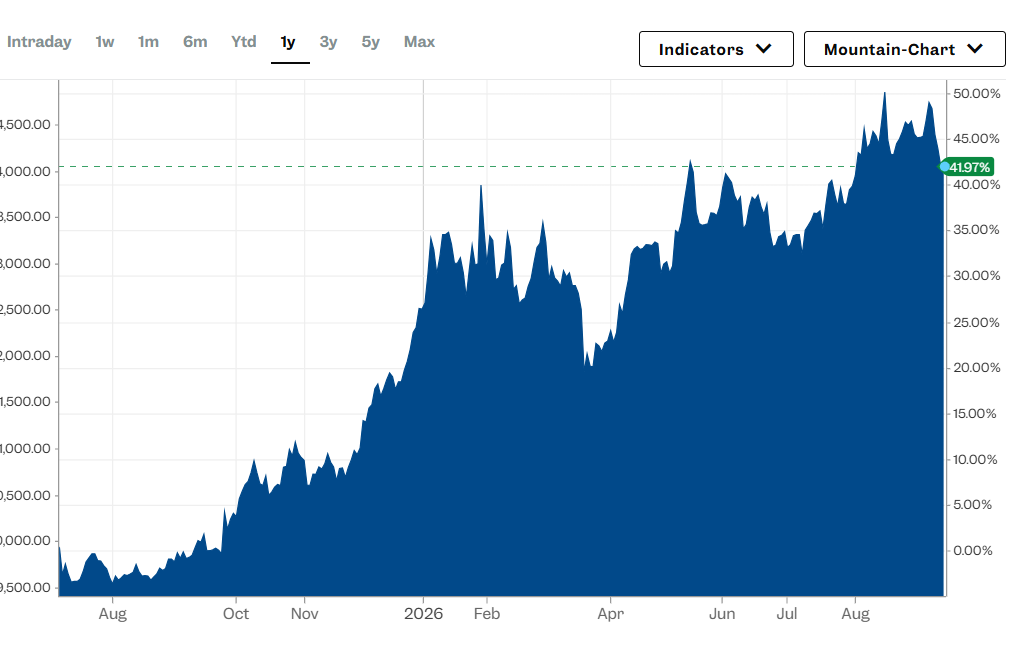
That’s a strange way for a “record breaking rally” to behave. Usually when a commodity hits an all time high, it’s because something fundamental has permanently changed. But copper’s chart right now looks less like a straight line up and more like a heart monitor. So what’s actually going on, and why does a metal nobody thinks about suddenly swing 4% on a single news report?
To understand that, you need to separate two very different stories that are currently tangled up inside the same price.
Story one is genuinely structural. Copper is having a demand moment it hasn’t had in decades. Every AI data centre needs vastly more copper for power delivery and cooling than a traditional server room ever did. Every electric vehicle uses three to four times the copper of a petrol car. Grid modernisation, the boring but essential work of rewiring entire countries for renewable power, is copper intensive by nature. None of this is speculative. It’s happening right now, and it’s compounding faster than most models predicted even two years ago. The IEA’s own 2026 base case still projects a structural supply gap out to 2040, even after accounting for new mining projects in the pipeline.
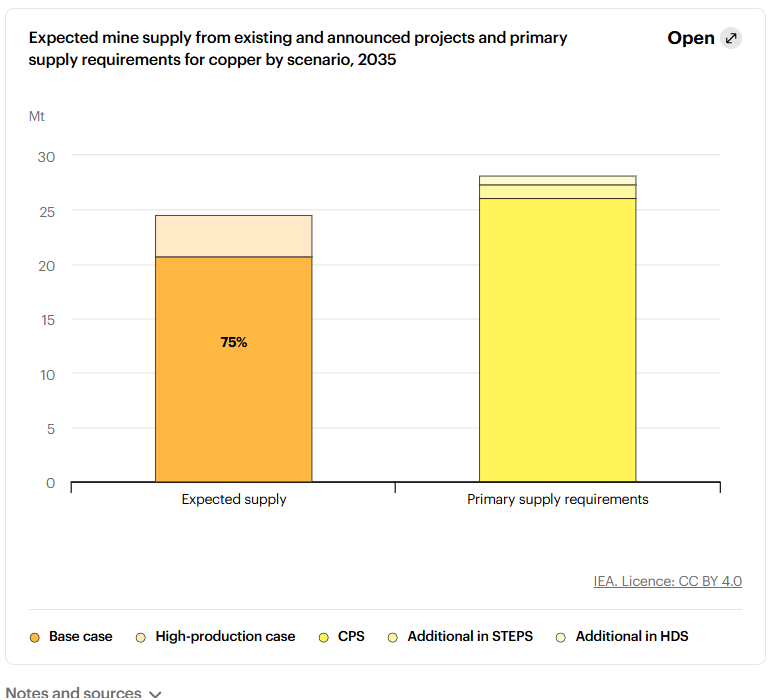
On the supply side, the picture is just as tight. Goldman Sachs estimated that disruptions in the Democratic Republic of Congo and Chile alone could put over 300,000 tonnes of 2026 output at risk. Shanghai’s warehouse stockpiles are down 85% from their March levels.
LME data shows over 120,000 tonnes could leave the exchange’s system in the coming weeks as cancelled warrants pile up. When inventories are this thin, even a small disruption moves the price a lot, the way a half empty water tank sloshes around far more than a full one.
Story two is political, and much more fragile.
In 2025, the US imposed a 50% tariff on semi-finished copper products, but spared refined copper cathode entirely.
The market has spent the past year nervously watching for signs that refined copper might get pulled into the tariff net too, with a proposed 15% rate floated for 2027, climbing to 30% by 2028.
Every time Washington so much as hints at movement here, copper futures swing hard in either direction. That’s exactly what happened on September 10th. The rally touched a record high on genuine tightness, and then gave part of it back the moment a tariff headline reminded traders how much of the move was speculative positioning rather than physical scarcity.
Why does this distinction matter so much? Because it changes what you’re actually betting on. If you believe the AI and EV driven demand shift is real and durable, and most serious commodity analysts do, then copper has a multi-year story that doesn’t depend on any single policy announcement. UBS, for instance, has floated $15,500 a tonne by mid-2027 if supply constraints persist. But if a chunk of the current price is really just traders front-running a tariff decision that may or may not happen, then that portion of the rally could unwind just as fast as it built up. Fitch’s own base case, notably, sees prices cooling to an $11,000 average by 2027, a full $4,500 below UBS’s bullish case. That’s not a rounding error. That’s two banks looking at the same metal and reaching wildly different conclusions, which tells you how much uncertainty is genuinely priced in right now.
So how does someone actually get exposure to this story, if they wanted to understand the mechanics of it?
Since copper doesn’t trade in any meaningful retail format on Indian exchanges, most exposure happens through US listed instruments. As of early September, there were nine of them, holding a combined $9 billion in assets, and they’re built in fairly different ways.
The split roughly comes down to what’s actually sitting inside the fund. Five of the nine hold copper mining companies outright. The largest by a wide margin is the Global X Copper Miners ETF (COPX), with about $7.3 billion in assets, roughly 41 holdings, and a 0.65% expense ratio, tracking a basket of global producers like Hudbay Minerals, BHP, Teck Resources, and First Quantum.
The iShares Copper and Metals Mining ETF (ICOP) takes a broader “copper and metals mining” mandate at a lower 0.47% fee, with around $431 million in assets. Sprott runs two narrower funds: the Sprott Copper Miners ETF (COPP), which concentrates roughly a quarter of its portfolio in a single name, Freeport-McMoRan, and also holds a small sleeve of the Sprott Physical Copper Trust; and the Sprott Junior Copper Miners ETF (COPJ), the only fund on the list built entirely around small and mid-cap exploration and development names, a higher risk, higher growth corner of the sector. The Themes Copper Miners ETF (COPA) is the smallest and cheapest of the equity funds at a 0.35% expense ratio, though with only about $12 million in assets.
Two funds skip mining companies entirely and hold copper futures contracts instead, aiming to track the metal’s spot price rather than any company’s earnings. The United States Copper Index Fund (CPER) is the main one, with about $732 million in assets and a 0.97% expense ratio. Because it’s structured as a CFTC regulated commodity pool rather than a standard fund, it issues a Schedule K-1 at tax time instead of a 1099, and its futures contracts get rolled forward monthly, which means its returns can drift from the spot copper price depending on whether the futures curve is in contango or backwardation.
The remaining three funds are built for very different purposes than long term holding. CPXR and COPZ are both 2x daily leveraged products, one tracking futures and one tracking COPX, designed to deliver double the single day return of their underlying benchmark. Because they reset daily, their returns compound in a way that can diverge sharply, sometimes in the opposite direction, from simply doubling the underlying move over any period longer than a single day. Both funds’ own literature warns that an investor could lose their full principal in a single trading day. KCOP takes yet another approach, an actively managed, options income fund that sells options against copper and mining exposure to generate monthly distributions, meaning its return profile has little in common with any buy and hold copper fund on this list.
None of this is a suggestion to buy any of these instruments, and this isn’t a complete picture either. Fund holdings, fees, and assets shift over time, so anyone looking into this would want to check the issuer’s own factsheet before drawing conclusions. For Indian investors exploring how to invest in copper ETFs from India, understanding these differences is an important first step. What’s useful here is simply that “a copper ETF” isn’t one thing. A futures fund, a diversified miners basket, a single-stock-heavy concentrated fund, a junior miners fund, and a leveraged trading product can all carry the word “copper” in their name while behaving in almost entirely unrelated ways.
What’s clear, regardless of which door someone chooses to understand this through, is that copper has stopped being a boring industrial metal that only shows up in economics textbooks as “Dr. Copper,” the barometer of global growth. It’s now sitting at the intersection of the AI buildout, the energy transition, and a live trade policy fight, and each of those forces is pulling the price in a slightly different direction. Whichever way the tariff decision eventually lands, the underlying demand story doesn’t go away. The only question is how much of today’s price is paying for that story, and how much is paying for the uncertainty around a decision that hasn’t even been made yet.
Note: This piece is for informational and educational purposes only. None of the funds, companies, or instruments mentioned are recommendations or endorsements. Fund structures, holdings, assets under management, and expense ratios change over time, verify current details with the issuer before making any decision, and consider speaking with a licensed financial adviser.