



Key Takeaways
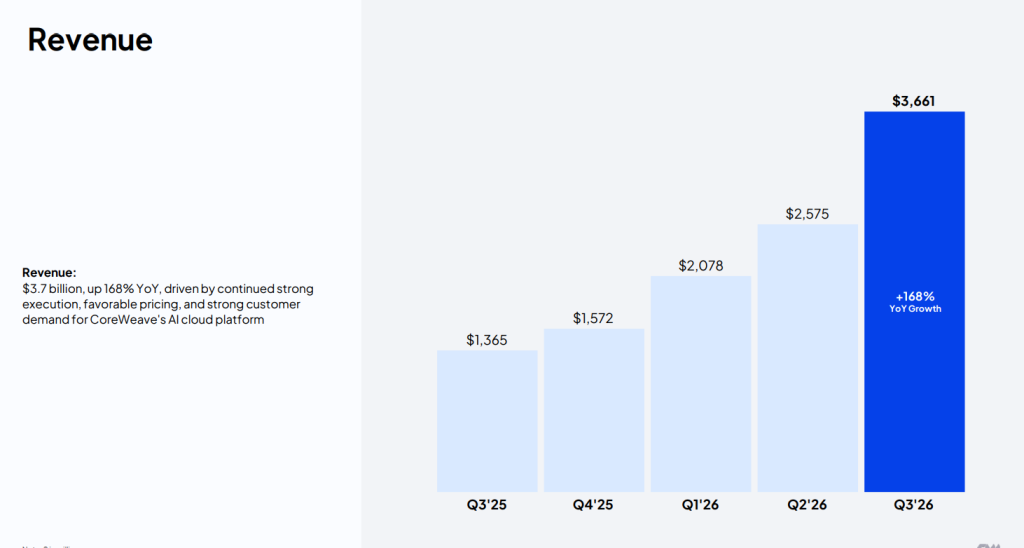
- CoreWeave Q3 revenue was $3.66 billion, up 168% from a year ago and ahead of the roughly $3.55 billion Wall Street expected.
- Adjusted operating margin increased to 10%, up from 5% in Q2 and 1% in Q1.
- Revenue backlog hit $132.5 billion, up from about $104 billion three months earlier.
- Full-year 2026 revenue is now expected at $13.0 to $13.3 billion.
- About $9 billion in customer prepayments is expected in the next three months.
- CoreWeave shares closed about 25% higher at roughly $60.77 on November 11, after falling about 40% in the month before results.
CoreWeave, Inc., listed on Nasdaq under the ticker CRWV, reported strong third-quarter results on November 10, 2026, supported by growing demand for AI computing infrastructure.
The company generated $3.66 billion in revenue, up 168% from $1.37 billion in Q3 2025. Its revenue backlog also reached $132.5 billion, showing the scale of customer commitments for future services.
However, the growth came with substantial investment. CoreWeave spent $14.5 billion on capital expenditure during the quarter and reported a GAAP net loss of $709 million.
For investors, the results highlight two sides of the AI infrastructure opportunity: strong demand and a growing business, but also significant funding requirements and execution risks.
CoreWeave stock rebounds sharply after earnings
CoreWeave share price surged 25% to close at $60.77 on Wednesday, one of its biggest single-day gains in recent months. Investors welcomed the company’s strong revenue growth and reassurance about its business model. However, the stock gave up some gains in after-hours trading, falling 6.37% to $56.90.
The stock has gained 29.53% over the past week but declined 24.35% in one month, 43.28% in three months and 44.64% in six months. It is down 17.08% so far this year and 36.76% over the past year.
The quarter in numbers
CoreWeave rents out powerful Nvidia-based computing to AI labs, big tech firms, and enterprises. Think of it as a landlord for AI chips. This quarter showed that the business is growing fast and getting more efficient.
| Metric | Q3 2026 | Q3 2025 | Change |
| Revenue | $3.66B | $1.37B | +168% |
| Adjusted EBITDA | $2.26B (62% margin) | $838M (61%) | +169% |
| Adjusted operating income | $379M (10% margin) | $217M (16%) | +75% |
| GAAP operating income | $207M | $52M | +298% |
| Interest expense | $846M | $310M | +173% |
| Net loss | $709M | $110M | Wider |
| Adjusted loss per share | $0.95 | — | Beat $1.16 estimate |
Revenue increased by about 42% from Q2’s $2.58 billion. Adjusted operating income nearly tripled from $128 million. That is the “operating leverage” management keeps promising: costs grow slower than sales as new capacity fills up.
One caution: the 10% adjusted margin is still below the 16% from a year ago. The recovery this year is real, but the business has not yet returned to its earlier profitability per dollar of sales.

Backlog, power and spending: the growth engine
CoreWeave’s revenue backlog, the value of signed future contracts, reached $132.5 billion. That is up 138% from a year ago and about $28.5 billion higher than in June. New wins included Canva, Substack and Wayve, while OpenAI, Jane Street, Cohere and Perplexity expanded their deals.
Only about 26% of the backlog, roughly $34 billion, is expected to turn into revenue within 24 months. About 36% sits more than four years out. So the backlog is a long runway, not near-term cash. It also depends on CoreWeave actually delivering the capacity on time.
That delivery runs on electricity. CoreWeave added more than 200 megawatts of active power in Q3, reaching over 1.7 gigawatts. Contracted power, its future pipeline, increased by more than 900 megawatts to over 4.6 gigawatts. More than 1.3 gigawatts of that is now international, including new sites in India, Indonesia and Spain.
Building all this is expensive. Capital spending hit $14.5 billion in Q3 alone, and full-year 2026 capex is now guided at $37 to $39 billion. Management said it is raising the low end because projects are coming online sooner than planned.
Pricing also looks firm. On the call, management said new four- to five-year contracts earn roughly $20 to $25 million in yearly revenue per megawatt. Shorter deals can fetch around $40 million. That suggests AI computing is still scarce enough for suppliers to set terms.
The debt question has not gone away
CoreWeave’s biggest problem is not demand. It is the cost of money. Total debt stood at about $46.9 billion at the end of September, more than double the roughly $21.4 billion at the end of 2025. Interest expense of $846 million swallowed all of the $207 million operating profit. In Q4, interest is expected to rise again to $1.05 to $1.15 billion.
Cash flow tells the same story. Operating cash flow was $1.98 billion, but much of that came from customer prepayments booked as deferred revenue; without that contribution, it would have been roughly $150 million negative. Meanwhile, cash spent on equipment was $9.44 billion. That leaves roughly $7.5 billion of negative free cash flow in a single quarter, filled mostly with new borrowing.
What changed this quarter is the funding plan:
- Customer prepayments: About $9 billion of prepayments and deposits is expected in the next three months. More than $3 billion of that relates to existing equipment being re-contracted, so no new building is needed for it.
- Contract-backed loans: Management said it will avoid unsecured bonds at today’s high yields and lean on loans tied to specific customer contracts, like the new $2.6 billion DDTL 5.5 facility.
- Limited new parent-level capital: The company expects to raise less than $5 billion of extra parent-level capital through 2027.
- Lower borrowing cost: The weighted average cost of debt fell to about 7.9%.
Shareholders should also watch dilution. Weighted average shares rose about 12% from a year ago, to 559 million. CoreWeave also set up a program to sell up to 35 million new shares and raised $4.2 billion in convertible notes, which can turn into stock later.
Management now expects adjusted net income to turn positive in the first half of 2028. That is an adjusted figure, not a promise of GAAP profit or positive free cash flow.
Raised guidance and what Wall Street said
CoreWeave raised its 2026 outlook across the board:
| Measure | New 2026 guidance |
| Revenue | $13.0B to $13.3B |
| Adjusted operating income | $1.275B to $1.375B (26% higher at midpoint) |
| Capital spending | $37B to $39B |
| Exit run-rate revenue | $20B to $21B |
| Q4 interest expense | $1.05B to $1.15B |
The guidance implies Q4 revenue of about $4.7 to $5.0 billion, another 28% to 36% jump from Q3. It also implies Q4 adjusted operating income of roughly $750 to $850 million. That would be a big step up, yet still below the Q4 interest bill. In simple terms, the operating business is catching up with its debt costs, but has not overtaken them yet.
The $20 to $21 billion run-rate means December revenue of about $1.7 billion, multiplied by 12. It is not a 2027 forecast.
What should investors watch next?
- Delivery on time: Q4 needs revenue of about $4.7 to $5.0 billion and more than 1.85 gigawatts of active power by year-end. Any data center delays would hit both.
- The $9 billion in prepayments: Watch for this cash to show up as deferred revenue in Q4. It is the backbone of the new funding story.
- Customers paying their bills: Accounts receivable jumped $1.74 billion in Q3 alone. Fast growth explains some of that, but it is worth tracking if it keeps rising faster than revenue.
- Profit versus interest: The key turning point is when adjusted operating income passes interest expense. Guidance suggests it is getting closer but not there in Q4.
- Chip ageing: Depreciation was $1.89 billion, about 52% of revenue. If newer chips like Nvidia’s Vera Rubin make older ones less valuable faster than expected, those costs could rise. The early Vera Rubin results, with 4.8 times the throughput of the prior generation, show how fast the technology moves.
- Customer concentration and dilution: A few big AI labs account for much of the backlog, and new share sales or note conversions could reduce each shareholder’s slice.
The bottom line
CoreWeave’s Q3 proved two things. Demand for AI computing is still strong, and the company has more ways to fund its growth than the market feared a week ago. That explains the 25% rebound.
What it did not prove is that shareholders will earn a profit. CoreWeave still spends far more than it brings in, and its interest bill keeps growing. The stock now trades on a simple bet: can revenue and margins climb faster than debt costs? The next two or three quarters will give a clearer answer.