






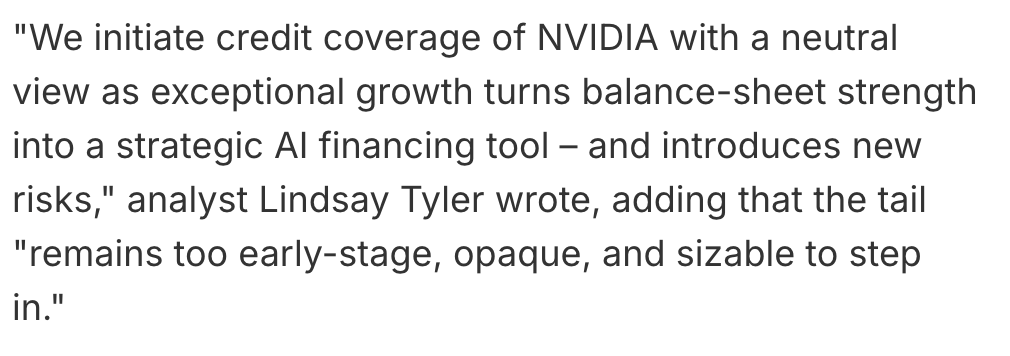
Morgan Stanley’s credit team started covering Nvidia this month with a neutral rating. Which is a strange thing to do.
Nvidia has about $8.5 billion of gross debt and more than $60 billion of cash and securities. It did $81.6 billion of revenue last quarter, up 85% year over year, at 75% gross margin. This company is not going to miss a debt payment (most unlikely).
But the note is not about the debt Nvidia has borrowed. It is about the debt Nvidia has promised.
Morgan Stanley thinks that by end of 2028, Nvidia will be carrying total credit exposure of roughly $200 billion. Only a small part of that is actual borrowing. Around $170 billion is guarantees and backstops that are off the balance sheet today but would hit it in a downturn.
The analysts call this “balance-sheet-as-a-service.” I think that is the right way to see it. And I think the common framing, that Nvidia is possibly hiding a mountain of debt, misses the actual story.
Let me walk through it.
The guarantees have been getting bigger for a year
Easiest to see this in order.
September 2025: Nvidia agrees to buy CoreWeave’s unused data center capacity, up to an estimated 500 megawatts, for $6.3 billion. If CoreWeave cannot rent out its GPUs, Nvidia becomes the customer of last resort.

July 2026: Nvidia publishes a blog about a “revenue-sharing and credit-support model” for cloud providers below the hyperscaler tier. Nvidia has not given the terms. The industry read, which Morgan Stanley also uses, is that Nvidia will guarantee the smaller GPU clouds (neoclouds) a minimum price per hour on their rentals, and take a cut of anything above that floor.
August 2026: the big one. Nvidia signs MOUs with Apollo, BlackRock, Blackstone, Brookfield, Goldman Sachs and KKR to raise more than $500 billion of outside money for AI infrastructure.
Nvidia is not putting up this money. Its job is to make the assets safe enough to lend against. Nvidia says it may provide residual-value support for up to 25% of an opportunity, decided project by project. In plain words: if the GPUs in a project end up worth much less than assumed, Nvidia covers a defined part of the gap.
25% of $500 billion is $125 billion. That is where the scary number comes from.
Why does a customer need Nvidia’s signature at all?
Start from the borrower’s problem, not Nvidia’s.
A neocloud buys GPUs worth billions and funds them with debt that runs five to seven years. But it rents those GPUs out on contracts that run months. Long-term debt, short-term revenue.
That is a mismatch every lender hates.
The lender also has a second problem: the collateral itself. A GPU loses value fast, and how fast depends on when the next chip generation makes it obsolete. Nobody knows that number. Not even the people selling the compute.
So on its own, a neocloud borrows at junk rates, if it can borrow at all.
With Nvidia guaranteeing a floor under its rental income, and covering the resale risk on the chips, the same borrower can raise money at close to investment grade.
Morgan Stanley’s template for this is a $35 billion structure the bank itself put together: Broadcom sold chips meant for Anthropic into a private credit vehicle funded by Apollo and Blackstone, kept it all off its own balance sheet, and backstopped most of the risk.
Nvidia wants to do this across the whole ecosystem. It is lending its credit quality to customers who do not have their own. The chip is the product. The guarantee is the financing that lets the customer buy the product.
The problem is correlation, not size
This is where I disagree with the “Nvidia has too much debt” scenario or framing.
Against Nvidia’s earnings, $200 billion is not that alarming. Morgan Stanley’s own numbers show gross leverage of 0.4x all-in, going to about 0.7x if growth flattens in 2028.
On their math, peak debt would need to roughly double again before Nvidia even gets close to an S&P downgrade. A company doing $60 billion plus of revenue a quarter can carry a lot of guarantees.
The real issue is when the guarantees get called. Think about what has to happen for Nvidia to actually pay. The residual-value support pays out if used GPUs are worth less than assumed. The revenue floors pay out if neoclouds cannot rent their capacity at good rates.
The CoreWeave-type backstops pay out if capacity is sitting unrented. All three are the same event: compute demand falling short of compute supply.
And what happens to Nvidia’s own business in that event? Orders get cancelled. Data center revenue, $75.2 billion last quarter, shrinks. So the guarantees cost Nvidia the most at exactly the moment its own cash flow is weakest.
Nvidia is selling put options on its own end market. It is like an insurer that only writes earthquake policies on buildings in its own city. Looks very profitable for years. Then one event hits every policy at once, and the insurer’s own office is in the same city.
There is also a link here to the GPU depreciation debate.
There has been a long argument between compute operators, who say GPU useful lives run well past the six-year accounting schedules, and skeptics who think three to five years is the truth. Nvidia has now put $125 billion behind the optimistic side.
If long useful lives are real, the residual-value support never gets called and Nvidia has created $500 billion of demand basically for free. If the skeptics are right, Nvidia pays the difference, and pays it during a downturn. Decide for yourself which way that cuts. But at least someone finally has real money on the table.
Nobody can compute this number yet, including Morgan Stanley
I should be honest about how soft the $200 billion is. Morgan Stanley is honest about it too.
The $500 billion platform is, today, a set of MOUs. No partner has committed a dollar. No project has been named. Nvidia has not said what “an opportunity” measures, whether it takes the first loss, who values the chips, or whether there is any overall cap. Morgan Stanley’s $90 billion peak estimate assumes 15 deals like the Broadcom one get signed by end-2028. The $81 billion estimate for the revenue floors assumes Nvidia ends up backstopping 5 gigawatts of capacity. Reasonable assumptions. But they are guesses built on term sheets.
That is why the analysts went neutral instead of negative. Their point is not that Nvidia is over-levered. Their point is that nobody can size this exposure right now. The structures are contingent, the disclosure is thin, and the rating agencies have already said they lean toward treating all of it as debt. When you cannot size the tail, you do not price it. You wait.
For investors looking to invest in Nvidia stock from India, understanding these financial risks is just as important as evaluating the company’s growth potential. Nvidia does not have a debt problem today. It has almost no debt. The question is different: should a company whose stock price assumes compute stays scarce also be the industry’s insurer against compute becoming cheap? The first signed platform deal, with actual triggers and caps written down, will tell us more than everything announced so far. Until then, the honest position is the one the credit analysts took. The risk is real. The size is unknowable. Those two facts together are the story.