





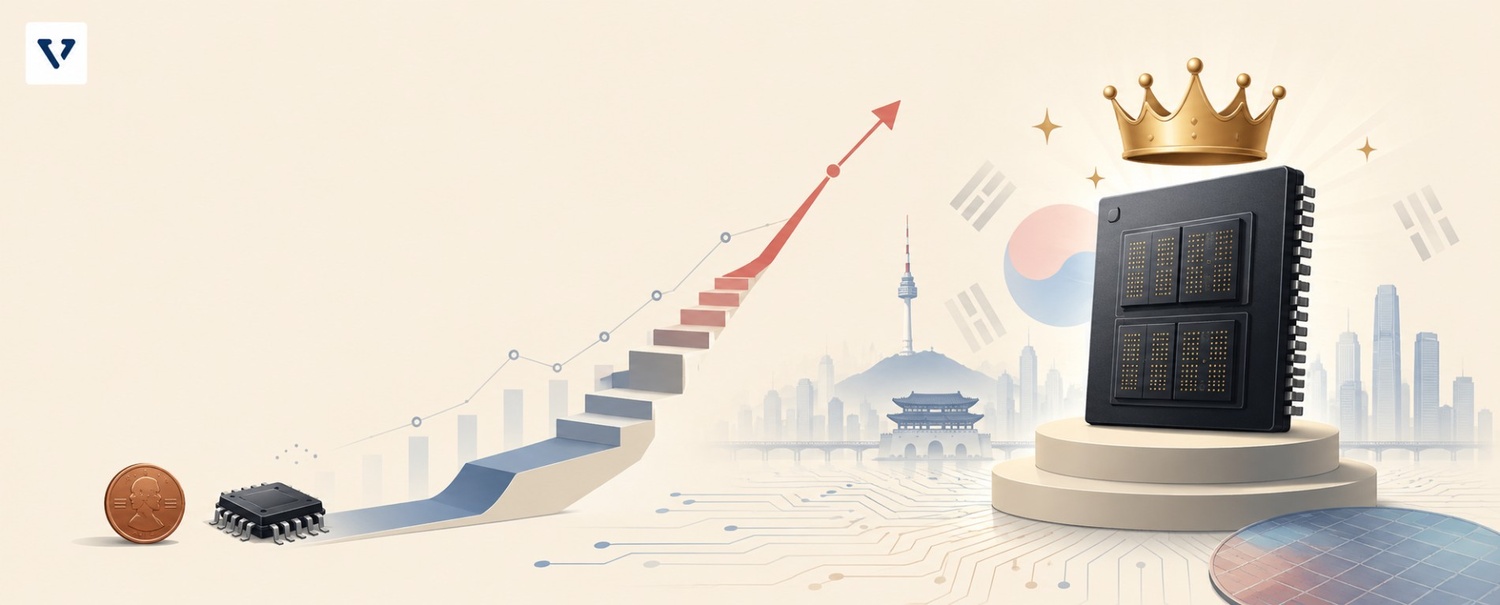
In 2003, a chip company was trading at 135 won a share.
One hundred and thirty-five won. Less than a tenth of a US dollar. So beaten down, so debt-ridden, so close to oblivion that Koreans gave it a nickname: Dongjeon-ju. The penny stock.
This week, that same company overtook Samsung Electronics to become South Korea’s most valuable listed firm, with a market cap of 2,080 trillion won. That is roughly $1.35 trillion. Its shares have rallied more than 340% this year alone.


If you want to understand what just happened in Korean markets, and why it matters far beyond Seoul, you need to understand one thing: High Bandwidth Memory. Or HBM. And why SK Hynix bet everything on it when nobody else would.
The company that nearly ceased to exist
SK Hynix was not always SK Hynix. It started life in 1983 as Hyundai Electronics, back when South Korea’s chaebols were building anything and everything they could. In 2001, it nearly went bankrupt as chip prices collapsed. Creditor banks, most of them state-backed, stepped in to keep the lights on.
Then in 2002, Micron Technology tried to buy it. The board said no. So Hynix spent nearly a decade under creditor control, restructuring, cutting costs, hoping for a cycle turn.
In 2012, SK Group, a conglomerate better known for telecoms and oil, bought it. Analysts were not kind. Standard & Poor’s assigned SK Telecom a negative outlook almost immediately, warning about the semiconductor industry’s brutal capital requirements and cyclical volatility. The deal looked, to put it politely, like hubris.
But SK Group Chairman Chey Tae-won had a different vision. “What I really wanted to accomplish,” he wrote in a book published this January, “was to transform it from a commodity memory producer into a mainstream semiconductor company whose products are indispensable.”
Indispensable. That word would take 12 more years to mean something.
The HBM gamble
Here is the thing about conventional DRAM chips, the kind that power your laptop and phone: everybody makes them.
Samsung, Micron, SK Hynix.
It is a commodity market.
When prices go up, everyone is happy. When they fall, everyone bleeds. And they fall a lot.
SK Hynix knew it could not beat Samsung at this game.
Samsung had 10 times the market cap. It had more engineers, more fabs, more scale. So Hynix’s executives made a call: find a different game.
The game they found was HBM. High Bandwidth Memory stacks DRAM chips vertically, like floors in a building, connected by microscopic copper pillars called through-silicon vias.

The result is memory that moves data 10 times faster than standard DRAM, at lower power consumption. The tradeoff: it is expensive, technically demanding to produce, and in 2012, had almost no customers.
SK Hynix released the world’s first HBM product in 2014 with AMD. It stumbled with the second generation, falling behind Samsung in the late 2010s. Internally, executives debated whether to kill the programme entirely.
They did not. They doubled down.
Shim Dae-yong, who led HBM development at SK Hynix at the time, told Reuters: “We believed that it would be impossible to overcome Samsung in commodity DRAM products. We were desperate to change the market dynamics.”
The company pumped more than 800 billion won into a packaging facility in Icheon and other production assets.
The facility sat underutilised in 2019. Demand from Nvidia and crypto miners had dried up. “It was a headache,” Shim recalled. “It was obsolete.”
Then, in November 2022, OpenAI released ChatGPT.
Why AI runs on HBM
To train a large language model, you need to move enormous amounts of data between the GPU and memory. Billions of parameters, flowing back and forth, millions of times. Speed matters enormously here. The GPU cannot wait around for data.
Standard DRAM cannot keep up. HBM can.
By sitting directly beside the GPU on a silicon interposer, connected by thousands of TSVs rather than a long PCB trace, HBM delivers bandwidth that conventional memory simply cannot match.
Nvidia’s H200 GPU uses five stacks of HBM3E, delivering around 5.7 terabytes per second of memory bandwidth. GDDR6X, the fastest standard memory, tops out near 1 terabyte per second.
This is not a marginal difference. It is the difference between a GPU that trains an AI model in days versus weeks.
So when the AI gold rush began, every hyperscaler on earth started ordering Nvidia GPUs as fast as they could. And Nvidia needed HBM for every single one of those GPUs. And the only company that could supply it at scale, with the yields required, was SK Hynix.
Samsung tried to qualify its HBM3E chips with Nvidia in 2024.

It struggled. Yield problems, thermal issues, precision bonding requirements that Samsung’s process had not yet mastered. SK Hynix’s thermal compression bonding technology had a reported yield north of 70% versus Samsung’s sub-50%. In a capital-intensive, precision manufacturing business, that gap is enormous.
By mid-2025, SK Hynix held 62% of global HBM shipments. Micron had 21%. Samsung trailed at 17%.

The financial transformation
Here is what that technology lead has done to SK Hynix’s numbers.
HBM chips sell for $20 to $25 per stack. Standard DDR5 DRAM sells for $5 to $7. Same fundamental technology, same basic physics. But the stacking precision, the yield management, the customer relationship with Nvidia means HBM commands three to five times the price per unit.
Gross margins on HBM are estimated at 50 to 60%, versus 20 to 30% for commodity DRAM.
In 2023, SK Hynix posted an operating loss of 7.73 trillion won as the DRAM market collapsed. In 2024, it swung to a record operating profit. In Q1 2025, it reported operating profit of 37.6 trillion won, a fivefold jump from a year earlier. For the full year 2025, operating profit reached 47.2 trillion won on revenues of 97.1 trillion won, up nearly 50% year on year.

By January 2026, Bank of America named SK Hynix its top global memory pick, forecasting a 51% surge in global DRAM revenue and calling the current environment a secular supercycle, driven not by PCs or smartphones but by artificial intelligence.
Bernstein tripled its price target to 3.3 million won from 1.15 million won, arguing that HBM pricing will force a major redistribution of margins from hyperscalers to chip suppliers.
The Nasdaq play
This week came the next act. SK Hynix announced plans to raise up to 45.45 trillion won, approximately $29.43 billion, via American Depositary Receipts listed on the Nasdaq, with trading expected to begin around July 10.
This would be one of the largest such fundraisings by any Asian company, surpassing Alibaba’s US IPO from over a decade ago.
The logic is straightforward.
Korean-listed stocks often trade at a discount versus US peers because of structural issues: foreign ownership limits, the Korea discount, limited analyst coverage from global institutions.
By listing in the US, SK Hynix steps alongside Micron and trades in a market that prices memory chips as AI infrastructure, not as legacy cyclical hardware.
There is also the passive fund effect. Index funds that track the Nasdaq, the S&P 500’s tech-heavy siblings, the global semiconductor ETFs, will mechanically add SK Hynix to their portfolios once it joins those benchmarks.
That is forced, price-insensitive buying. The ADR listing creates a structural tailwind that has nothing to do with quarterly earnings.
TSMC did this in 1997. It is now among the most widely held stocks by US institutional investors, and trades at a significant premium to its Hong Kong-listed peers.
SK Hynix, the penny stock, plans to use the proceeds to build new domestic chip plants and expand its production capacity for HBM4 and HBM4E, the next two generations of its flagship product.
The risks that cannot be ignored
This is where any honest analysis has to slow down.
First, customer concentration. An estimated 35 to 45% of SK Hynix’s revenue flows through Nvidia. If Nvidia’s GPU shipment schedule slips, if hyperscalers hit pause on AI capex because they are running out of free cash flow and increasingly turning to debt markets to fund their spending, SK Hynix feels it immediately.
BNP Paribas noted this week that as US rates stay elevated under the Fed’s new chair Kevin Warsh, who dropped the easing bias at his first meeting, the cost of capital for hyperscalers rises. That matters for GPU orders.
Second, the memory cycle.
The DRAM industry has a structural boom-bust rhythm, and it has not gone away.
Gartner forecasts PC shipments falling 10% and smartphone deliveries falling 8% this year.
That is the commodity DRAM market, which still accounts for roughly 65% of SK Hynix’s revenue, getting softer.
Meanwhile, China’s CXMT is ramping commodity DRAM at scale using older equipment, potentially flooding the lower end of the market by 2026 or 2027.
Third, Samsung. The rivalry is not over.
Samsung has begun shipping its own HBM4 chips and is aggressively working to clear customer qualifications. Importantly, HBM4 uses a logic base die, which means
Samsung’s in-house foundry arm gives it a potential structural advantage in the next generation that it simply did not have in HBM3E. Citi modelled a scenario where Samsung qualifies HBM4 with Nvidia by end-2025, potentially pulling SK Hynix’s market share down from 60% to 40% by 2026.
Fourth, volatility. This week illustrated the risk in concentrated bets. SK Hynix dropped more than 10% on Tuesday as AI sentiment soured on Wall Street and Nvidia slipped 4%. Single-stock leveraged ETFs tracking SK Hynix and Samsung, introduced in South Korea in late May, are amplifying swings in both directions. The Korean financial regulator has already expressed regret about the speed of that rollout.
What it all adds up to
The SK Hynix story is ultimately a story about one thing: what happens when a desperate underdog makes a technology bet that the market leader considers niche.
Samsung had more capital, more engineers, more fab capacity.
SK Hynix had HBM conviction and a decade of compounding technical advantage in a product that nobody outside of a few GPU designers cared about.
Then ChatGPT happened. Then the entire world decided it needed AI accelerators. And the only bottleneck standing between a GPU and a functional AI data centre was HBM. And SK Hynix had 62% of it.
“No one would ever have imagined that SK Hynix would overtake Samsung,” said Shin Jae-yong, a business administration professor at Seoul National University. “It is almost impossible for a runner-up to catch up with the market leader in this capital-intensive industry. HBM was the powerful driver behind how they turned the tables.”
In 2024, SK Group Chairman Chey Tae-won set a target: get SK Hynix to 1 quadrillion won in market cap. Then raise it to 2 quadrillion.
On Monday, it crossed 2.1 quadrillion won.
The penny stock became the king of the Korean market. And the AI infrastructure race has only just begun.