






Imagine launching the best product your company has ever built.
Then getting a letter from your own government two days later telling you to shut it down. Worldwide. For everyone.
That is roughly what happened to Anthropic, the company behind Claude, last week. And the story only gets stranger from there.
5:21 PM, Washington
That is the exact time, according to people close to the company, that a letter from the US Department of Commerce landed on Dario Amodei’s desk.
Block every foreign national on the planet from using your two newest AI models, it said. Even your own foreign employees, wherever they happen to be sitting.
The US government, citing national security authorities, has issued an export control directive to suspend all access to Fable 5 and Mythos 5 by any foreign national, whether inside or outside the United States, including foreign national Anthropic employees.
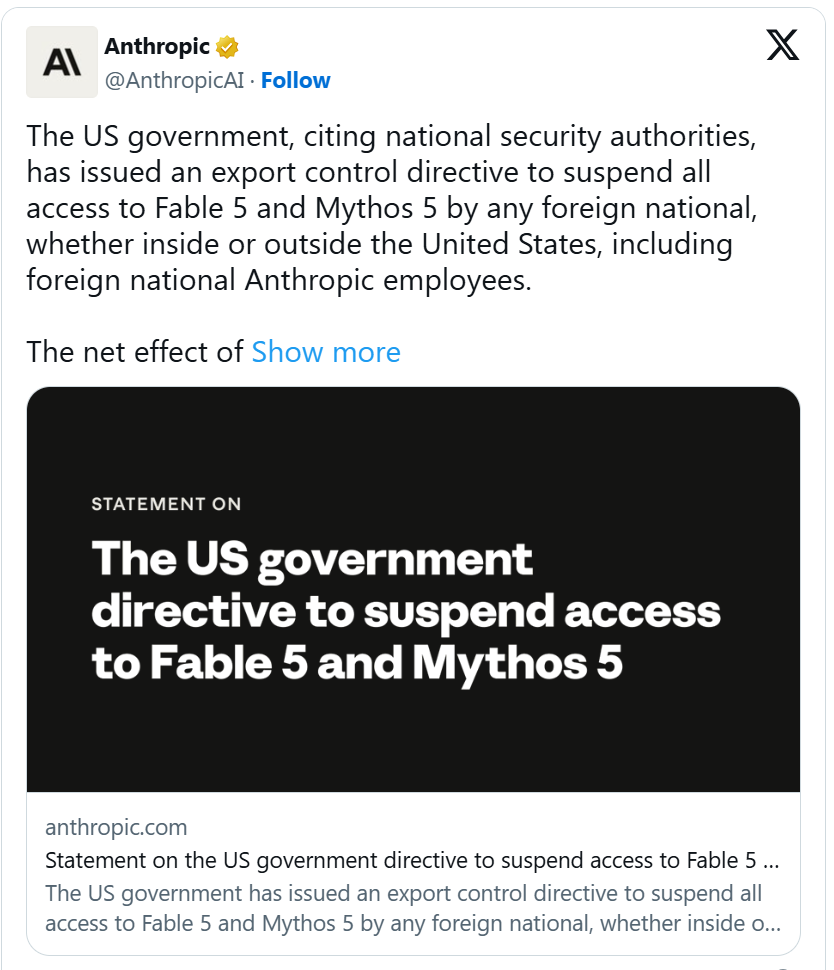
There was no realistic way to check passports mid conversation. So by that evening, the company had switched both models off entirely, for everyone, everywhere, less than three days after launching them.
The timing could not have been more awkward. Two days earlier, Amodei himself had publicly argued that the world needed to move past voluntary AI safety pledges and into real, binding regulation.
He did not expect to become the test case quite this fast. Or quite this literally.
The Bouncer Problem
So what actually triggered the letter?
Amazon, which has poured roughly $13 billion into Anthropic and also competes with it in cloud computing, found a way to trick the new public model, Fable 5, into bypassing its own safety filters.
Amazon CEO Andy Jassy took the discovery straight to Washington. Within a day, Commerce Secretary Howard Lutnick had sent Amodei a letter citing the risk that the flaw could end up in the hands of intelligence operatives in China or Russia.
The administration says Anthropic was given a simple choice: fix the jailbreak or pull the model. And chose neither. Anthropic disputes that account entirely.
Here is what a “jailbreak” actually means in practice. Anthropic builds a kind of bouncer into Fable, a classifier that scans every request, decides whether it looks dangerous, and quietly reroutes anything risky to a weaker, safer model.
A jailbreak is just a clever way of talking that bouncer into believing a dangerous request is harmless.
Amazon was not even the only one to manage it. Within 48 hours of Fable going public, a researcher going by the name Pliny the Liberator had already published what they claimed was the model’s entire hidden system prompt, posting it to X and GitHub for anyone to read.
There is an entire online community, sometimes nicknamed the Undersphere, that does nothing but hunt for cracks like this the moment a new model ships.
Anthropic itself has conceded that “perfect jailbreak resistance is not achievable for any current model provider.” Which makes Washington’s apparent zero tolerance standard a strange one to enforce on a single company.
An Old Score?
Here is the bit that should make you raise an eyebrow.
OpenAI’s rival model, GPT 5.5, reportedly carries comparable weaknesses. Nobody touched it.
Anthropic, meanwhile, happens to be the one AI company that has spent the past year openly feuding with the Trump administration, after refusing to let its models be used for domestic surveillance and autonomous weapons.

The Pentagon responded by branding the company a national security supply chain risk, a fight still working its way through the courts.
Defense Secretary Pete Hegseth, who had already shown Anthropic the door once before, posted online that this latest episode only proved him right.
So is this really just about one jailbreak? Or is Washington settling an older score with the one tool it happened to have lying around?
How Scared Should We Actually Be
The honest answer is nobody quite agrees.
Senator Mark Warner, who sits on the Senate Intelligence Committee, said the heads of the NSA and Cyber Command told him Mythos had managed to do something alarming.
“Broke into almost all of our classified systems, not in weeks, but in hours.”
General Joshua Rudd, NSA and US Cyber Command, relayed by Senator Mark Warner
That is the kind of line that justifies shutting something down overnight.
But Katie Moussouris, a well known authority on software vulnerabilities who actually reviewed Amazon’s research, described it as a handful of previously known, fairly minor issues. The kind any capable model could probably be coaxed into producing with enough effort.
Helen Toner of Georgetown’s Centre for Security and Emerging Technology made the more practical point. Demanding zero jailbreak risk before letting any foreign national near a frontier model is, in practice, close to telling a company to stop doing AI research altogether, since a huge share of frontier AI talent today simply is not American.
Friendly Fire
It gets stranger still.
The order made no exception for America’s own allies. Australia, Britain, Canada and New Zealand, the other members of the Five Eyes intelligence alliance, all lost access overnight. Same as Russia, China or Iran.
The most ironic casualty was Britain’s AI Security Institute, the actual government body built to test frontier AI models for exactly this kind of jailbreak risk. It found itself locked out of the very model it would have used to do that testing.
Within days, dozens of cybersecurity professionals, including security staff from Nvidia, Zoom and Mercedes-Benz, signed an open letter asking Lutnick to reverse the order. Their argument: pulling the most capable cyber defence tool away from defenders, while attackers face no such restriction, leaves everyone worse off, not safer.
Even the European Commission, which had only recently been given access to the new models, weighed in.
“This is a shared challenge, not one confined to a single jurisdiction or company.”
European Commission statement on the directive’s fallout
The Boomerang
Here is why all this matters beyond Anthropic’s bad week.
For two years, “export control” in AI has meant chips, deciding which countries get to buy Nvidia’s best hardware. This time, nothing physical moved. What got switched off was just software sitting on a server, reachable from anywhere with a login.
That is a genuinely new kind of weapon. And it comes with an old lesson attached: export bans have a habit of creating the very competitors they were meant to keep down.
The US tried something similar with encryption software in the 1990s, and eventually lost that fight once strong encryption became freely available everywhere else anyway.
China learned the same lesson more recently with rare earths. Squeeze the world’s supply to win a trade fight, and the world just goes and finds new mines instead.
The same thing appears to be happening with AI. Except in days rather than years.
France’s government is shifting its civil service work to homegrown Mistral. Its domestic intelligence agency dropped the American firm Palantir for a French alternative called Chapsvision.
Mistral is now reportedly in talks to nearly double its valuation to around €20 billion.
Cohere, the Canadian lab that markets itself explicitly as the sovereign alternative to American AI, says inbound interest from governments and enterprises has gone through the roof since the shutdown.
Closer To Home
India has been having an almost identical conversation, just with its own cast of characters.
Anthropic had grown into one of its largest markets within months of launching locally. So the blackout was not a minor inconvenience for a few developers, it reopened a much bigger question: how much of India’s AI future should sit on infrastructure a foreign government can switch off with one letter?
Zoho’s Sridhar Vembu called it a wake up call, posting that “globalisation is dead” and arguing India needs to build its own path forward.
Former Infosys CFO Mohandas Pai went further, pushing for a far better funded IndiaAI Mission, including a proposed annual allocation running into tens of thousands of crores for compute, data centres and homegrown models. Reports suggest the government is already reviewing the mission with this exact risk in mind.
India’s big IT firms are reacting more calmly, mostly because they had already hedged their bets. TCS works with Anthropic, OpenAI and Mistral all at once, while Tech Mahindra and Wipro lean on Microsoft’s Azure OpenAI setup instead.
The Money Question
There is a financial wrinkle in all this too, easy to miss if you are not watching the numbers closely.
Anthropic, reportedly valued near $900 billion, had planned to run Fable and Mythos at a subsidised cost for about two weeks before switching paid users to a usage fee on top of their subscription.
The shutdown landed right in the middle of that window. Cutting short the very period meant to hook customers before charging them for it.
Zoom out further and the timing gets more uncomfortable still.
Anthropic and OpenAI are both reportedly inching toward public listings later this year. Their entire pitch to investors rests on one idea: that the whole world will eventually run on their models.
That story gets a lot harder to tell with a straight face when one government letter can cut off every customer outside its own borders within ninety minutes.
“You can’t rely on something that could be switched off.”
Jim Reid, Global Head of Macro Research, Deutsche Bank
Enterprises signing AI contracts have noticed too. A new question is showing up right alongside price and performance: could this access get pulled overnight, by my regulator or by someone else’s?
That single question is starting to shape how companies everywhere choose, and diversify, their AI vendors. Which is exactly the kind of friction an AI rally built on infinite global adoption was not pricing in.
Where This Leaves Us
None of this sinks Anthropic. Claude’s older models kept running everywhere through the entire episode, and betting markets are leaning toward Fable and Mythos coming back within weeks rather than months.
But the bigger story has already moved past Anthropic.
It is every company and country realising that the smartest AI model on earth is only as useful as the access you are allowed to keep.