





The Fed has just made borrowing more expensive, and the President who picked its chairman wants the opposite.
America’s central bank, the Federal Reserve or the Fed, sets the main interest rate which decides how much it costs banks, companies and families in the US to borrow money.
And it raised the interest rates yesterday.
Now you may be prompted to think, why should I care? Fair.
Well, when the Fed raises rates, the US becomes a more attractive place to park money. Money moves there, the rupee can weaken, and things become costlier in India. That’s not a rule, but it is a pattern that has played out before.
For investors, it cuts both ways. A stronger dollar means US or global holdings convert to more rupees. But higher US rates can pull foreign money out of Indian markets, pushing stock prices lower. Globally too, higher borrowing costs can slow company earnings and weigh on stock prices.
And for the US, this is not the first time.
In 1972, the then US President Richard Nixon pressed his Fed chairman Arthur Burns to allow borrowing cheap before an election, according to a 2006 study.
Prices in the US then rose much faster. Inflation was 3.3% in 1972 and 11.1% in 1974, after oil prices jumped in 1973.
In 2026, a President again wants cheaper borrowing, and oil prices are above $100 a barrel. This time, the Fed has raised interest rates.
That leaves one question for investors:
Can higher interest rates bring prices under control without hurting the economy and share prices too much?
The Fed’s first-rate hike since 2023
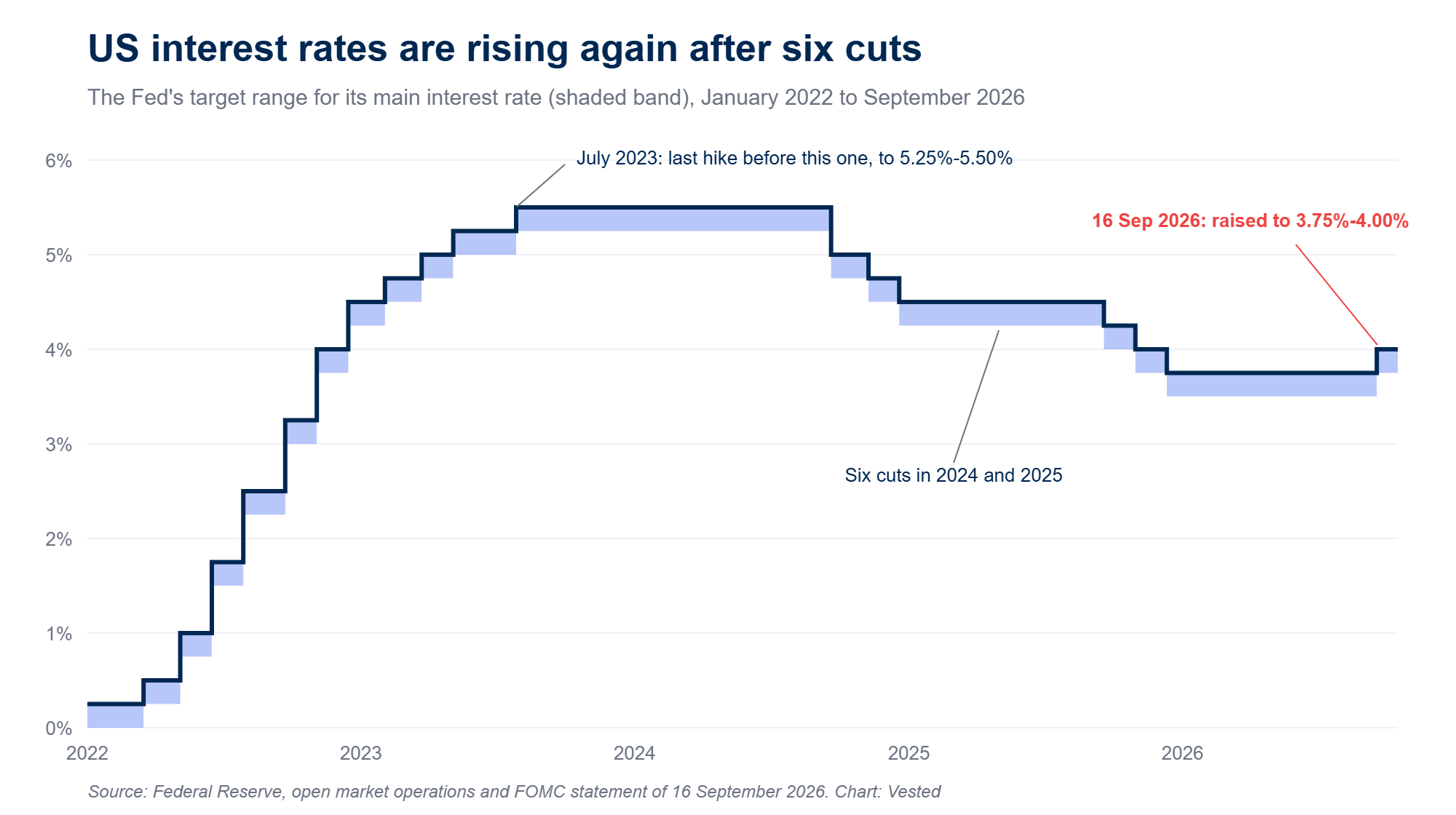
The Fed raised its main interest rate by 0.25 percentage points on Wednesday, 16 September, to a range of 3.75% to 4%. All 12 officials who vote on rates agreed.
It was the Fed’s first-rate increase since July 2023. The Fed had cut rates six times in 2024 and 2025, and then kept them unchanged until this week.
Kevin Warsh has run the Fed since May 2026, after President Donald Trump picked him for the job. At his press conference on Wednesday, Warsh said prices had been rising faster than the Fed’s 2% goal for more than five years:
“The plain fact is that inflation is too high and has been for too long.”
Why prices are rising
Everyday prices (CPI) in the US were 3.4% higher in August than a year earlier, according to the Bureau of Labor Statistics. Petrol cost 27.4% more.
Oil is a big reason. Fighting between the US and Iran around the Strait of Hormuz, a narrow sea route that normally carries about a fifth of the world’s oil, has pushed oil above $100 a barrel.
The Fed’s own favourite inflation measure, called PCE, was up 3.7% in July, according to the Bureau of Economic Analysis. The Fed’s goal is 2%.
| Price measure | Rise over 12 months |
|---|---|
| CPI, August 2026 | 3.4% |
| CPI without food and fuel, August 2026 | 2.4% |
| Petrol, August 2026 | 27.4% |
| PCE, July 2026 | 3.7% |
Source: BLS, BEA
President Trump criticised the decision on the same day. He said interest rates in the US “should be 1%, or less“, according to Yahoo Finance.
Trump also said he had spoken to Warsh before the vote, and that he still had confidence in him despite what he called a very tough board.
How higher rates slow prices
A higher interest rate works by making loans cost more.
When borrowing is cheap, households buy more goods and services and businesses spend more to grow.
Raising rates pushes the other way. Loans for cars, homes and new factories get more expensive, so people and companies tend to spend less, and that can slow the pace at which prices rise.
The effect takes time.
The Fed says the links from its rate decisions to prices and jobs are “not direct or immediate”, and that many other factors also affect inflation.
This year, the biggest of those factors is oil.
Wall Street’s reaction
US shares slipped after the decision. The S&P 500, an index of 500 of the largest US companies, closed 0.45% lower on Wednesday.
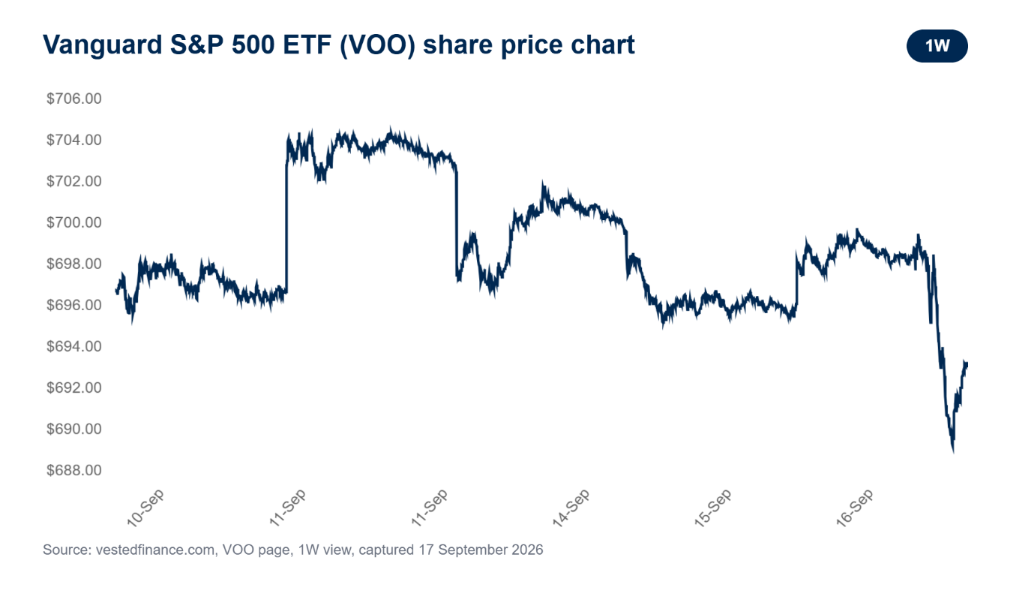 Source: VOO on Vested
The US dollar got stronger against other major currencies after the decision, according to Reuters.
If this is the start of a new round of rate rises, history offers a guide.
Charles Schwab studied 18 periods of Fed rate rises since 1946, in a report published on 9 September 2026.
On average, the S&P 500 fell as much as 12% at some point in the six months after the first rise, and as much as 14% within a year, according to Schwab. In the year before the first rise, the index had gained 18% on average.
Schwab also found that the biggest falls tended to come early, and that recoveries followed relatively quickly.
What the Fed expects next
Most Fed officials expect one more rate rise this year. In forecasts released with the decision, 12 of 18 officials expect one more rise, four expect two more, and two expect none.
Traders see an even chance of another rise at the Fed’s next meeting, on 27 and 28 October, according to Reuters.
| Projections | 2026-end (projected) | 2027-end (projected) | 2028-end (projected) |
|---|---|---|---|
| Fed’s main interest rate | 4.1% | 4.1% | 3.9% |
| PCE inflation | 3.7% | 2.3% | 2.1% |
| Unemployment rate | 4.1% | 4.1% | 4.1% |
Source: Federal Reserve
The worry
Oil prices are the main worry.
Tai Hui, chief market strategist for Asia Pacific at J.P. Morgan Asset Management, told Reuters there are “no immediate signs for inflation to ease“, given the stand-off in the Middle East. He added that the Fed may need to keep raising rates.
The Fed itself expects PCE inflation to end 2026 at 3.7%, almost double its 2% goal.
The hope
Leaving out food and fuel, US prices (CPI) rose 2.4% in the year to August, the slowest pace since March 2021.
Jobs are also holding up. Warsh said about 4.1% of Americans who want a job do not have one, which is not that grave.
The verdict so far
For now, the Fed has raised rates once, and its own forecasts show prices getting close to its 2% goal only in 2028.
What 2022 showed Indian investors
The Fed last raised rates quickly in 2022, and Indian markets felt it.
Foreign investors, meaning overseas funds and institutions that buy Indian shares, sold a record ₹1.22 trillion, about $16.58 billion, of Indian shares that year up to 21 December, according to Business Standard.
The rupee lost 10.2% against the US dollar over the same period. Business Standard listed the Fed’s rate rises among the main reasons for both.
Indian shares still held up. The Sensex, an index of 30 large Indian companies, was 4.8% higher for the year, as Indian investors kept putting money into the market through mutual funds.
The same pull is visible in 2026. Foreign investors took $18.84 billion out of Indian shares in just over three months to April, more than in the whole of 2025, which was itself a record year, according to Investing.com.
Indian mutual funds put $31 billion into the market over that time, the same report said.
India’s oil bill and the RBI
Oil is the second link to India. India imported 88.7% of the crude oil it used in 2025-26, a record share, according to provisional government data reported by ThePrint.
When oil is above $100 a barrel and the rupee is weaker, India pays more in rupees for every barrel it buys. Retail prices in India rose 4.82% in August from a year earlier, up from 4.45% in July, with food the main driver, according to Deccan Herald.
The Reserve Bank of India (RBI) kept its main interest rate at 5.25% in August. Its next decision is due on 7 October.
We expect a rise back here as well.
What this means for investors
Higher US interest rates matter to Indian investors in two ways that were visible this week.
The first is the rupee. It closed at 95.95 per US dollar on Wednesday, close to the 96 level traders were watching, according to Reuters.
If the rupee weakens, your dollar investments are worth more in rupees. And vice-versa.
The second is US shares, which slipped on the day of the hike.
Higher rates also hit some stocks harder than others. Generally, companies whose earnings sit far in the future tend to lose more, because those future profits are worth less today when rates are higher. That makes it worth checking what you own and why, rather than watching only the index.
Three dates matter over the next six weeks. The RBI announces its rate decision on 7 October, and US price data for September comes out on 14 October.
Then the Fed meets again on 27 and 28 October, when traders will find out whether one rise was enough.
One thing that has changed: dollar cash now pays close to 4%. For someone building a US portfolio over time, that changes the cost of waiting. Money sitting in bonds now has the potential to yield better than earlier.
On Vested, you can track the S&P 500 through the Vanguard S&P 500 ETF (VOO) or look at short-term US government bonds through the iShares 0-3 Month Treasury Bond ETF (SGOV), which tracks bonds maturing in under three months.
None of this changes LRS limits or TCS. The mechanics of investing from India are unchanged.
Past performance is not indicative of future returns. For educational purposes only. Nothing in this article is a recommendation.