





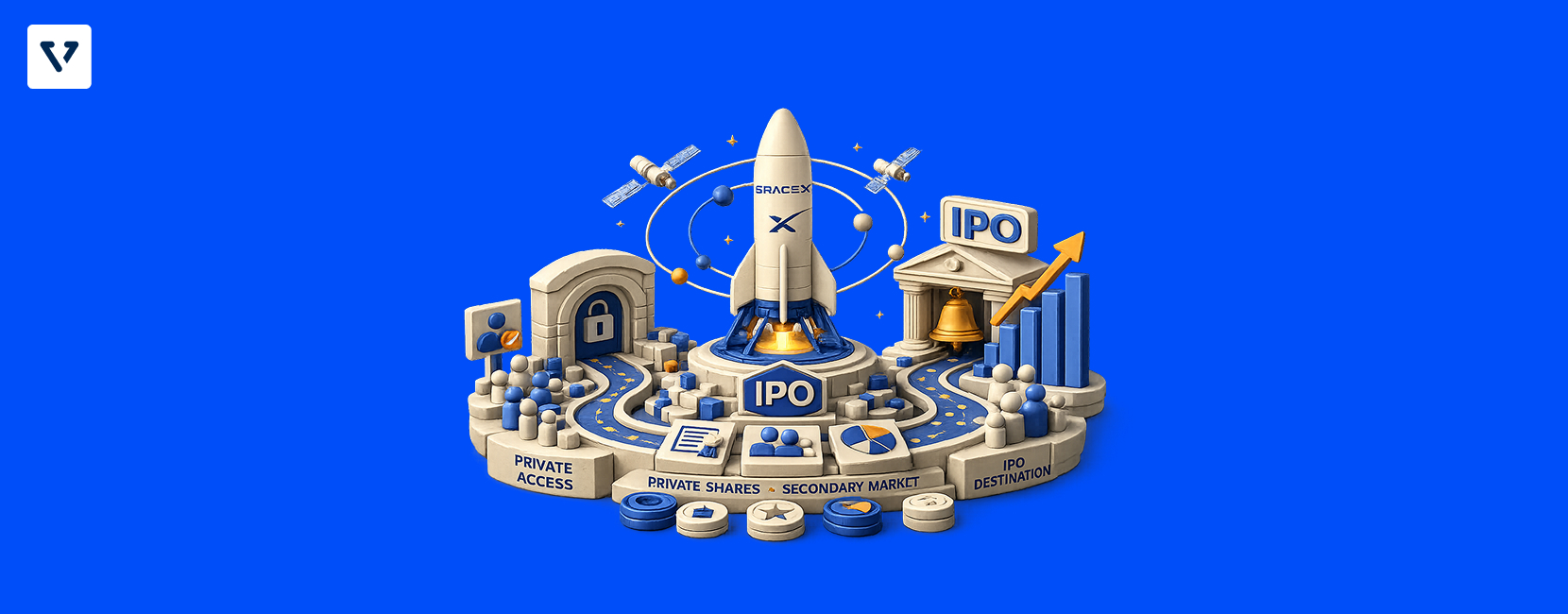
The largest IPO in history is days away. But a quiet group of funds, and one giant tech company, have been sitting on this position for years. Here is what that means for you.
SpaceX filed its S-1 on May 20, 2026. It is targeting a Nasdaq listing under the ticker SPCX on June 12, raising $75 billion at a valuation of $1.75 trillion. To put that in context, Saudi Aramco’s 2019 offering, the previous record, raised $29 billion. This is not a normal IPO.
The company’s 2025 revenue came in at $18 billion. Starlink, its satellite internet business, generated $11.4 billion of that, about 61% of the total, and was the only profitable division with $4.42 billion in operating income. Starlink subscriptions crossed 10.3 million in Q1 2026, doubling year on year. Everything else, rockets, Starship, government contracts, is either breaking even or running losses. The bull case is essentially a Starlink bet dressed in a spacesuit.
But here is the thing. Most retail investors are asking how to get in. The more interesting question is: who is already in?
The funds that got in early
Because SpaceX never listed, the only way to own its stock was through private funding rounds, secondary market transactions, or funds with the mandate to participate in both. A small group did exactly that.
| Fund | SpaceX Allocation | Type | Key detail |
|---|---|---|---|
| Baron Partners Fund BPTRX | 33% | Mutual Fund | Ron Baron first invested in 2017 at a $20B valuation. That position has generated $4B in profits. |
| ARK Venture Fund ARKVX | 17% | Interval Fund | SpaceX is the largest holding. $653M AUM. Built to democratise venture capital access, minimum $500 investment. |
| Destiny Tech100 DXYZ | 23% | Closed-End ETF | Largest SpaceX weight of any listed vehicle. Trades at a steep premium to NAV. Surged 21% as IPO excitement built. |
| ERShares Crossover ETF XOVR | ~$292M | ETF | Holds SpaceX via an SPV. No accredited investor requirement. $1.5B in AUM, 0.75% expense ratio. |
| Private Shares Fund PRIVX | 19% | Interval Fund | Post the SpaceX and xAI merger in February 2026, holds a 19.36% position in the combined entity. |
| Fidelity (32 funds) FBGRX, FCNTX + more | $21.55B | Mutual Funds | 71% of all disclosed institutional SpaceX exposure sits inside Fidelity. Fidelity Contrafund holds SpaceX as its fifth-largest position at ~5.1% of assets. |
The caveats matter. Interval funds like ARKVX and PRIVX offer quarterly redemptions, not daily liquidity. Closed-end funds like DXYZ trade on exchange but at premiums that can disconnect sharply from what the underlying assets are actually worth. And holdings through SPVs, as with XOVR, mean you do not own SpaceX directly. You own a fund that owns a vehicle that owns SpaceX shares. That is a different thing.
The Google angle
In April 2026, a routine regulatory filing in Alaska, where companies must disclose shareholders with stakes above 5%, revealed that Google LLC, a subsidiary of Alphabet, held 6.11% of SpaceX at end of 2025. The original $900 million investment was made in 2015 when SpaceX was valued at $12 billion. That stake has since appreciated roughly 64 times.
Following SpaceX’s merger with xAI in February 2026, Alphabet’s stake was diluted to approximately 5%. At a $2 trillion IPO valuation, that position is worth around $100 billion. Alphabet’s stock barely moved on the news, which is either a sign that the market was already pricing this in, or that a $100 billion asset sitting inside a $4 trillion company simply does not move the needle the way it would anywhere else.
For investors who want SpaceX exposure without the structural complexity of interval funds or the premium-to-NAV risk of closed-end vehicles, Alphabet offers a liquid, straightforward path. You are not buying SpaceX. You are buying a company that owns a large piece of it alongside a strong cloud business, an AI portfolio, and a 14% stake in Anthropic.
What happens once it lists?
Most funds that hold SpaceX shares will be locked up for 90 to 180 days after the IPO. They cannot sell. Their position gets re-marked to whatever SPCX trades at on day one, which could push NAV sharply higher or lower depending on how the market receives the stock.
Then there is the passive wave. SpaceX is expected to enter the S&P 500 at roughly 0.5% weight. That sounds small. But index funds tracking the S&P 500 manage trillions in assets. The mechanical buying required at inclusion, estimated at $22 to $27 billion across S&P 500 and Nasdaq 100 index funds, will happen regardless of what any analyst thinks about a $1.75 trillion valuation. If you hold any broad US index fund, you will own SpaceX whether you choose to or not.
The IPO prices tomorrow. The stock trades Thursday. And a company that spent 24 years as the most closely watched private business on earth will become, almost overnight, something anyone with a brokerage account can buy at market open.
Indian investors can access US stocks, ETFs, and global funds directly through Vested. Open an account to explore what is available.
