





| Quick Answer: Once your Qualcomm RSUs vest, you can choose to hold the shares or sell them and diversify your portfolio. If you decide to reduce your exposure to Qualcomm, you can sell your vested shares and use the proceeds to invest in other US stocks, ETFs, and global funds through Vested. This can help you build a more diversified portfolio instead of keeping a large portion of your wealth tied to your employer’s stock. |
If you are joining Qualcomm and your compensation package includes Restricted Stock Units (RSUs), it’s important to understand how they work. Without proper planning, you may end up paying more taxes and exposing your wealth to the fortunes of a single company.
This guide explains how Qualcomm RSUs work, how they fit into your overall compensation, and a Qualcomm RSU strategy to minimise your tax liability.
What are Qualcomm RSUs?
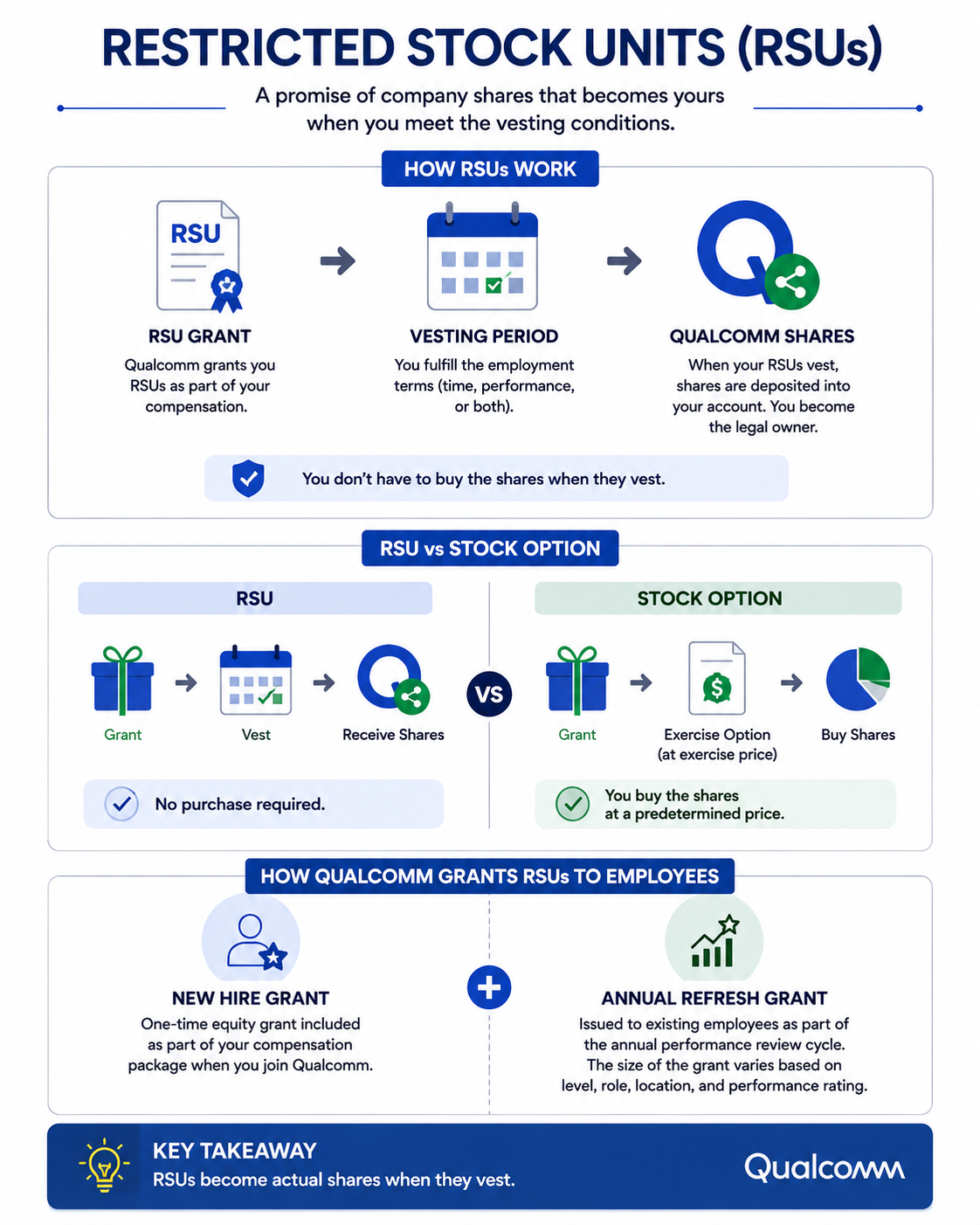
Restricted Stock Units (RSUs) are share awards granted to employees as part of their compensation. You don’t receive the shares immediately. Instead, they become yours as you meet the conditions and complete the vesting period outlined in the grant.
RSUs are often mixed up with stock options. A stock option gives the right to buy shares at a predetermined price, while an RSU converts into company shares when it vests without requiring you to buy the shares. When your RSUs vest, new shares are issued and deposited into your investment account.
When Qualcomm Grants RSUs to Employees
Qualcomm may grant RSUs as part of new-hire compensation and through ongoing equity awards to eligible employees.
The new-hire RSU grant is offered to eligible employees when they join the company as part of the overall compensation package. These are generally one-time grants, and companies commonly use it to attract and retain employees.
Qualcomm may also provide additional equity awards to existing employees. These can form part of the company’s ongoing compensation and performance review process. The size and terms of these grants may vary depending on the employee and the applicable grant terms.
How Qualcomm RSU Vesting Schedule Works
If your compensation package includes RSU grants, it doesn’t mean you would receive the Qualcomm shares immediately after joining. The grant is subject to a vesting schedule, which specifies when you would receive those shares.
For instance, Qualcomm generally follows a three-year vesting schedule for most of its RSU grants. Specific RSU grant terms can vary, but generally one-third of the grant vests after the first year, with the remaining shares vesting in quarterly instalments over the following two years.
To receive the RSUs seamlessly, continued employment through the applicable vesting dates is generally required.
How Qualcomm Calculates Your RSU Grant
In the offer letter, Qualcomm may not specify the number of shares you would receive; instead, it specifies the dollar value. For example, $100,000 cash salary + $30,000 as RSU grants.
The number of RSUs you receive depends on the terms of your grant. Your offer letter or equity grant documents should specify the number of RSUs awarded and the applicable grant terms. Since Qualcomm does not publicly disclose a standard share-price methodology for calculating employee RSU grants, it is best to refer to your individual grant documents for these details.
For example, if your grant documents state that you will receive $30,000 worth of RSUs and the applicable share price is $180, the grant would represent approximately 167 RSUs. As per the vesting schedule, you would receive nearly 56 Qualcomm shares after the first year, and the remaining 111 shares vest in equal quarterly instalments over the following two years.
Annual Refresh Grants
Qualcomm also makes additional equity grants through RSUs to eligible employees, including annual awards.
Additional RSU grants generally have their own vesting schedule, often spanning three years. After several years at the company, there is a chance that you might have received multiple refresh grants, creating multiple vesting schedules.
For example, by the third year at Qualcomm, your initial new-hire grant might be almost fully vested; your first-year refresh grant is in the second year of vesting; and your most recent refresh grant might just be starting to vest. This creates an overlapping structure.
But if you leave Qualcomm before your vesting date, all unvested RSUs are forfeited. However, specific grant agreements may provide exceptions, including certain retirement, death, disability, or qualifying termination situations.
What Happens When Qualcomm RSUs Vest?
On every vesting date, a part of your RSU grant gets converted into real Qualcomm shares and moved into your brokerage account. For each unit of RSU, you would receive one share of Qualcomm. Once the shares are transferred to your brokerage account, you own them like any other shareholder. You can either continue holding them or sell the shares, subject to Qualcomm’s insider trading policies.
Qualcomm RSU Income Tax Treatment
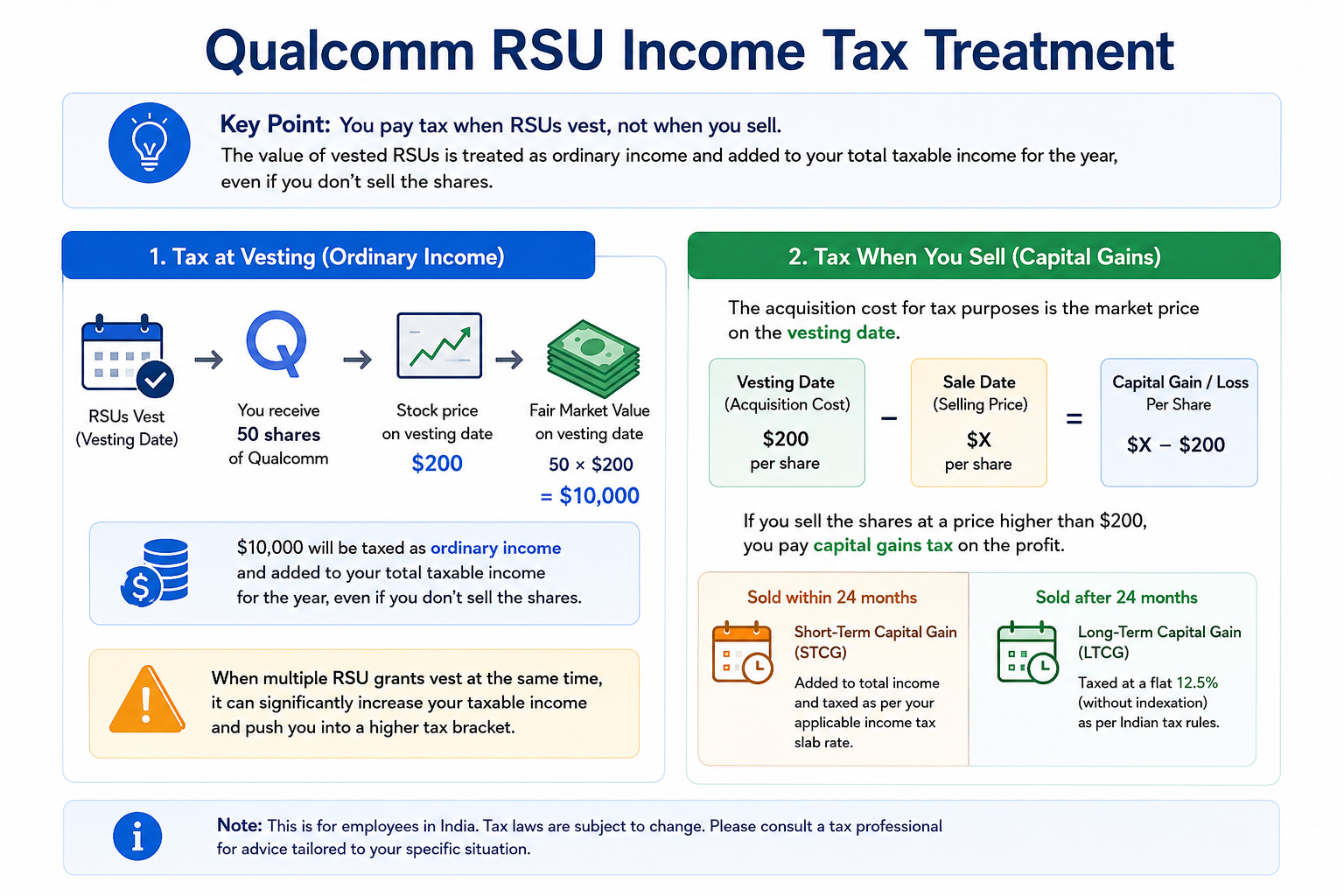
At two key stages, you need to pay taxes on your vested Qualcomm RSU shares. First, when you receive them, and second, when you sell them for a profit.
Suppose you received 50 Qualcomm shares on vesting day. That day, the Qualcomm share price was $200. Meaning you received Qualcomm shares worth $10,000 in your brokerage account. Since RSUs are part of your compensation package, $10,000 will be treated as ordinary income and added to your total income and taxed as per your income slab.
Qualcomm Withholds Shares to Cover Taxes
For the majority of Qualcomm’s RSUs, shares are issued net of the shares needed to satisfy statutory tax-withholding requirements.
Just like you receive your salary after taxes are deducted, Qualcomm withholds some of your vested shares and sells them to cover the taxes. This is known as a sell-to-cover arrangement.
For example, on the vesting date, 50 RSUs vest. Qualcomm will retain some of the shares to cover the tax expenses and transfer the remaining shares to your brokerage account.
Qualcomm RSUs: Taxation Implications in India
For calculating capital gains, the price of the shares on vesting day is considered the acquisition price. So, when you sell your shares at a higher price than the acquisition price, you need to pay capital gains tax.
Suppose on vesting day, your RSUs vest at $200 per share. Now $200 will be the acquisition price of Qualcomm shares. If you sell the shares at a rate higher than this, you need to pay capital gains tax on the profit. The rate of tax depends on the period of holding.
For a resident Indian, Qualcomm shares are generally treated as unlisted foreign shares. If the shares are sold within 24 months from the date of vesting, it is treated as short-term. Any profit on the sale of Qualcomm shares will be added to your total income and taxed as per your income tax slab rate.
But if you sell the shares after holding them for more than 24 months, it will be treated as long-term. Therefore, any gains will be taxed at 12.5% without indexation.
Should You Hold or Sell Your Qualcomm RSUs?
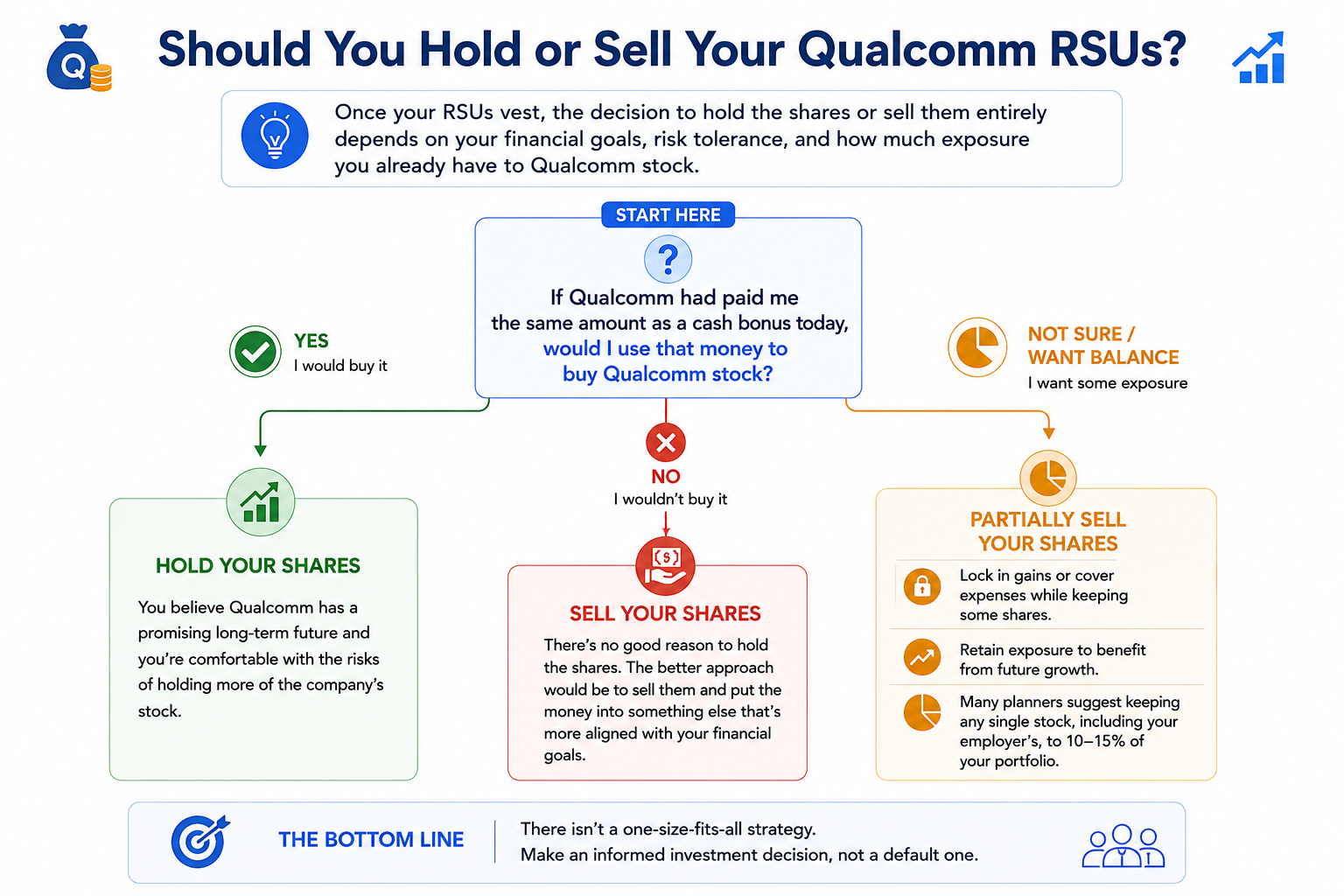
Once your RSUs vest, the decision to hold the shares or sell them entirely depends on your financial goals, risk tolerance, and how much exposure you already have to Qualcomm stock.
Holding Your Shares
If you’re confused between holding or selling the shares, you have to ask yourself a simple question: “If Qualcomm had paid me the same amount as a cash bonus today, would I use that money to buy Qualcomm stock?”
If yes, then you should hold the stock. That is, you believe Qualcomm has a promising long-term future and you’re comfortable with the risks of holding more of the company’s stock.
If your answer is no, there’s no good reason to hold the shares. The better approach would be to sell those shares and put the money into something else, as it could be more in line with your financial goals and help diversify your portfolio.
Partially Selling Your Shares
Instead of keeping all the rewards in Qualcomm stock, many prefer to sell a portion of their vested RSUs and reallocate the proceeds to other growth assets. This approach is useful if multiple RSU grants are vesting at the same time.
Some financial planners also suggest limiting exposure to any single stock to around 10 to 15% of your overall investment portfolio. The right level, however, depends on your financial goal, risk tolerance, and overall asset allocation.
If you decide to reduce your Qualcomm exposure, platforms such as Vested allow Indian investors to invest in US stocks, ETFs, and global funds. This can help you redeploy the proceeds from your Qualcomm shares across a more diversified global portfolio.
There isn’t a one-size-fits-all strategy. The best approach depends on your financial goals, tax situation, and overall portfolio. The idea is to make an informed investment decision, not to own Qualcomm shares because they were part of your pay.
Qualcomm RSU: Key Takeaways for Better Tax Planning
If managed well, Qualcomm RSUs can make a big difference in your long-term wealth. But knowing how they are granted is only half the story. It is also important to understand how they are taxed on vesting, how capital gains are calculated when you sell, and how INR-USD currency fluctuations may impact your total returns.
Keep detailed records of your grants, vesting statements, and share sales to make it easier to file your taxes. And consider talking to a qualified tax professional to make sure you’re fully compliant with tax laws.