





Key Takeaways
- If you hold Uber ESOPs or RSUs, this guide helps you understand what happens to your equity after it is granted and vested.
- Uber RSUs can form a significant part of your overall compensation.
- Your vesting schedule determines when RSUs become shares.
- RSUs are taxed as salary at vesting and as capital gains on sale.
- Holding too much Uber stock can increase portfolio concentration risk.
- Review your hold-or-sell decision at every vesting event.
Working with Uber comes with a lot of employee benefits, including health insurance, Uber Ride Credits for personal rides, paid time off, etc. In addition to these benefits, employees are also offered equity compensation in the form of Restricted Stock Units (RSUs). If managed properly, these RSUs can help you build long-term wealth.
This guide will help you to understand the Uber RSU program, how the Uber RSU vesting schedule works, and how to manage them properly.
What are Uber RSUs?
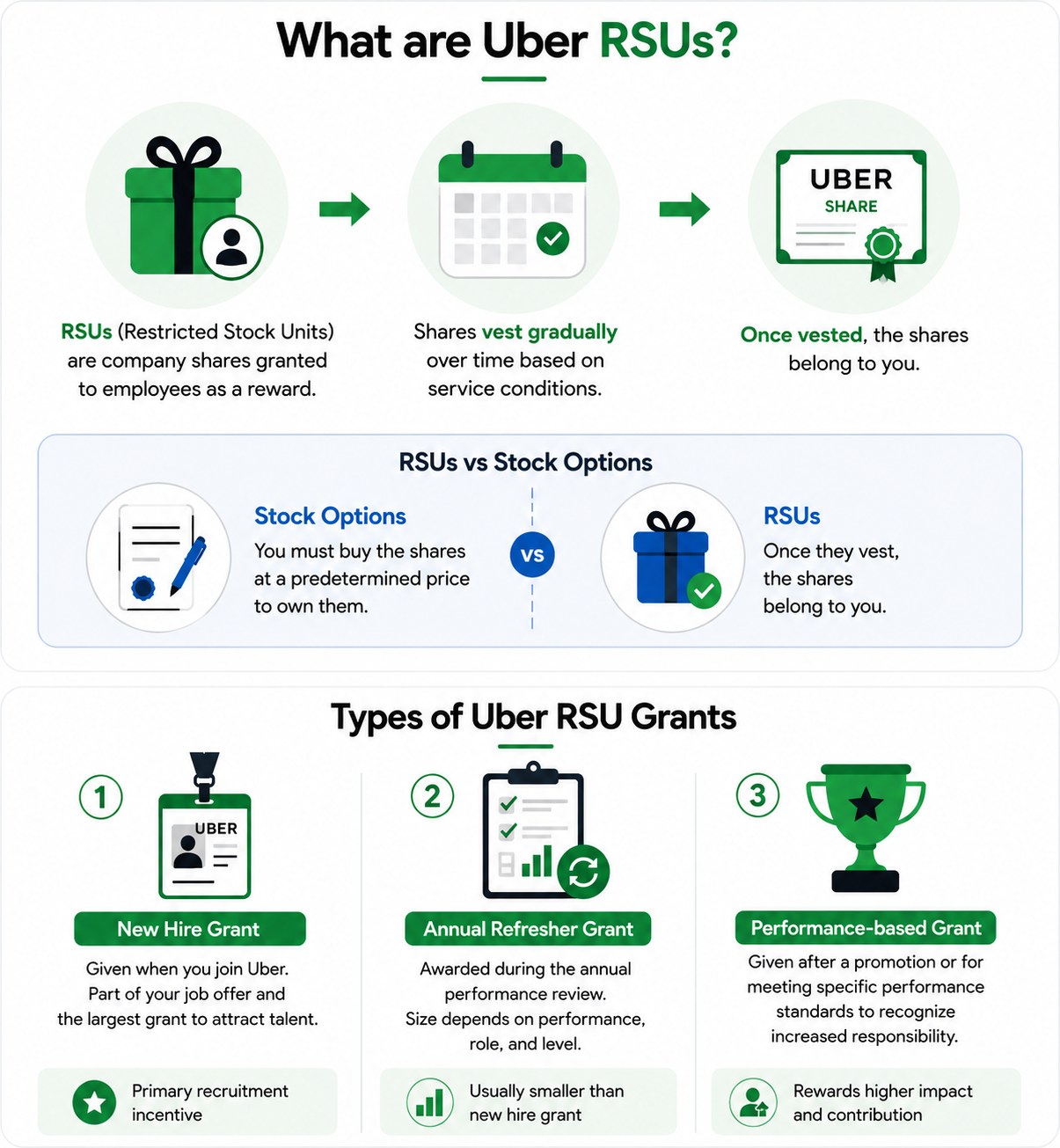
RSUs, or Restricted Stock Units, are company shares granted to employees as a reward. They are given either at the time of joining the company or during an annual performance review, or both. The shares are transferred gradually over time upon meeting certain service conditions, usually by remaining employed with the company until the vesting date.
Uber began offering RSUs to its employees after its stock got listed in 2019. Before that, it offered stock options to its employees. In stock options, you have to buy these shares at a predetermined price to own them. Whereas, in RSUs, once they vest, the shares belong to you.
Whether your RSUs are from Uber or any other company, understanding the vesting schedule and vesting date is important. These determine when your RSUs vest and when you actually receive the shares.
Types of Uber RSU Grants
Uber generally issues three distinct types of RSU grants to its employees. As per the regulatory filings, the three distinct types of Uber RSUs are:
New Hire Grant: It is offered when you join Uber as an employee. It’s part of your job offer and serves as a primary recruitment incentive. These are generally the largest single grant an employee receives.
Annual Refresher Grant: This is an additional grant an employee receives during the annual performance review cycle. The size of the grant depends on performance, role, and level. Usually, it is kept smaller than the new hire grant.
Performance-based Grant: These grants are awarded after a promotion or for meeting certain performance standards to recognize increased responsibility.
Uber RSUs Vesting Schedule
Vesting simply means the date when the promised shares officially become yours. RSUs are not transferred to employees’ brokerage accounts when they are granted. There is an initial lock-in period, after which RSUs are transferred in small amounts to employees at regular intervals.
At Uber, the vesting schedule of RSUs differs based on the position and role of the employee in the company. But, in common, Uber follows a four-year vesting schedule for its RSUs.
- The first year is the cliff period. No shares vest during the first year.
- After one year from the date of the RSU grant, 25% of RSUs vest on the first vesting date.
- After that, the remaining 75% vest every month over the next three years.
Therefore, from 13th month onward, you would receive approximately 2.08% of your total grant every month until the 48th month.
How Are Uber RSUs Converted Into Shares?
Your offer letter doesn’t mention the number of RSUs you would receive. Instead, it mentions the RSU grant value in dollar terms.
The grant value is converted into a specific number of RSUs by dividing it by the 30-day average share price before the date of your offer letter.
There are two different conversions involved in Uber’s RSU program. Understanding the difference makes it much easier to follow how your Uber RSU works.
1. Grant value to RSUs
When Uber makes you an offer, it usually mentions the dollar value of your RSU grant. This value is then converted into a specific number of RSUs.
Number of RSUs = Grant Value ÷ Average Uber share price
In public forums, employees have reported that Uber typically calculates the number of RSUs based on the 30-day average share price before the date of your offer letter.
Suppose your offer includes $50,000 worth of RSU grants. If Uber’s 30-day average share price is $70, you’ll get about 714 RSUs.
2. RSUs to Uber shares
The second conversion happens when your Uber RSUs vest. Generally, one vested RSU represents one Uber share.
As per the vesting schedule of your RSU grant, the RSUs will be converted into Uber shares on vesting day.
What is Uber’s Vesting Schedule?
As per Uber’s 2019 Equity Incentive Plan, the vesting commencement date will be the 16th day of the month in which the employee’s start date falls. For example, if you join Uber on July 3, 2026, your vesting commencement date would be July 16, 2026. The vesting schedule will work as follows:
- No RSUs vest between July 16, 2026, and July 15, 2027
- On July 16, 2027: 25% of your grant vests at once
- From August 16, 2027 onwards, the remaining RSUs vest in 36 equal monthly installments.
- By July 16, 2030, all your RSUs will vest
If you leave Uber before the vesting date, your remaining unvested RSUs will be forfeited.
Refresher and promotional grants follow the same process and have their own vesting schedule. Therefore, after some years at Uber, it is common to have multiple RSU grants vesting simultaneously.
Uber RSU Taxation
For Uber employees based in India, RSUs are taxed twice under the Indian Income Tax Act 1961: once at vesting and again as capital gains when the shares are ultimately sold. Understanding Uber RSU tax calculation is important to manage Uber RSUs effectively.
At Vesting: Taxed as Salary Income
RSU awards are part of your compensation package, so when they vest, they are added directly to your salary income for the year.
Let’s say your Uber RSU vests, and you receive 100 shares of Uber. On that day, the stock price closed at $90, meaning you received stocks worth $9,000. Since the stocks are part of your compensation package, $9,000 is added to your taxable income and taxed as per your income slab.
Tax Withholding
Uber uses a “sell-to-cover” mechanism to partly pay the taxes arising from RSU vesting. Under this mechanism, Uber will sell a few shares to fund the tax due, and remainder shares will be credited to the employee’s investment account. Just like how TDS is deducted from salary income.
At Sale: Capital Gains
For taxation purposes, the market price on the vesting date when your RSUs vest is considered the purchase price. If you sell the shares at a price higher than what you paid for them, you will pay capital gains tax.
Under Indian tax laws, foreign shares are treated as unlisted/foreign securities, and you need to hold them for more than 24 months for gains to be treated as long-term capital gains (LTCG). The gains are taxed at a flat rate of 12.5%.
For holding periods less than 24 months, it is considered short-term, and gains are added to taxable income and taxed at your income slab rate.
| Quick-Reference Table: Uber RSU Taxable Events | |||
| Event | What Happens | Tax Treatment | Reported As |
| Grant | You receive a conditional promise of future Uber shares | No tax event | Not reported |
| Vesting | Shares are delivered to you at their fair market value (FMV) on the vesting date. | Taxed as salary/perquisite at your applicable slab rate. TDS may be deducted through sell-to-cover; any tax shortfall must be paid when filing your return. | Salary Income |
| Sale (≤24 months held) | You sell shares within 24 months of vesting | Short-term capital gain (STCG), taxed at your applicable slab rate | Capital gains schedule |
| Sale (>24 months held) | You sell shares after 24 months of vesting | Long-term capital gain (LTCG), generally taxed at 12.5%. | Capital gains schedule |
| Held | You still hold vested shares as foreign assets | No additional tax. However, foreign-asset disclosure may be required. | Schedule FA |
Should You Sell or Hold Your Uber RSUs?
The decision to hold or sell your Uber RSU depends on your financial goals, risk tolerance, and what percentage of your wealth is already tied to Uber.
Since there is no single framework to manage Uber RSUs, you may use this framework. If Uber gives me the same amount as a cash bonus, would I use it to invest in Uber shares?
If the answer is yes, you may continue holding. But if the answer is no, you may sell some or all of the shares and invest the money elsewhere.
Since both your salary and potential wealth from RSUs are tied to Uber’s performance, your wealth growth can be affected if Uber’s business slows down. Therefore, holding too much employer stock can increase your overall risk. As a general rule, one should not exceed 10 to 15% of an investment portfolio in a single stock.
If you are an Uber employee based in India, you can use Vested Finance to sell your Uber RSU shares and diversify your holdings to other stocks and global funds.
Uber RSU Planning Checklist
Track each vesting event: You should track vesting dates of each grant, the number of shares you would receive, and finally, at what price Uber shares are transferred. This will help you calculate taxes correctly.
Hold or sell: Your decision to hold or sell Uber RSUs should be based on your long-term financial goals and risk tolerance. It should not depend on taxes.
Revisit decision at each vest: Your view on Uber and financial goals might change over time. Therefore, review your Uber RSU management strategy periodically.
Keep an eye on portfolio concentration. Don’t let Uber stock crowd out the rest of your portfolio just because you keep getting new RSUs.
Consult a tax advisor: If you are an Uber employee living in India, you should consult a tax advisor who can assist you with income tax, capital gains tax, and foreign asset reporting requirements.
Frequently Asked Questions
How are Uber RSUs taxed in India?
RSUs are taxed as salary income when they vest and as capital gains when you sell the shares.
Should I hold or sell my Uber RSUs?
It depends on your financial goals, risk tolerance, and how much of your portfolio is already invested in Uber stock.
Can I sell Uber RSUs immediately after they vest?
Yes. Once the shares are credited to you, you can generally sell them, subject to Uber’s trading policies and applicable tax rules.
Do I need to report Uber RSUs in Schedule FA even if I don't sell them?
Yes. If you hold vested Uber shares as a foreign asset, you generally need to disclose them in Schedule FA while filing returns, even if you haven’t sold them.