


The Story
On 12 November, Nvidia announced that Jensen Huang had resigned as president, CEO and board member with immediate effect, bringing an abrupt end to a 33-year run at the company he co-founded in 1993.
CFO Colette Kress has stepped in as interim CEO while continuing to handle the finance role, Harvey C. Jones has become the company’s first-ever independent board chair, and a search firm has been hired to find a permanent successor.
The market reaction was swift.
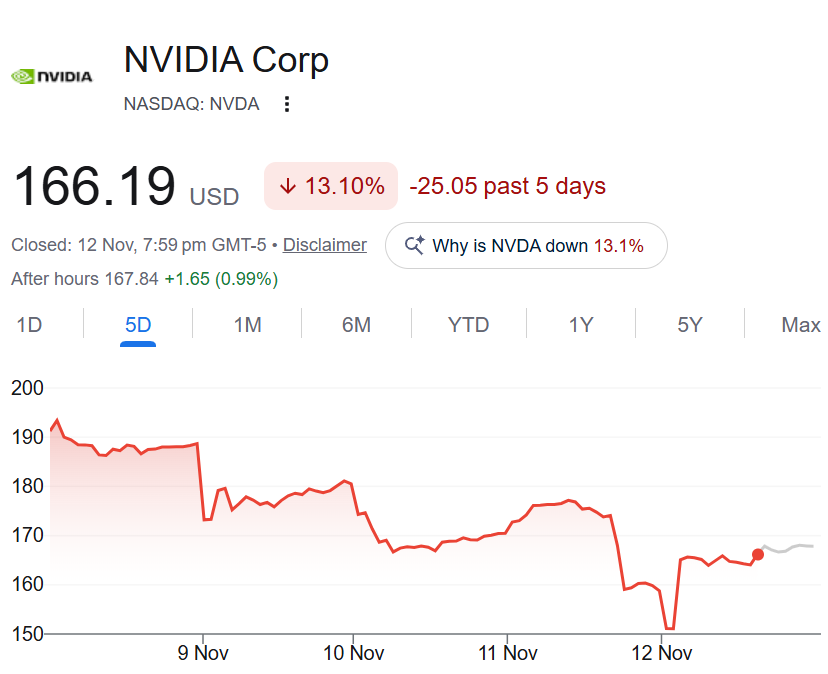
Nvidia’s shares fell more than 10% after the announcement, extending a slide that has erased roughly $600 billion in market value in a single week.
Just last month, Nvidia was worth nearly $5.8 trillion, and it is now hovering around the $4 trillion mark.
And this isn’t a problem that stays inside one stock.
As of early November, Nvidia made up close to 7% of the S&P 500, which means that if you own a plain-vanilla US index fund, a meaningful slice of your money is riding on how this transition plays out.
So why does one person’s exit carry so much weight? It comes down to three roles Huang played at the same time.
Nvidia, the AI industry’s banker
The first was architect. Nvidia’s dominance in AI isn’t only about having fast chips, it’s about CUDA, the software platform Huang championed years before AI went mainstream.
Because most AI developers have spent years writing code and building tools on CUDA, moving to a rival chip from AMD, Google or Amazon means rewriting a lot of that work, and that switching cost is what has kept Nvidia’s market share and margins so high even as competitors have caught up on hardware.
The second was operator.
Nvidia never had a conventional corporate hierarchy under Huang.
He had dozens of senior executives reporting directly to him, set the long-term strategy personally and expected the organisation to execute quickly around his calls.
It made Nvidia unusually fast-moving, but it also concentrated an enormous amount of decision-making in one person.
The third was ambassador.
Huang was the AI industry’s most influential voice, making the case to governments, customers and investors that the world needed far more computing infrastructure, that regulation should stay light, and that US chipmakers should be allowed to keep selling to China.
When he set out a vision, the entire AI supply chain tended to move with it.
But there was a fourth role that has become the biggest source of worry, and that’s Huang as the AI industry’s financier.
Over the past two years, Nvidia generated so much cash from chip sales that Huang began recycling it back into the ecosystem on a scale no chipmaker has attempted before. This year alone, Nvidia and its venture arm made more than 120 investments, which works out to roughly one every two and a half days, and by the end of July its equity investments, including those it had committed to, stood at $124 billion.
Its portfolio spans AI labs like OpenAI, Anthropic and xAI, listed companies like Intel and Nokia, and hundreds of smaller startups.
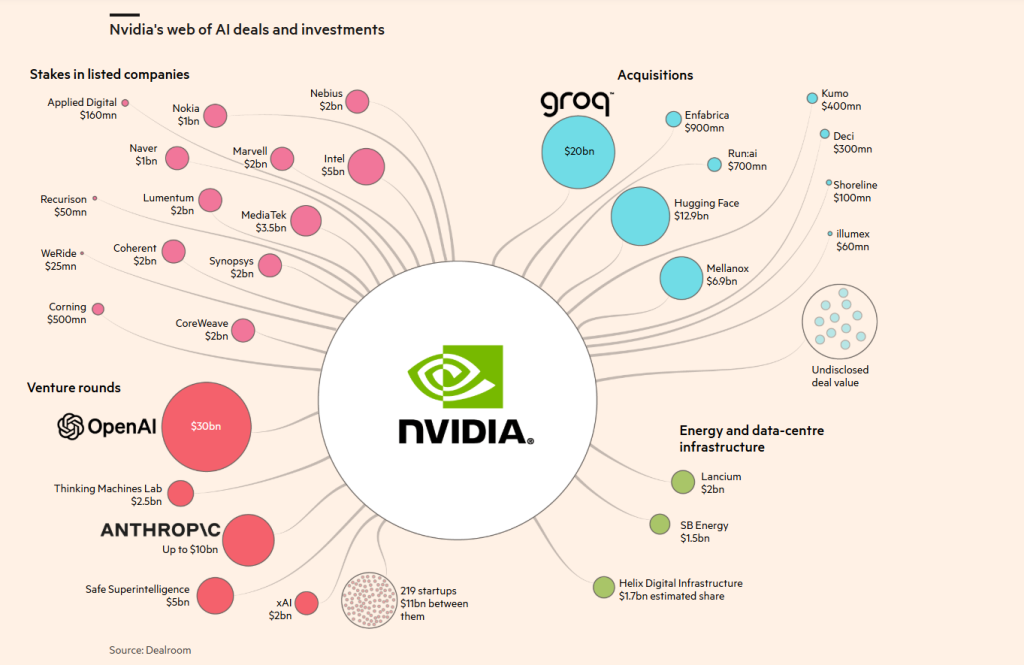
It went well beyond buying stakes, though. Nvidia guaranteed up to $105 billion of OpenAI’s lease and power payments for a 4.25 gigawatt data centre campus in Ohio, in exchange for that campus running Nvidia hardware exclusively for 20 years.
It committed $36 billion to buying computing capacity from AI cloud providers if they couldn’t find other customers, signed $20 billion of data centre leases that it planned to pass on to others, and was working with Wall Street firms on a plan to use its balance sheet to unlock more than $500 billion of outside capital for chip financing.
The biggest beneficiaries of all this were the neoclouds, a newer breed of cloud companies like CoreWeave, Nebius and Lambda that rent out AI computing power. Nvidia backed them for a clear strategic reason.
The big cloud players like Amazon, Microsoft and Google are increasingly designing their own chips, so building up a set of independent cloud providers that buy Nvidia hardware in bulk helped lock in demand.
CoreWeave alone received a $2 billion equity investment in January along with a $6.3 billion commitment from Nvidia to buy any unused capacity, and Nebius got another $2 billion in March.
Critics call this circular financing, because a lot of the money Nvidia invests ends up flowing straight back to it as chip orders. Whether that’s a smart way to build an ecosystem or an unhealthy way to inflate demand is debatable, but Nvidia itself acknowledged the risk. In its August filing, it added a new risk factor warning that these commitments and guarantees expose it to financial, counterparty and execution risks and might not deliver the expected benefits.
That risk was already growing before Huang left.
Much of this financing works because GPUs are treated as valuable collateral that keeps earning rent for years. But Microsoft has reportedly decided not to renew a deal to rent older-generation Nvidia GPU capacity from Oracle because it no longer fit its needs, which raises an awkward question about how quickly these chips lose value. Add tighter credit conditions and high bond yields, and the whole structure was already under pressure.
Now take away the person who personally drove many of these deals, and you can see why neocloud stocks fell alongside Nvidia, and why at least one industry executive expects Nvidia’s dealmaking to largely pause until the leadership situation settles.
Which brings us to the next problem: who actually replaces him?
This is what investors call key man risk, and Nvidia carried more of it than almost any company of its size. There was no public succession plan, Huang had repeatedly said he intended to keep running the company for decades, and his flat structure meant nobody had been groomed as an obvious number two.
The names being floated show how hard the search will be. Internally, there’s Kress, who knows the numbers and the investors better than anyone but comes from finance rather than technology, and Ian Buck, the creator of CUDA who runs the data centre business but hasn’t run a large public company.
Externally, the candidates include leaders at Arm, AMD, Apple, Amazon Web Services, Micron and Google, each of whom brings deep strengths in either chip design, operations or cloud infrastructure. What none of them obviously brings is the full package Huang offered, which was technical depth, operational control, dealmaking instincts and the ability to sell a vision to the entire industry, all in one person.
The timing also isn’t great on the policy front.
Huang was Nvidia’s most effective advocate in Washington, especially on chip exports to China, and Congress is currently negotiating defence legislation that includes proposals on chip-location tracking and tighter controls on advanced AI chip exports. With Democrats taking control of congressional committees in January, scrutiny of Nvidia’s China business is likely to intensify just as the company loses its most persuasive negotiator. To be fair, the direct revenue at stake is small, since China now accounts for less than 1% of Nvidia’s data centre revenue, but the episode makes it harder for Nvidia to argue its case for regaining access to what has been the world’s largest chip market.
And rivals are paying attention. AMD’s shares rose as traders bet on a distracted Nvidia, and Google has been rolling out a broader range of its own AI chips to capitalise on the moment. Customers who were already looking to reduce their dependence on Nvidia now have one more reason to diversify.
So, is Nvidia still worth $4 trillion?
The bearish argument is that Nvidia’s valuation was built on a growth story that Huang actively engineered, and that story now looks more fragile.
An interim CEO who also holds the CFO job is likely to be more conservative with capital, and if Nvidia slows its investments, guarantees and capacity commitments, the neoclouds and startups that depend on that support could struggle to raise money.
That would mean fewer data centres getting built and, eventually, fewer chips being ordered. Combine that with questions over how long GPUs hold their value, tighter credit markets, stronger competition and tougher regulation, and the bears would argue that a lower valuation is justified until a credible long-term leader is in place.
The bullish argument is that Nvidia’s advantages are structural rather than personal. Customers buy its chips because they remain the best available and because the CUDA ecosystem is so deeply embedded, and neither of those things changes because the CEO has.
The board has said the product roadmap and customer commitments remain intact, and the underlying demand for AI computing hasn’t gone away.
There’s also precedent for founder-led companies doing well after their founders leave, with Apple after Steve Jobs being the most famous example, even if it took investors several years to be convinced. And after a slide of more than 30% from its October peak, some would argue that a good deal of the bad news is already priced in.
The first real test arrives on 17 November, when Nvidia reports its quarterly results with Kress at the helm. Beyond the usual revenue and margin numbers, investors will be looking for three things: signs that data centre demand is holding up, clarity on whether Nvidia will honour and continue its investment and financing commitments, and a sense of how long the search for a permanent CEO is likely to take.
Because ultimately, Nvidia’s valuation has always rested on confidence that it would keep innovating, keep funding the AI ecosystem and keep shaping where the industry goes next. For most of the last three decades, that confidence was hard to separate from Jensen Huang himself. The coming months will show how much of it belonged to the man, and how much to the company he built.
Until then…
Don’t forget to share this story with your friends, family or anyone who’s been watching the Nvidia sell-off and wondering what comes next. Just hit share on WhatsApp, LinkedIn or X.