





Key Takeaways
- US stock investments can involve additional tax reporting in India, including foreign asset and income disclosures.
- Choosing the right ITR form is important and depends on your income sources and whether you have business or professional income.
- US stocks held during the year may need to be reported in Schedule FA, even if you did not sell them.
- US dividends and capital gains need to be reported separately in the relevant ITR schedules.
- Tax deducted in the US may be eligible for foreign tax credit in India, subject to the applicable rules.
- Using the correct exchange rate and reporting period can help you avoid errors while filing your ITR
- This guide will help Indian resident taxpayers who invest in US stocks and need to correctly report capital gains, dividends, and foreign holdings while filing their ITR.
Filing Income Tax Returns (ITR) in India is a legal requirement for taxpayers who meet the filing conditions. People often find the process tedious when multiple tax forms are involved. Things can get a little more complicated when you also invest in US stocks. There is more to keep track of, from your capital gains and dividends to your foreign investments and other disclosures.
It is easy to miss a detail, particularly when you are filing an ITR after making your first overseas investment. Here are some common mistakes while filing ITR that investors should keep an eye on.
Common ITR Filing Mistakes US Stock Investors In India Should Avoid
1. Choosing The Wrong ITR Form
You can earn income from US stocks in different ways, such as through capital gains and dividends. So, not every US stock investor needs to file the same ITR form. For investors earning capital gains without any business or professional income, ITR-2 is generally the form to use. ITR-3 comes into the picture when you also have income from a business or profession.
This is why understanding the difference between ITR 2 vs ITR 3 matters a lot when you invest or trade in US stocks. Picking a form simply because it looks easier can result in incorrect filing.
2. Forgetting To Report US Stocks In Schedule FA
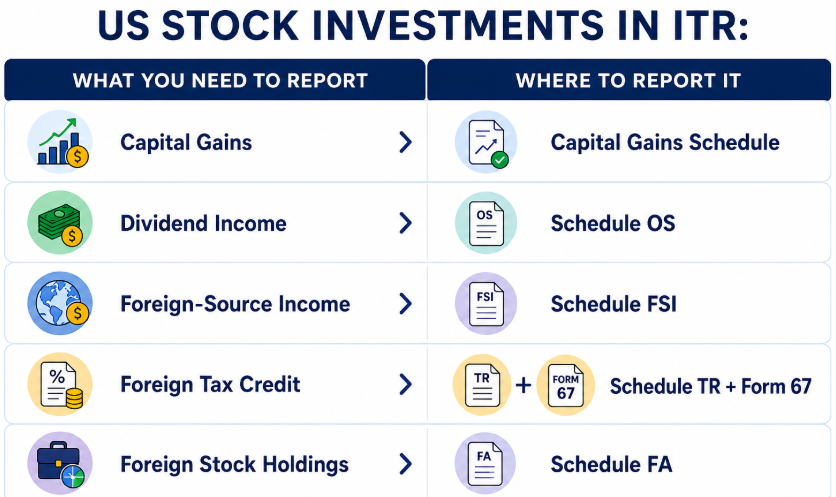
You do not necessarily have to wait until you sell your US stocks to report them. Eligible resident taxpayers also need to disclose their foreign holdings in Schedule FA, which includes foreign equity and debt investments.
So, if you bought US shares and held them through the year, you may still need to report details even if you did not make any capital gains. Missing Schedule FA in Income Tax Returns can lead to a penalty of ₹10 lakh under Section 43 of Black Money Act. From October 1, 2024, however, an exemption is applicable if the aggregate value of the relevant foreign assets, other than immovable property, does not exceed ₹20 lakh.
3. Not Reporting Dividend Income From US Stocks
Dividends from US stocks are taxable in India, even if you leave the money in your brokerage account. You would generally report this income in Schedule OS (Income from Other Sources). Since it is income earned outside India, the details should also be reported in Schedule FSI (Foreign Source Income).
If the US has already deducted tax from the dividend, you can claim the eligible foreign tax credit in India. The tax relief is reported in Schedule TR (Tax Relief). So, when filing your ITR, keep track of both the dividend you earned and the tax deducted in the US.
4. Using The Incorrect Exchange Rate For US Capital Gains In ITR
When you sell US stocks, the amounts must be converted from dollars to rupees when calculating your capital gains. The exchange rate you use for this calculation matters, so you cannot simply use the USD-INR rate on the day you file your ITR.
Under Rule 115 of the Income-tax Rules (now Rule 206 under the Income-Tax Rules, 2026), the Telegraphic Transfer Buying Rate (TTBR) is used for converting foreign-currency income into rupees. TTBR is the exchange rate used by banks for currency conversion. For Indian tax purposes, SBI’s TTBR is used to convert foreign-currency income into INR under the prescribed tax rules.
For capital gains, the rate is taken with reference to the last day of the month immediately before the month of sale. So, if you sell your shares in August, the relevant rate would generally be the one applicable on the last day of July.
Let us say you sell your US shares on 21 August 2026. You would generally use SBI’s TTBR applicable on 31 July 2026 for conversion. You can check the applicable rate on SBI’s official website, where historical TTBR rates are also available.
5. Not Claiming Foreign Tax Credit Correctly
If dividend withholding tax has already been deducted in the US on your dividend income, you may be able to claim a foreign tax credit in India, subject to the applicable rules. But the credit does not happen automatically.
To claim it, you need to provide the required details in Form 67 and report the foreign income and tax paid in the relevant schedules of your ITR. Form 67 is the form used by Indian taxpayers to claim a foreign tax credit for eligible taxes paid or deducted on income earned outside India. It provides details of the foreign income and the tax paid in the foreign country.
So, do not simply assume that the tax deducted in the US will automatically be adjusted in your Indian ITR.
6. Mixing Up The Reporting Periods
Not every detail in your ITR is reported for the same period. This can be easy to miss when you have US stocks or other foreign investments.
For example, most income and capital gains are reported for the financial year, which runs from April to March. Some foreign asset details may instead follow the calendar year, from January to December. So, do not use the same dates for every section of your ITR. Check the reporting period required for each schedule before you file.
| What you’re reporting | Relevant period |
| Income and capital gains | April 1 to March 31 |
| Foreign assets in Schedule FA | January 1 to December 31 |
This is where Vested Finance’s tax filing documents can help. They bring together key information about your US stock investments, making it easier to keep track of the details you need while filing your ITR.
What Should US Stock Investors Keep Ready Before Filing ITR?
Before you start filing, keep your US stock records in one place. Your brokerage statement and transaction history should cover the shares you bought or sold, along with any dividends you received.
You will also need details of the tax deducted in the US and your foreign holdings. If you have made several trades, go through the transaction dates, amounts, and exchange rates once before entering the details in your ITR. Having everything together makes the filing process easier and reduces the chances of missing something.
This is where Vested Finance’s tax filing documents can help. They bring together key information about your US stock investments, making it easier to keep track of the details you need while filing your ITR.
US Stock Tax Reporting Checklist
Conclusion
Filing an ITR with US stock investments does involve a few extra steps. But most ITR filing mistakes can be avoided if you keep your records ready and check your foreign assets, capital gains, dividends, and tax details before submitting your return.
Vested also make this process easier by providing tax documents with summaries of your capital gains, dividends and foreign assets. The information is available in INR and can be accessed from the platform. Vested also integrates with ClearTax, allowing you to transfer these details and complete the rest of your ITR filing there.
Sources:
Frequently Asked Questions
What if I file the wrong ITR?
Don’t panic. If you spot the mistake after filing, you may be able to correct it by filing a revised return, as long as you meet the applicable conditions and deadline.
Can ITR filing mistakes lead to scrutiny?
Not necessarily. A mistake does not automatically lead to scrutiny. However, incorrect or missing information can result in questions from the Income Tax Department.
Do I have to report US stock losses in my ITR?
Yes. If you sold US stocks at a loss, you should still report the transaction while filing your return. Depending on the type of loss and your circumstances, you may also be able to carry it forward.
Do fractional US stocks need to be reported in an ITR?
Yes, fractional shares are still investments in foreign securities. The fact that you own only a portion of a share does not by itself remove the applicable reporting requirements.
Do I need to pay tax if I only bought US stocks during the year?
Not necessarily. Simply buying US stocks does not create a capital gain. Hence, capital gains taxes may not be applicable. However, if those stocks paid dividends during the year, the dividend income may still be taxable in India, even if you did not sell any shares.