





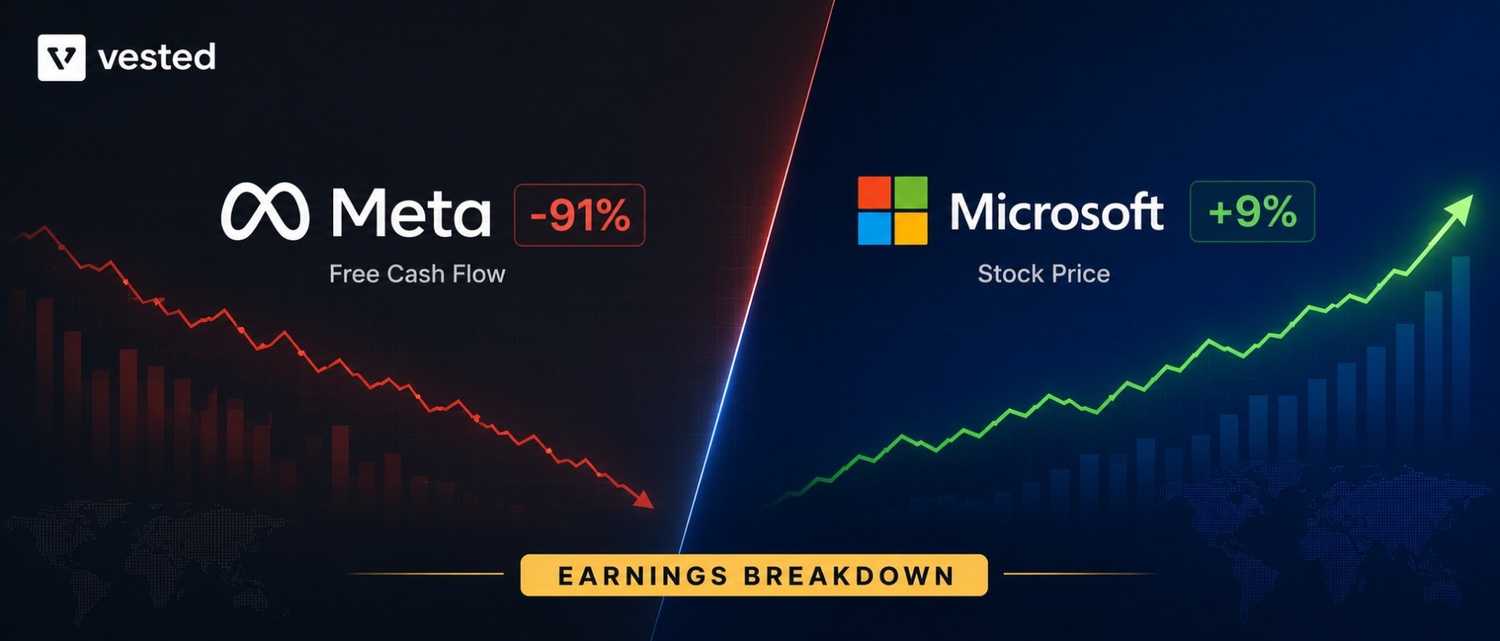
Wednesday was earnings day for two of the biggest spenders in the AI race. Microsoft shares spiked as much as 9% in the initial reaction before settling to a 4.4% gain in aftermarket trading. Meta wasn’t as lucky; its stock slid as much as 10%.
Both companies are pouring unprecedented sums into AI. Both beat revenue estimates. And yet Wall Street decided one of them deserved a party and the other didn’t. Let’s understand why.
Microsoft: When spending finally looks like it’s paying off
Microsoft earned $90 billion in revenue for the April-June quarter, translating to $4.81 per share. That’s up 18% from a year earlier, and comfortably ahead of what analysts were expecting ($4.24 per share on $87.62 billion in revenue).
The star of the show, as usual, was the cloud. Microsoft Cloud revenue came in at $59.3 billion, up 27% year-on-year. Azure alone grew 43%, riding a wave of demand for AI infrastructure. And for the first time ever, Azure crossed $100 billion in revenue for the full fiscal year.
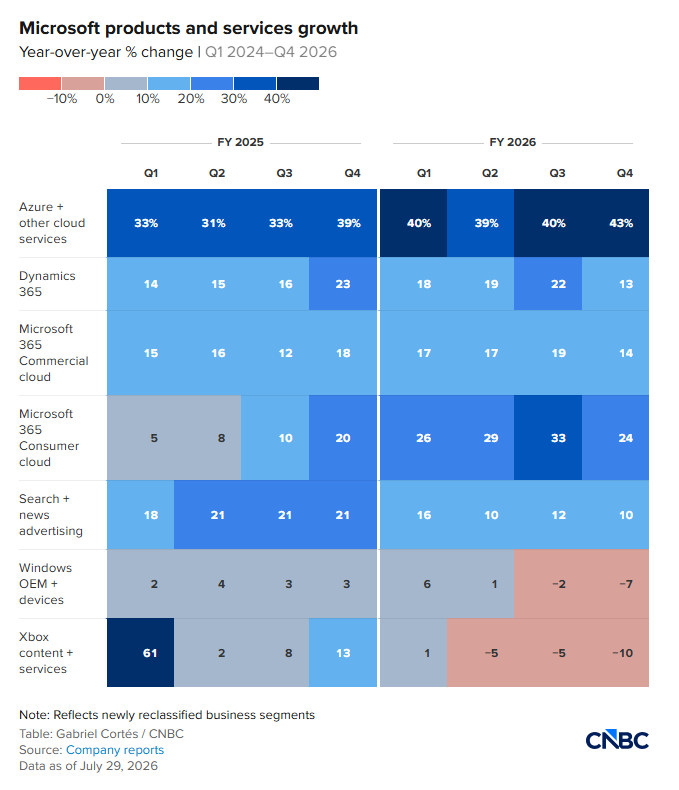
But here’s what really got investors excited. It isn’t just that Microsoft is renting out cloud infrastructure for other people’s AI ambitions. It’s also making money from AI directly, through products people already use every day. Microsoft 365 Copilot, the company’s AI assistant baked into Word, Excel and Outlook, now has over 30 million paid seats. That’s a real number, not a promise.
Think about what this means. Microsoft is winning on two fronts at once. It supplies the picks and shovels (cloud infrastructure) to everyone building AI, while also selling AI tools to the millions of office workers already inside its ecosystem. Not many companies can claim both.
Here’s how each business line stacked up against what Wall Street was expecting:
| Segment | Revenue | YoY growth | Beat estimates? |
| Intelligent Cloud (Azure) | $39.31B | 31.6% | Yes ($38.16B expected) |
| Productivity & Business Processes (Office, LinkedIn, Dynamics) | $37.85B | 14.3% | Yes ($37.19B expected) |
| More Personal Computing (Windows, Surface, Xbox, Bing) | $12.85B | -4.4% | Yes ($12.17B expected) |
Notice something interesting. Even the “declining” segment, More Personal Computing, beat what analysts expected. Nobody was really betting on Windows or Xbox anyway, so a smaller-than-feared decline barely dented sentiment. The real story was Azure alone growing faster than the whole company.
Now, about the elephant in the room: capital expenditure. Microsoft has been spending furiously to build data centers and buy chips, and this quarter alone it spent $41 billion on capex. CFO Amy Hood told investors that full-year 2026 spending guidance stays roughly unchanged. An accounting shift will nudge the headline figure toward $175 billion, but the underlying plan hasn’t moved.
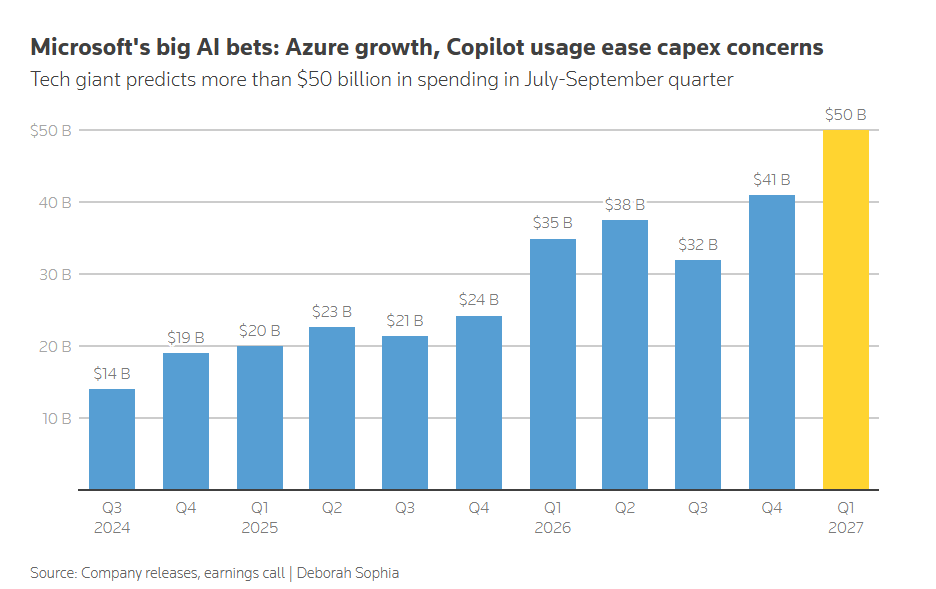
That word, “unchanged,” mattered more than it sounds. Rivals like Meta and Alphabet have been raising their spending forecasts quarter after quarter, worrying investors that the AI arms race has no ceiling. Microsoft holding steady signalled discipline, and for the first time in a while, the market seemed willing to believe the spending is actually buying something real.
The result? Microsoft’s stock jumped as much as 9% in after-hours trading, touching $426, before settling to a 4.4% gain. Free cash flow did fall 23% for the quarter, but with Azure growing this fast, nobody seemed to care.
Meta: The bill is due, and investors aren’t impressed
Now flip to Meta. The company reported earnings per share of $6.18, badly missing the $7.22 Wall Street expected. Revenue told a better story: it jumped 28% to $60.8 billion, the fastest pace of growth since late 2021. Meta’s apps also crossed 3.6 billion daily active people, up 3% year-on-year. But none of that was enough to save the stock.
Why the miss? Meta flagged $2.4 billion in charges tied to legal proceedings, pushing full-year expenses up to a range of $165-169 billion.
Operating income actually fell 8% for the quarter. Strip out the legal charges and severance costs from a restructuring that saw about 8,000 employees, roughly 10% of the workforce, laid off in May, and operating income would have grown 9% instead.
And its 2026 capex guidance climbed too, now expected between $130 billion and $145 billion, up from an original forecast of just $115-135 billion at the start of the year.
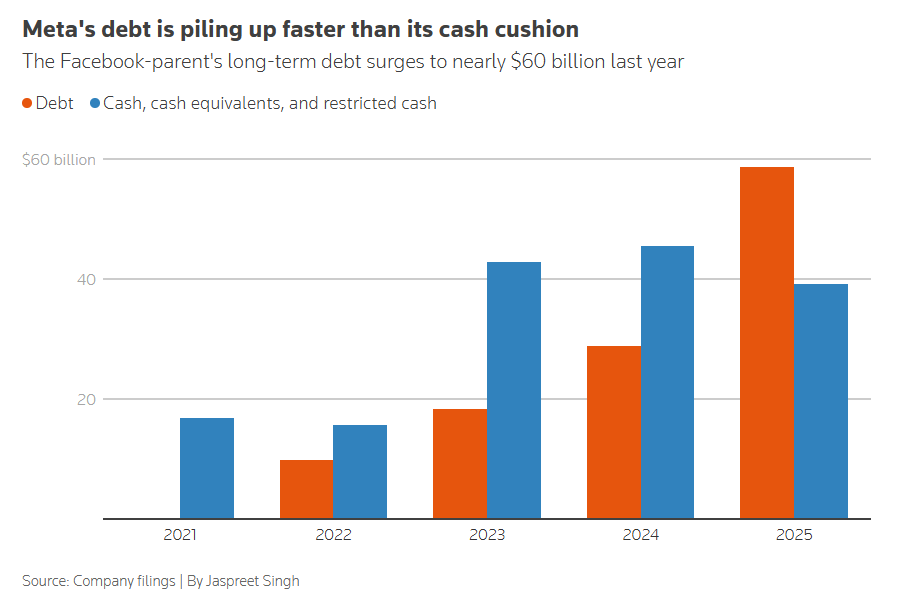
This is the crux of Meta’s problem. Unlike Microsoft, Meta doesn’t have a cloud business it can point to and say “look, this is exactly what the money bought.” Its AI spending has to justify itself entirely through better ads, better products and, eventually, some new business nobody has fully seen yet.
Mark Zuckerberg tried to get ahead of the earnings with a media blitz. He wrote an op-ed in the Wall Street Journal painting a picture of “personalized super-intelligence,” essentially an AI assistant tailored to every individual, and argued this was fairer and safer than a single centralized AI controlled by one company. He gave interviews to the New York Times and Financial Times pushing the same message.
It didn’t work. The stock fell as much as 10% anyway, extending what was already Meta’s longest losing streak on record.
Adding to the pressure, Meta’s Reality Labs division, the unit behind Quest headsets and Ray-Ban Meta glasses, posted an operating loss of $4.62 billion for the quarter, even though revenue rose to $431 million.
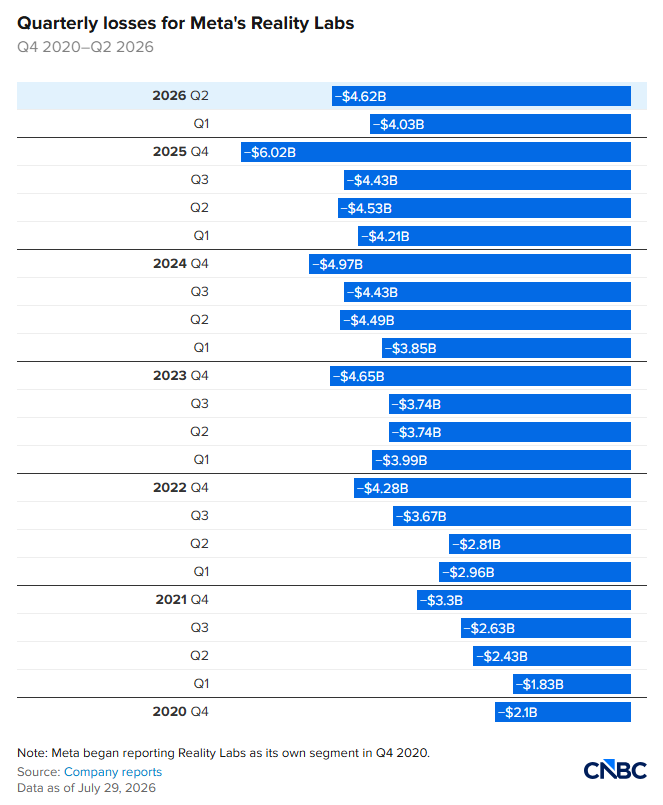
Since 2020, Reality Labs has burned through more than $80 billion. Zuckerberg’s big bet on the metaverse, the reason he renamed the company in the first place, still hasn’t found its footing, and now it’s competing for capital with his AI ambitions too.
On top of all this, Meta faces close to 3,000 lawsuits alleging its products are designed to be addictive and harmful to children, with cases from 42 states and a federal trial coming up. This month, four states even asked for $1.4 trillion in penalties in a court filing over the same allegations. None of this shows up directly in the earnings numbers, but it adds another layer of uncertainty that investors have to price in.
The number that really spooked investors: free cash flow
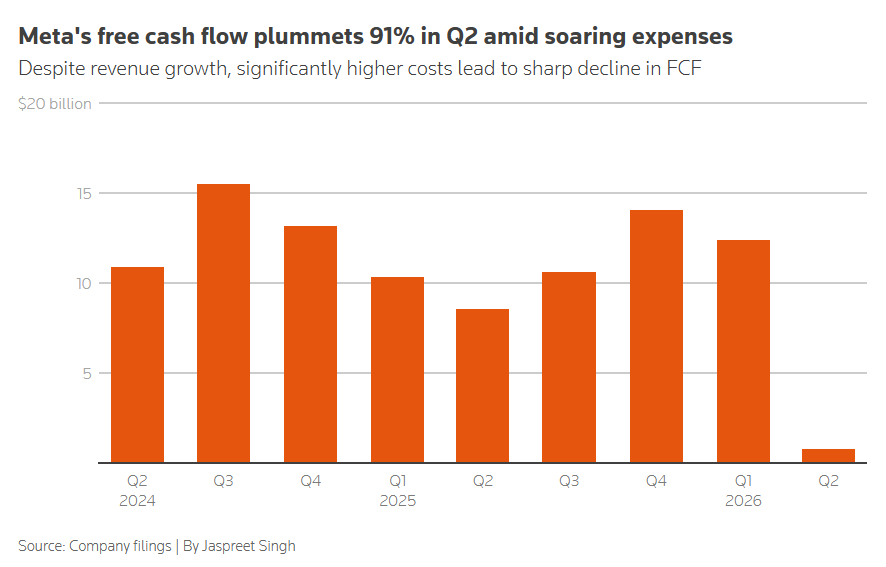
Here’s where things get uncomfortable. Free cash flow is the actual cash a company has left after running the business and funding its capex, the money that could go toward buybacks, dividends or a rainy day. And on this measure, Meta’s quarter was ugly.
| Microsoft | Meta | |
| Free cash flow (Q2) | $19.64B | $784M |
| YoY change | -23% | -91% |
| Free cash flow a year ago | ~$25.5B | $8.55B |
A 91% collapse in free cash flow is the kind of number that makes CFOs nervous. Meta’s own free cash flow is now at its lowest since late 2022, back when investors were similarly worried about its metaverse spending spree. And this isn’t happening in isolation. Alphabet reported its first-ever cash-flow-negative quarter just a week earlier, so investors are now watching for whether every major AI spender is headed the same way.
Microsoft’s free cash flow also dropped, 23% year-on-year, but nobody panicked because Azure’s growth gave everyone a reason to believe the spending would eventually pay for itself. Meta didn’t get that same benefit of the doubt.
On the earnings call, Zuckerberg tried to explain where all that compute was actually going, telling analysts that a large share would go toward training models, growing the core ad business, and building “personal agents and new products,” while Meta also tries to build a business serving large enterprise customers. It’s a reasonable pitch. But as Forrester’s Mike Proulx put it, Meta’s AI spending was easy to cheer for when margins were expanding, and it’s a lot harder to cheer for now that the costs are actually showing up in the numbers.
So why did the market react so differently?
Put the two report cards side by side, and the contrast is stark:
| Microsoft | Meta | |
| Revenue | $90.0B (beat) | $60.8B (beat), up 28% YoY |
| EPS | $4.81 (beat estimate of $4.24) | $6.18 (missed estimate of ~$7.22) |
| Free cash flow | $19.64B, down 23% | $784M, down 91% |
| 2026 capex guidance | ~$175B, called “unchanged” | Raised to $130-145B |
| Stock reaction | Up as much as 9%, settled at 4.4% | Down as much as 10% |
| Standout number | Azure crossed $100B for the year; Copilot at 30M+ paid seats | Reality Labs lost $4.62B for the quarter |
Strip away the noise, and the difference comes down to proof versus promise.
Microsoft could point to Azure crossing $100 billion and Copilot hitting 30 million paid seats. Concrete numbers showing the AI spending is translating into revenue today, and that gave investors enough comfort to look past a 23% drop in free cash flow. Meta, on the other hand, is still asking investors to trust that “personalized super-intelligence” will eventually pay off, while its near-term numbers show a 91% collapse in free cash flow, rising legal costs and a still-bleeding Reality Labs unit.
Both companies are betting hundreds of billions of dollars on the same underlying belief, that AI will reshape how the world works and whoever builds the infrastructure first wins big. Both are also watching their free cash flow shrink because of it, much like Alphabet did the week before. But investors aren’t rewarding conviction anymore. They’re rewarding evidence that the spending is turning into revenue, not just expenses.
Microsoft had that evidence this quarter. Meta didn’t.
Until next time.