






Picture this. You’re the most talked about company on the planet. Everyone wants your product so badly they’re begging for supply. Business could not be better.
And yet, this week, you convinced six of the biggest names in finance to hand over half a trillion dollars to keep your customers buying.
Sounds strange, right? If demand is this strong, why does Nvidia need Wall Street’s help at all?
That’s exactly the question investors started asking the moment the news broke. And the answer says a lot about where the AI boom actually stands right now.
Here’s what happened.
Nvidia signed agreements with Apollo Global, Blackstone, BlackRock, Brookfield, Goldman Sachs and KKR to raise more than $500 billion for AI infrastructure.
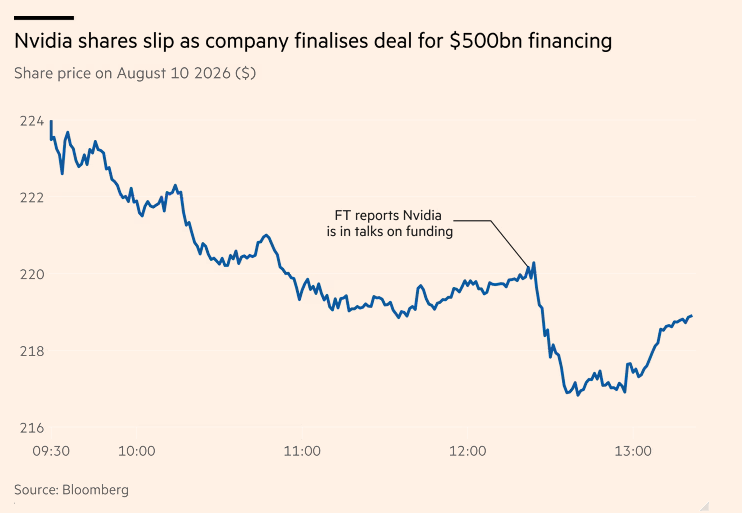
And instead of celebrating, Nvidia’s stock fell, shedding almost $60 billion in market value in a single day. On paper this looks like a massive vote of confidence. So why the nervous reaction? Let’s unpack it.
The problem Nvidia is solving
AI infrastructure is expensive. Not “buy a nice car” expensive. We’re talking data centres, power plants and chip factories that cost hundreds of billions of dollars to build.
Big tech companies, the Metas, Microsofts, Amazons and Googles of the world, are already spending over $730 billion this year on this build-out. And that number is expected to climb. Morgan Stanley thinks hyperscalers alone will spend $3.5 trillion between 2026 and 2028. Apollo’s president Jim Zelter puts the total AI infrastructure bill at a staggering $8 trillion.
Here’s the catch. Even the richest companies on earth cannot fund that entirely out of their own cash flows. So they’ve been tapping public markets, issuing bonds, raising equity, doing whatever it takes to keep the AI buildout moving. But public markets have limits. There’s only so much appetite for corporate bonds and stock issuances before investors start asking uncomfortable questions.
Enter private capital.
Why private capital giants are the new lenders of choice
Firms like Apollo, Blackstone and KKR built their reputations doing leveraged buyouts. Buy a company, load it with debt, fix it up, sell it for a profit. That was the old playbook.
The new playbook looks very different. These firms now sit on enormous pools of capital, money from insurance companies, pension funds and ordinary savers, all looking for returns slightly better than a plain vanilla investment grade bond. AI infrastructure, with its predictable long-term cash flows once a data centre is up and running, fits that appetite nicely.
So Nvidia’s pitch to them is simple. Come finance the AI ecosystem, and we’ll make sure the returns are attractive.
Under the arrangement, these six firms will build dedicated pools of capital, essentially financing platforms, that lend to Nvidia’s customers at “attractive rates.” Think of it as Nvidia helping its customers get cheaper financing to buy Nvidia’s chips.
The Jensen Huang safety net
Here’s where it gets interesting. For private capital to lend hundreds of billions of dollars into a sector as new and untested as AI infrastructure, they need some assurance the bet won’t blow up.
That assurance comes from Nvidia itself. CEO Jensen Huang said the company may offer a “residual value support mechanism” covering up to 25 percent of a project’s value. In plain English, Nvidia is telling lenders that if things go sideways, it will absorb a chunk of the losses.
This is a big deal. It means Nvidia isn’t just selling chips anymore. It’s underwriting the risk of the entire ecosystem it sits at the centre of.
The mechanics reportedly work like this. Compute power itself becomes the collateral. Special purpose vehicles will issue debt, sometimes tens of billions of dollars at a time, and then lease that compute capacity to Nvidia’s customers. Because compute is relatively liquid, meaning it can be reallocated to a different buyer if the original customer defaults, the risk to debt investors is somewhat cushioned.
Why Nvidia’s stock fell anyway
You’d think a $500 billion vote of confidence would send the stock soaring. Instead it dropped.
The likely reason is the circularity concern that has been following Nvidia around for a while now. Nvidia sells chips to AI companies. Some of those companies are themselves partly funded by Nvidia, or by financing structures Nvidia helped engineer. Now Nvidia is also helping arrange the debt that lets its customers buy more of its chips.
Round and round it goes. Nvidia’s revenue, its customers’ spending and the debt financing that enables that spending are all becoming increasingly intertwined. Analysts have flagged this before. As one risk management executive put it, these arrangements effectively make Nvidia’s products cheaper without actually cutting sticker prices, while also making future demand a lot more sensitive to credit conditions.
In other words, if credit markets tighten or AI returns disappoint, the entire structure feels the pain simultaneously. Investors are right to ask what happens if the music stops.
It’s not just Nvidia
This deal is the biggest of its kind, but it’s part of a much broader pattern.
BlackRock recently struck an individual agreement with Meta to co-finance and take a majority stake in a Texas data centre.
Anthropic, separately, has tied up with Macquarie Asset Management and Singapore’s sovereign wealth fund GIC to fund its own compute needs.
Nvidia is also reportedly in talks to guarantee financing for a massive 10 gigawatt data centre project in Ohio that OpenAI plans to lease, a deal that could involve backstopping up to $250 billion.
Every major player in AI, chipmakers, cloud companies, foundation model labs, is now stitching together financing from private capital in increasingly creative ways. The old model of just issuing corporate bonds isn’t cutting it anymore.
The debt numbers are starting to show up
This isn’t the first time Nvidia’s growing web of AI commitments has rattled debt markets.
A few weeks before the Wall Street financing platform was announced, reports surfaced that Nvidia was in talks on a separate stack of deals worth more than $750 billion, including the potential $250 billion OpenAI guarantee, talks to finance $350 billion of OpenAI’s chip purchases, and a $500 billion partnership with SK Group.
That news alone was enough to send Nvidia’s five year credit default swap spreads, essentially the price investors pay to insure against the company defaulting, up by roughly 0.14 percentage points in a single day to around 0.82 percentage points.
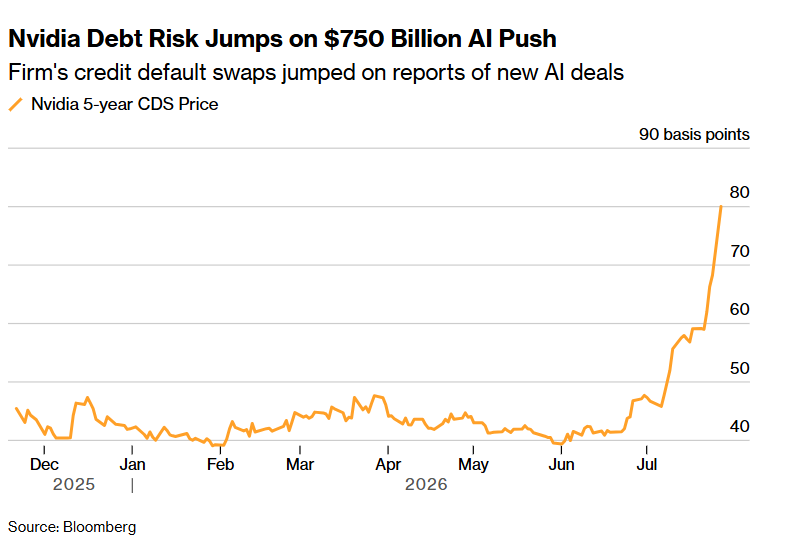
That was the largest single day jump since these contracts started actively trading in November 2025.
Put that in context. Nvidia’s own balance sheet is nowhere close to fragile. The company holds somewhere between $8.5 billion and $50 billion in cash and cash equivalents depending on which reporting period you look at, against a relatively modest $8.5 billion in total debt as of fiscal 2026.
So the market isn’t worried Nvidia itself is about to default. It’s worried about the size and structure of the obligations Nvidia keeps signing up for on behalf of everyone else.
Nvidia has actually been testing the bond markets directly too. In June 2026 it issued its first bonds in five years, between $20 billion and $25 billion worth of high grade debt.
Demand for that offering reportedly hit $85 billion, close to four times oversubscribed. So even as CDS spreads widen and signal rising perceived risk, actual buyers of Nvidia’s debt are still lining up.
That contradiction, rising insurance costs alongside strong bond demand, sums up where investor sentiment sits right now. Cautious headlines, but money still flowing in.
A chipmaker index fell 2.2 percent on the day the $750 billion in deal talk broke. The timing wasn’t kind either.
Alphabet had just reported its first negative quarterly free cash flow since its 2004 IPO, alongside plans to spend as much as $205 billion on capex. That’s the exact scenario circular financing critics keep warning about. A company spending faster than it earns, betting the payoff arrives eventually.
Not everyone is diving in with the same enthusiasm.
Pimco, which manages $2.3 trillion, is being notably more careful.
Its CIO personally signs off on every AI infrastructure deal and insists on long duration bond structures matched to lease terms, the kind of discipline it applied to a $16 billion Oracle data centre financing in Michigan.
That contrast is telling. While Nvidia spreads guarantees across an ever expanding list of partners, some of the biggest pools of capital are moving in with a lot more caution.
The bigger picture
What’s happening here is a genuine shift in how infrastructure gets built. Private capital firms are no longer just buying distressed companies and flipping them. They are becoming the default financiers of a technological transition, the same way banks financed railroads in the 19th century or telecom infrastructure in the 1990s.
KKR’s co-CEOs summed it up well when they called compute a “critical infrastructure asset.” That’s a notable shift in language. Compute, the raw processing power behind AI, is now being spoken about the same way you’d talk about toll roads or power grids. Something you finance for decades, not something you simply buy off a shelf.
Whether this ends well depends entirely on one question nobody can fully answer yet. Will AI generate enough real economic value to justify the trillions being poured into building it? Nvidia, and now half of Wall Street, is betting the answer is yes. The rest of us just get to watch how the bet plays out.
For anyone looking to invest in US stocks with exposure to this shift, Nvidia’s financing web is worth watching closely — it signals which parts of the AI supply chain the smartest capital in the world is willing to bet on.
