





Here’s a stat that should stop you for a second.
SK Hynix stock is up close to 670% over the last year. It’s also down 30% from its peak just last month. And this week, of all weeks, its US share sale closed more than 7 times oversubscribed.
A stock that volatile usually scares investors off. Instead, sovereign wealth funds, global long only funds, and technology focused funds all showed up wanting more of it.
So what’s actually going on here? Let’s unpack it.
The AI memory supercycle, in one company
SK Hynix makes memory chips. Specifically, it’s become Nvidia’s favourite supplier of high bandwidth memory, the specialised chips that sit next to AI processors and feed them data fast enough to keep up.
That one product line has turned SK Hynix into one of the most important companies in the entire AI supply chain, right alongside Samsung and Micron. Demand for AI infrastructure has been so intense that memory chip shortages are now showing up in ordinary consumer electronics, pushing up prices for things like phones and laptops that have nothing to do with AI directly.
The result has been a wall of earnings. SK Hynix’s profits nearly doubled last year on the back of this demand, and the stock followed. Along with Samsung, it now makes up roughly half the entire weight of Korea’s Kospi index, up from about a quarter just a year ago. Two stocks, half a national stock market.
That concentration is exactly why things have gotten volatile.
Why the stock has been swinging so hard
When two companies carry that much weight in one index, every rumour about them moves the whole market. Korea has seen multiple circuit breakers this year alone, more than the market has seen in its entire history combined, largely triggered by swings in Samsung and SK Hynix.
Comments last month from SK Hynix about possibly slowing its AI memory expansion were enough to trigger one of the Kospi’s worst single day drops ever, dragging global markets down with it. Analysts have openly flagged the pattern as a warning sign. The kind of volatility usually seen only during genuine bear markets, like the Asian financial crisis or the dot com bust, not in the middle of a rally.
The bull case is straightforward: AI infrastructure spending from hyperscalers is real, growing fast, and reliant on chips only a handful of companies can make. The bear case is just as straightforward: valuations have run far ahead of any reasonable estimate of near term earnings, and a lot of that spending is now being funded by debt rather than free cash flow, since even hyperscaler cash flow can’t keep up with the pace of AI capex anymore.
Nobody knows yet which case wins. That uncertainty is exactly what’s been whipsawing the stock.
Enter the US listing
Against that backdrop, SK Hynix decided this was the moment to raise money from American investors too, not just Korean ones.
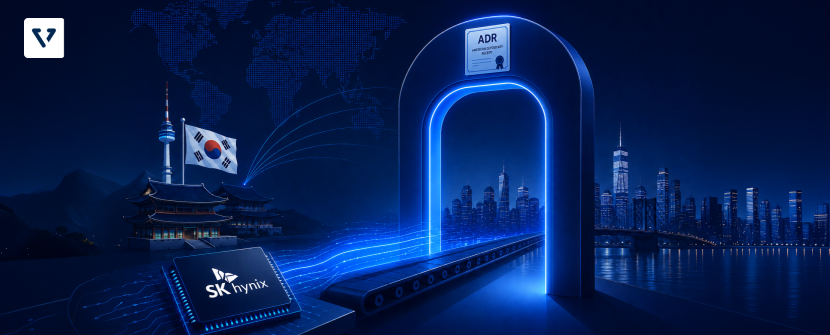
Technically, SK Hynix hasn’t “listed” in the US in the way a company like Airbnb did. It’s traded on the Korea Exchange for years and still does. What launched this week is an ADR, a dollar denominated certificate that a US bank issues against SK Hynix shares it holds in custody back in Seoul. Buy the ADR, and you own a dollar priced claim on the Korean stock, tradable on the Nasdaq during normal US hours, without ever touching a Korean brokerage account.
It’s a well worn mechanism. Samsung, Toyota, Infosys, and plenty of other foreign companies already sit in US portfolios this same way. The point of doing it is simple: access a much larger, deeper pool of global capital than the home market alone can offer.
And investors showed up in force. The 177.9 million ADRs on offer, each worth a tenth of one Korean share, were covered more than 7 times over. SK Hynix ended up pricing them at $149 apiece, raising $26.5 billion in total, the largest ever listing by a foreign company on a US exchange, and the second biggest stock sale globally after SpaceX’s IPO last month.
What the oversubscription actually tells you
Here’s the nuance most headlines skip. The huge demand isn’t really a statement about the ADR itself. It’s a statement about what investors believe regarding AI memory demand specifically, right now, even with the stock down 30% from its peak.
As one strategist put it this week, there’s no evidence of a slowdown in memory chip demand, even though the stock has looked jittery lately. The real debate isn’t whether to buy SK Hynix exposure. It’s how long the current earnings boom lasts, and what price is fair for a company riding it this hard.
Worth remembering: a packed order book and a stock that holds its value are two very different things. SpaceX’s IPO last month drew north of $350 billion in demand and its shares have still slid to their lowest level since debut. Big demand on day one tells you what investors wanted then. It doesn’t tell you what they’ll still want a year from now.
The bigger picture
There’s also a national angle here. SK Hynix and Samsung are part of an $880 billion, government backed initiative to cement South Korea’s position in the global AI race, with plans that include new fabrication plants and gigawatt scale AI data centres across the country. SK Hynix alone has committed roughly $64 billion just to expand its own memory manufacturing capacity domestically.
So this US listing isn’t happening in isolation. It’s one piece of a much larger bet, by SK Hynix, by Samsung, and by the South Korean government, that the AI memory supercycle has years left to run, and that raising capital now, while demand is at its peak, is the smart move regardless of how bumpy the ride gets along the way.
Whether that bet pays off is genuinely an open question. But understanding the difference between an oversubscribed order book and a durable stock price, and between a company “listing” and a company simply making itself easier to buy, is a good place to start if you want to actually follow where this goes.
If you want to understand the ADR mechanism SK Hynix used to raise this money, and the specific risks that come with owning a dollar certificate instead of the underlying foreign share, GlobEd has a chapter that breaks it down: ADRs Explained.