





Two months ago, SpaceX pulled off the biggest IPO in history. Elon Musk’s rocket and satellite company started trading in June, and for a few dizzying days it was worth more than Microsoft and Amazon. Big claims. Bigger valuation.
This week, SpaceX had to back it up with actual numbers. And the results tell a very SpaceX story: growing fast, spending faster, and asking investors to be patient for just a little longer.
Here’s the deal.
The headline numbers
Revenue nearly doubled. That’s the good news. The less good news is that spending grew even quicker, and the stock dropped anyway.
| Metric | Q2 this year | Q2 last year | Change |
| Revenue | $7.8 billion | $4.1 billion | Up 92% |
| Capital expenditure | Over $18 billion | $2.83 billion | Up roughly 6x |
| Net loss | Around $541 million | About $1 billion | Loss narrowed |
| Loss per share | 9 cents | Expected 26 cents | Beat estimates |
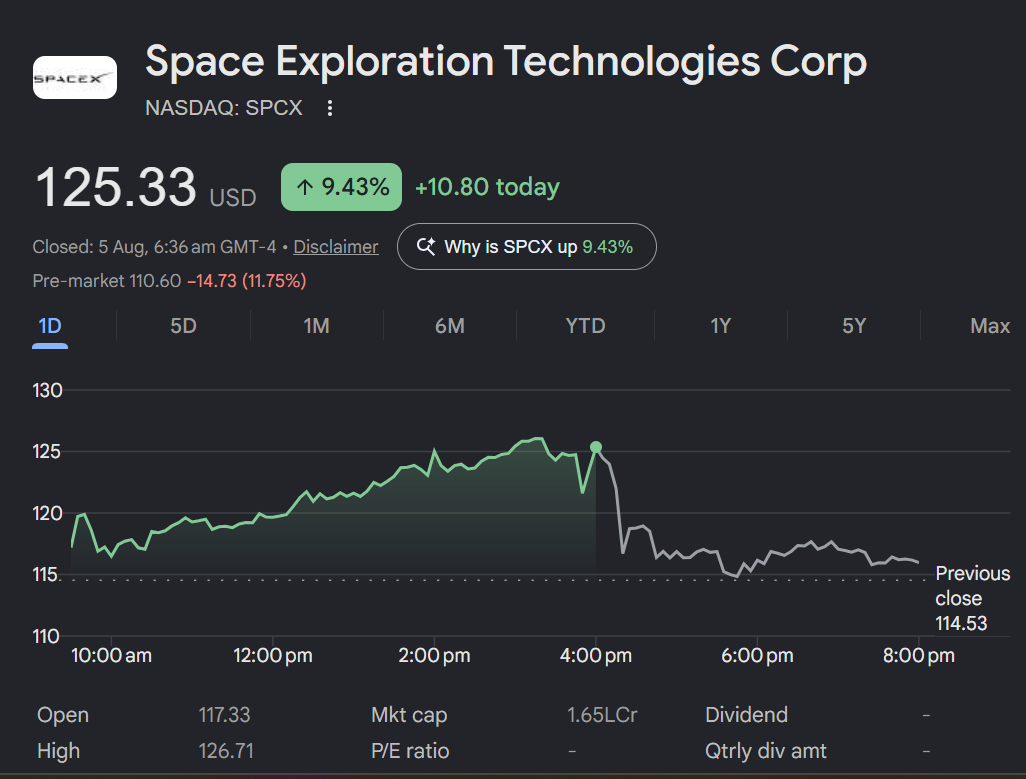
On paper, that’s a decent quarter. Revenue beat what analysts were expecting. The loss narrowed. So why did the stock fall as much as 7.5% in after hours trading, even after climbing 9.4% earlier in the day?
Because SpaceX isn’t really one business. It’s three very different businesses wearing one company’s clothing, and only one of them is actually making money.
Three businesses wearing one company’s clothing
SpaceX now reports itself in three buckets: Space (the rocket launches everyone knows it for), Connectivity (mostly Starlink), and AI (data centres, xAI, Grok, and the social platform X).
| Segment | Revenue | Operating result | What it does |
| Space | $962 million | Loss of $542 million | Rocket launches, Starship development, NASA and defence contracts |
| Connectivity (Starlink) | $4.29 billion | Profit of about $1.66 billion | Satellite internet for consumers, government and military |
| AI (xAI, Grok, X, data centres) | $2.56 billion | Loss of $1.26 billion | Compute, AI models, social media |
Notice something. Starlink is the only segment making money, and it’s making a lot of it. The rocket business, the thing SpaceX is famous for, is losing money.
And the AI business, the thing Musk is betting the company’s future on, is losing even more.
So really, Starlink is quietly funding the other two.
There’s an operational wrinkle in the Space segment worth flagging too. SpaceX actually launched fewer rockets and carried less mass into orbit than expected this quarter, 38 launches instead of an anticipated 43, and about 485 tonnes lifted versus a projected 581 tonnes. Revenue still grew because the mix shifted toward bigger, more valuable external missions, but on pure launch cadence, the company came in under its own pace from a year ago.
The revenue mix is shifting fast
Zoom out one quarter and the shape of SpaceX’s business is already changing.
Connectivity made up nearly 70% of total revenue back in Q1. By Q2, that share had slipped to just under 55%. Space held roughly steady at around 12 to 13%.
The AI segment is the one that moved. Its share of total revenue nearly doubled quarter over quarter, climbing from around 17% to close to 33%.
A big part of that jump traces back to the compute deal with Anthropic to power the Colossus supercomputer, which appears to have given the AI segment a real lift in just three months.
It’s worth sitting with that. A single quarter shouldn’t normally reshuffle a company’s revenue mix this much.
When it does, it usually means either the base business slowed or one segment is scaling unusually fast.
Here it’s the latter, AI is growing into a much bigger share of the pie even while still losing money on an operating basis.
Whether that’s a sign of a business finding its footing or a segment simply spending its way into relevance is exactly the debate playing out among the analysts below.
Where all the cash actually went
Capex is a fancy term for money spent building things that’ll (hopefully) pay off later. Factories, satellites, data centres, that sort of thing.
And SpaceX’s capex ballooned from $2.83 billion a year ago to over $18 billion this quarter.
Almost all of that jump came from one place: AI infrastructure. Spending on AI compute alone rose from $749 million a year ago to $15.83 billion this quarter.
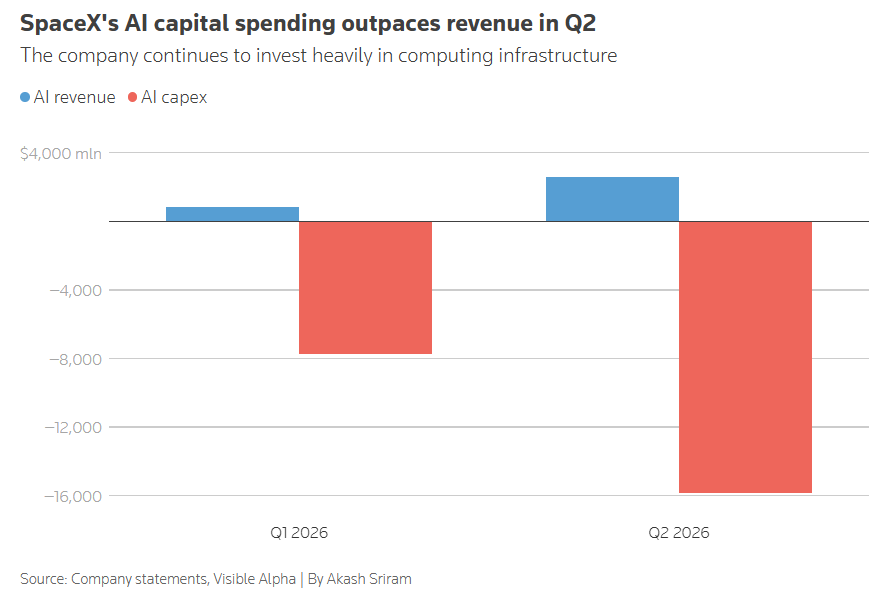
That’s a 21x jump, if you’re counting.
Musk’s pitch is that this spending pays for itself fast.
He told investors the payback period on new AI compute investments would be under a year.
He also said SpaceX is building AI compute capacity faster than anyone else, and that by the end of next year it plans to have close to 10 gigawatts of computing power running, up from roughly 2 gigawatts this year.
To put that in perspective, Nvidia’s own CEO has said each gigawatt of compute capacity can generate $40 to $50 billion of revenue for a company building at that scale.
If SpaceX hits its 10 gigawatt target, the math starts looking very ambitious indeed.
The catch is that finance chief Bret Johnsen told investors capex would stay at similarly elevated levels for at least the next couple of quarters. In other words, the spending spree isn’t slowing down anytime soon.
Starlink: the business quietly paying the bills
Starlink subscribers doubled to 12 million during the quarter, a genuinely impressive number for a satellite internet business. Revenue from the segment grew 66%.
But there’s a wrinkle.
Average revenue per subscriber fell 22%, from about $85 a year ago to roughly $66 now.
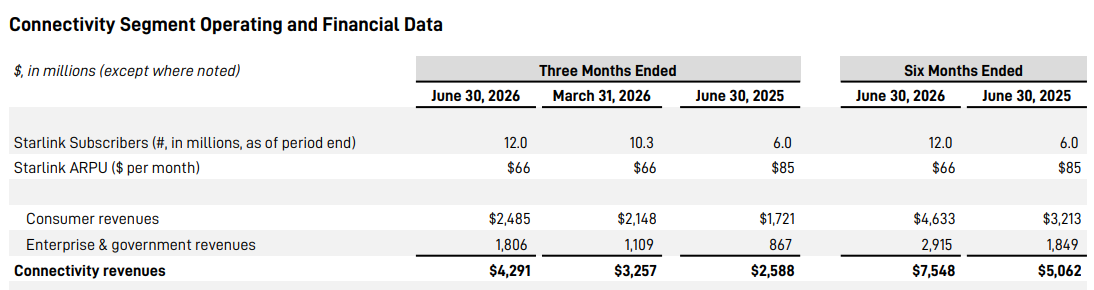
SpaceX has been expanding into more international markets and rolling out cheaper plans to grow faster, which means it’s making less money per customer even as it adds more of them.
Classic land grab strategy: worry about profit per user later, worry about market share now.
The part of Starlink growing fastest isn’t retail customers though.
It’s enterprise and government contracts, which more than doubled to around $1.81 billion. That includes Starshield, the military and defence version of the network, which has locked in multi-year US government contracts worth several billion dollars.
That’s the kind of revenue that’s hard to walk away from once it’s signed, and it’s a big reason Starlink increasingly looks less like a consumer internet provider and more like critical infrastructure.
Musk isn’t shy about how big he thinks this business can get.
He’s talked about Starlink eventually powering most of the world’s internet, and SpaceX’s president Gwynne Shotwell said the company plans to build ground infrastructure to go after telecom customers directly, meaning existing users of T-Mobile, AT&T and Verizon. Shares of those telecom companies actually dipped after her comments.
The number that flatters and the number that doesn’t
Here’s something easy to miss if you only skim the headlines.
SpaceX also reported adjusted EBITDA, a profitability measure that strips out costs like depreciation and stock based compensation, of $3.54 billion.
That’s a huge beat versus what analysts expected, and on its own it makes the quarter look genuinely profitable.
But strip away the adjustments and the picture looks very different.
Under standard accounting rules, SpaceX’s operating loss for the quarter was $143 million. The gap between the two numbers comes almost entirely from $2.85 billion in depreciation and amortisation and $831 million in stock based compensation, costs that are very real even if they don’t show up as cash leaving the bank this instant.
Why does this matter so much for SpaceX specifically?
Because its entire business model runs on constantly buying and replacing expensive things, satellites, rockets, chips, servers.
Depreciation isn’t some accounting footnote here, it’s close to the whole story.
A company that spends this much building and replacing hardware probably shouldn’t be judged mainly on a metric that assumes none of that spending matters.
Is the stock actually expensive
Even after the post earnings slide, SpaceX’s market value sits somewhere around $1.5 to $1.6 trillion, down from a peak closer to $2 trillion.
Against expected full year revenue of roughly $38 to $39 billion, that works out to about 40 times sales.
Even using the more flattering adjusted EBITDA number annualised, the stock still trades above 100 times that metric.
For comparison, that’s a valuation that assumes SpaceX doesn’t just win in rockets or just win in satellite internet, but wins meaningfully across space launch, satellite communications, AI infrastructure and eventually mobile services too, more or less all at once. That’s a lot of things that have to go right simultaneously to justify the price tag.
There’s also a supply side pressure building.
Roughly 911.5 million shares became eligible to trade once the post IPO lock up period lifted, and further lock up expirations could free up more than 5 billion shares by December. None of that means insiders will actually sell, but it does mean the scarcity that helped push the stock up right after the IPO is starting to fade, which on its own can weigh on the price regardless of how the business performs.
The analyst breakdown
Wall Street’s reaction was mixed, and reading between the lines of what analysts said is where the real story sits.
The bulls: Brian Mulberry of Zacks Investment Management pointed out that AI revenue is already growing fast without needing Starlink to bail it out, calling that a genuinely positive surprise. Thomas Monteiro of Investing.com said the quarter answered the basic question of whether the business underneath the hype actually works, and on that front, SpaceX delivered.
The cautious middle: Analyst Brady Wang noted Starlink’s subscriber growth is strong, but it remains the only segment turning an operating profit, which makes it hard to call the entire company “underestimated,” as Musk claimed on the earnings call. Fabien Yip from IG made a similar point: with AI still burning cash as spending rises, calling the whole business undervalued is a stretch.
The skeptics: David Nicholson from The Futurum Group was blunt that SpaceX’s expenses weren’t surprising, and that buying the stock right now is closer to an emotional bet on the company’s long term vision than something that can be justified by near term fundamentals. One independent analysis went further, maintaining a Strong Sell rating even after acknowledging the numbers beat expectations across the board. The argument wasn’t that the quarter was bad, it was that the current share price already assumes SpaceX wins in rockets, satellite internet, AI infrastructure and mobile all at once, and that’s simply too many things needing to go right for the risk to be worth it at this valuation.
Basically, everyone agrees Starlink is real and growing. The disagreement is over whether the AI bet is a smart use of Starlink’s profits or an expensive distraction that keeps the whole company from being profitable.
Why the stock keeps sliding
SpaceX debuted at $150 a share in June. It’s now trading meaningfully below that, and dropped further after this earnings report, even touching lows around $116 in extended trading.
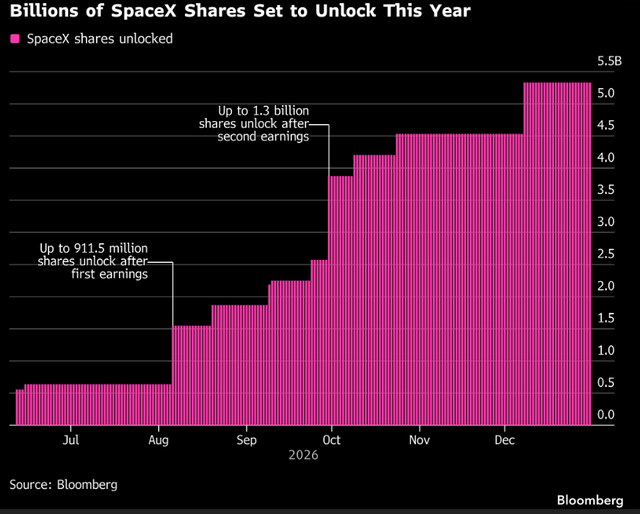
There’s another factor hanging over the stock this week that has nothing to do with the earnings themselves: the IPO lock up period expires soon.
That’s the window during which early investors and employees are contractually barred from selling their shares. Once it lifts, a wave of insider selling can hit the market and push the price down further, regardless of how the business is actually doing.
So investors are dealing with two things at once. Genuine questions about whether the AI spending will pay off, and a purely mechanical supply of shares about to hit the market.