





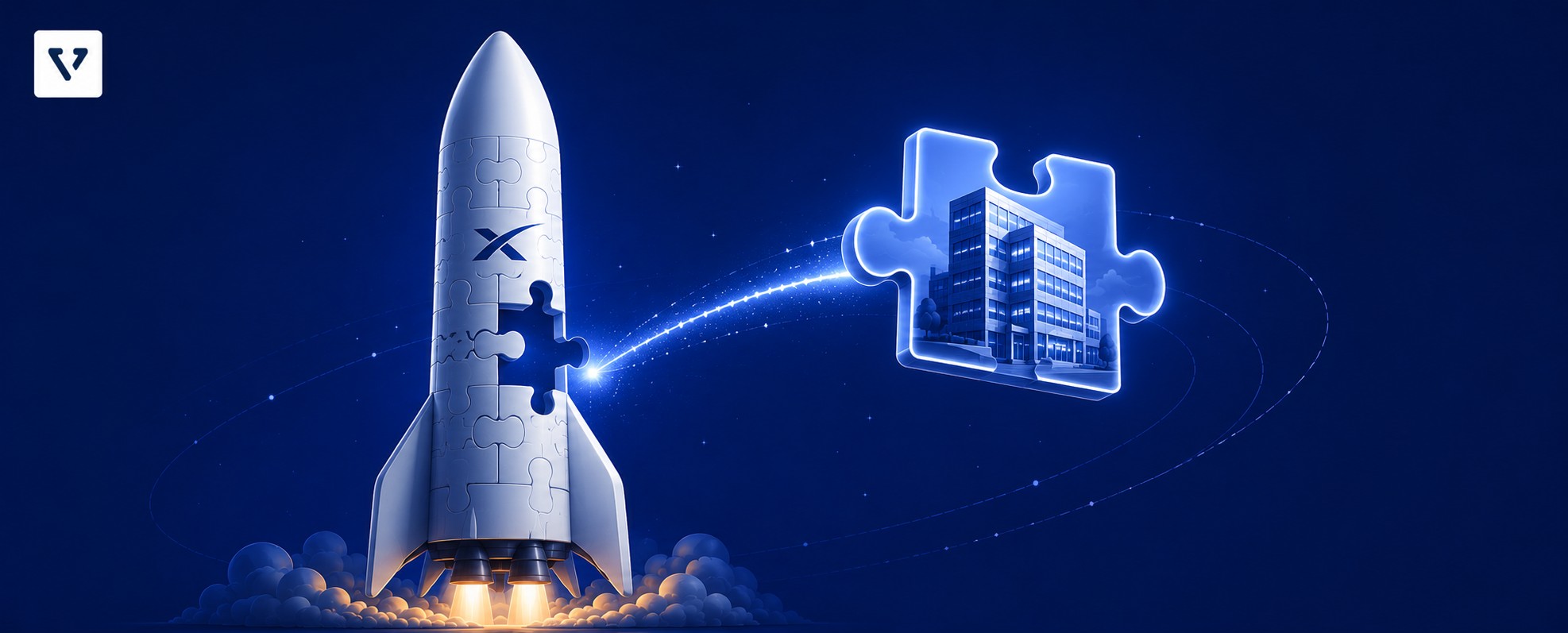
Imagine going public on a Friday and buying a $60 billion company by Tuesday. That is basically what SpaceX just did.
On June 12, SpaceX listed on the Nasdaq in the biggest IPO ever recorded, blowing past Saudi Aramco’s seven year old record. It raised $75 billion and got priced at roughly $1.75 trillion. Four days later, SpaceX agreed to spend $60 billion buying Cursor, the AI coding tool that had spent two years telling much bigger, much richer companies to get lost.
Here is why that is a far more interesting story than “rich company buys another company.”
The money was basically free
SpaceX did not touch a single dollar of its IPO cash for this. The whole $60 billion is paid in SpaceX stock, and the deal had more or less been locked in back in April, when SpaceX bought itself an option: pay $10 billion to stay partners with Cursor, or buy the whole thing for $60 billion once the IPO was done. SpaceX picked door number two almost immediately.
The market loved it. Shares jumped 10% on the news, taking SpaceX’s stock to $211.27, a gain of 56% over its $135 IPO price, and adding roughly $247 billion to its market cap in a single session. That put SpaceX within striking distance of overtaking Amazon to become the fifth largest company in America, less than a week after its stock started trading at all. At a market cap above $2.5 trillion, $60 billion in stock barely shows up as a rounding error. SpaceX even hedged its own bet: if the deal collapses for ordinary reasons, it owes Cursor’s investors a $10 billion breakup fee, but if it falls apart specifically over antitrust concerns, that fee drops to just $4 billion.
Compare all this to OpenAI and Anthropic, both reportedly building toward IPOs of their own this year. Neither could pull off a move like this, not for lack of ambition, but for lack of a stock to spend. SpaceX’s biggest edge here was not rockets or satellites. It was simply getting to the stock exchange first.
What Cursor actually sold
It was not the software. Coding assistants are everywhere now, every big AI lab ships one. It was not really the model either, since SpaceX, through its xAI arm, already owns one of the biggest compute clusters on Earth, the kind of firepower Cursor never had on its own. A shortage of compute is reportedly exactly what had been holding Cursor’s growth back. What Cursor was really selling was its reputation for not picking sides.
For most of its life, Cursor was the coding tool that did not belong to any of the AI labs it ran on top of, and that is exactly why developers trusted it with serious work. OpenAI tried to buy it twice over the past two years and got turned down both times, despite Cursor having gone through OpenAI’s own startup accelerator early on. Microsoft, owner of the more popular GitHub Copilot, looked at buying it too and walked away. Cursor kept raising money on its own terms instead, with backers like Andreessen Horowitz, Thrive, Nvidia and even Google reportedly in talks to fund it at a $50 billion valuation, just weeks before SpaceX made the whole independence debate pointless.
There is one wrinkle though. Cursor and xAI had quietly been co-training a coding model called Grok Build for months before this deal was even announced. Cursor’s reputation for staying neutral had already started slipping well before the paperwork caught up.
The twist
Cursor’s market share in coding tool spending had already fallen from 41% a year ago to about 26% by May, with Anthropic’s own tools eating into the lead. Here is the irony. Anthropic, the company beating Cursor on market share, is currently one of SpaceX’s biggest data center tenants, paying for a share of roughly $26 billion a year in compute capacity leased from the very infrastructure now expected to power Cursor’s future. That lease runs on a 90 day rolling notice, so SpaceX can claim the capacity back for itself the moment it decides Cursor and Grok need it more than Anthropic does.
By the time SpaceX showed up waving a $60 billion stock cheque, Cursor’s independence was not just a principle anymore. It was starting to look like a cost the company could not keep paying alone.
The lesson
SpaceX had pitched its IPO investors on a jaw dropping idea, that its total addressable market could theoretically be worth $28.5 trillion, with a big slice of that coming from enterprise AI. Buying Cursor is a down payment on that pitch. Cursor now sits inside the SpaceX stack as a fully owned subsidiary, keeping its revenue, its brand and its team. Whether it keeps the trust that made it worth $60 billion is a different question altogether.
The bigger takeaway for anyone building a product on someone else’s platform: when your layer of the stack turns into a commodity, value moves to one of two places, the infrastructure you actually own, or the story only you can tell. Cursor’s story was independence. The moment that story stopped matching the numbers, the only thing left to negotiate was the price.
SpaceX won the IPO race, banked the biggest war chest a stock market has ever handed anyone, and spent close to a tenth of it before the confetti even settled. The easy part was writing the cheque. The hard part, the one nobody can answer yet, is whether a coding tool can keep selling independence once it does not have any left to sell.
