





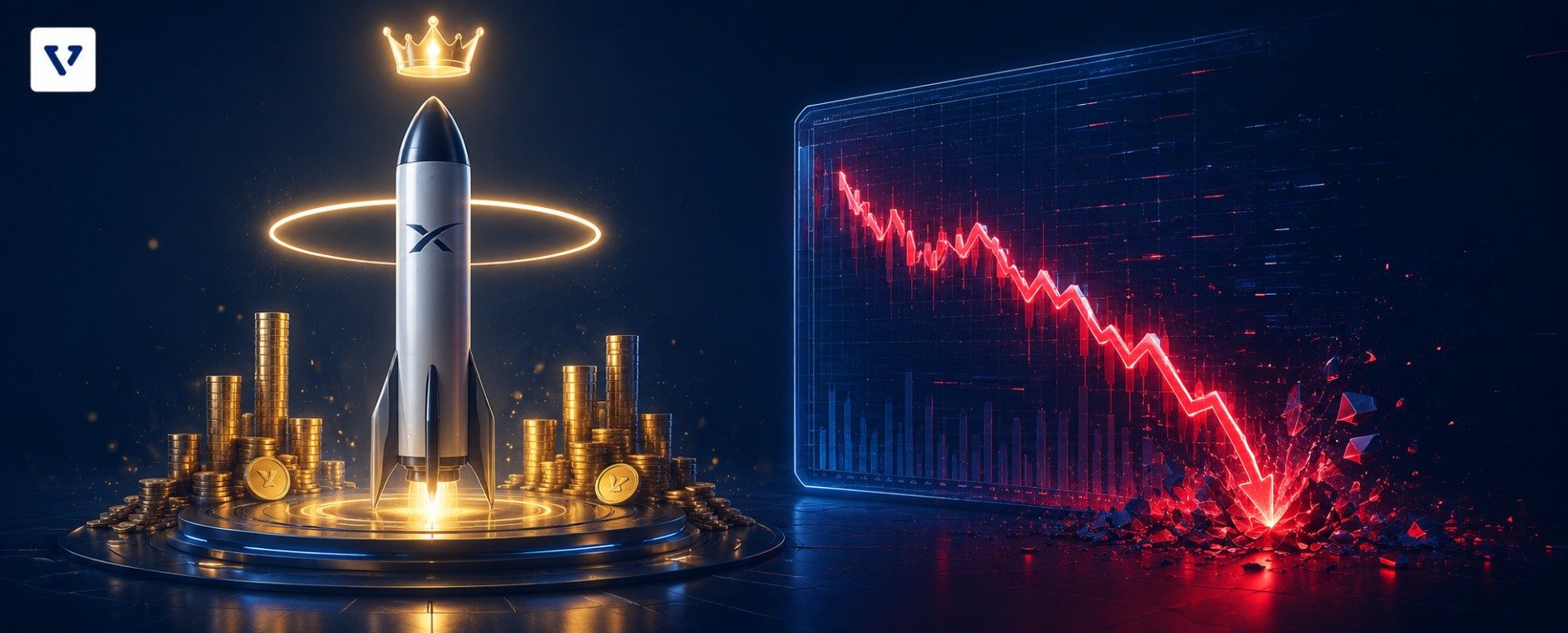
Every mega IPO gets a honeymoon period.
A few weeks where the market falls in love with the story, ignores the fine print, and just buys. SpaceX got one of the best honeymoons in stock market history. It lasted about four days.
Now, ten weeks later, the stock is back where it started, and every piece of news that used to be shrugged off is suddenly landing like a punch.

The four day fairy tale
SpaceX priced its IPO on June 12 at $135 a share, already the largest public offering ever attempted. Then trading opened, and the story got even bigger.
Shares tore past $150 within minutes and kept climbing, eventually touching $225.64 within days. That put SpaceX’s value above $2 trillion and made Elon Musk, on paper, the first trillionaire in history.
For those four days, nothing about SpaceX seemed like a problem. Not the fact that the company lost nearly $5 billion the year before.
Not the fact that it had folded in Musk’s AI venture, xAI, just four months earlier, adding a whole new business the market barely understood.
Not the fact that most of the company was still privately held and would stay that way for months. Investors were buying a story: rockets, satellites, and AI, all run by the same person who has made outrageous timelines come true before.
That is what a honeymoon looks like. Nobody is checking the math yet.
Then the questions started
The math started getting checked almost immediately. By early August, the stock had slid all the way back down through its $135 IPO price, a nearly 40% drop from the peak in under two months. And once a stock starts falling, every subsequent headline gets read in the worst possible light.
The first earnings report as a public company should have been a triumph. Revenue came in at $7.81 billion, up 92% year over year and well ahead of what Wall Street expected. Losses narrowed sharply too.
But the market fixated on one number instead: capital expenditure had exploded past $18 billion for the first half of the year, more than four times the year before, most of it going into AI infrastructure.
A story that used to sound like ambition now sounded like a company burning cash it could not yet justify. The stock dropped roughly 8% on the earnings call.
Then came the lockup calendar, the schedule that determines when early investors and employees are finally allowed to sell their shares.
SpaceX built this as a staggered release rather than a single cliff, drip feeding roughly 88% of its 13 billion shares into the tradable market over the next year and a half. The first big test, on August 6, actually went well.
The stock absorbed nearly a billion newly tradable shares and rose 6%, a genuine show of strength.
But just two weeks later, a much smaller unlock of 319 million shares coincided with the stock falling anyway, this time dragged down by news that a Chinese rocket company, LandSpace, had successfully landed an orbital class booster for the first time, chipping at the one claim that has always justified SpaceX trading at a premium to everyone else in the industry: that nobody else can land rockets and reuse them at scale.

Even Musk’s own updates started sounding less like guarantees and more like slippage. Starship’s tower catch attempt, once targeted for August, is now pushed to a few months out, with the ship’s first reflight expected late this year or early next. Starship is not a side project. It is the hardware underneath SpaceX’s Moon, Mars, and orbital AI datacenter ambitions, the part of the bull case that is hardest to prove and easiest to doubt the moment a date slips.
What actually changed
None of the underlying facts about SpaceX are meaningfully worse than they were on IPO day. Starlink is still profitable.
Revenue is still growing faster than almost any company its size. The AI business is still new and unproven, but it was exactly that unproven on day one too. What changed is not the company. It is the lens the market is using to look at it.
In a honeymoon, uncertainty reads as opportunity. A do-nothing scenario still hits $100 billion in revenue, said Musk on the earnings call, and a few weeks earlier, that line would have sent the stock higher on faith alone. After the slide, the same claim from the same person gets picked apart instead of celebrated. The stock has not just lost value. It has lost the benefit of the doubt.
That shift matters most for what comes next. In November, the largest lockup tranche yet, 1.3 billion shares, unlocks right around Q3 earnings, the next moment investors get a full look at how much SpaceX is still spending to build its AI ambitions. During the honeymoon, that kind of spending got waved through as the cost of a bold vision. Now, every dollar of it will get scrutinized as a reason the stock might be overpriced.
The takeaway
A honeymoon ending is not the same as a marriage failing. SpaceX is still one of the fastest growing, most dominant companies in its industry, and the fundamentals that got investors excited in June have not disappeared. What has disappeared is the willingness to look past the numbers simply because the story is exciting. From here on, SpaceX has to earn its valuation the same way every other public company does: one earnings report, one unlock, one delivered promise at a time.