





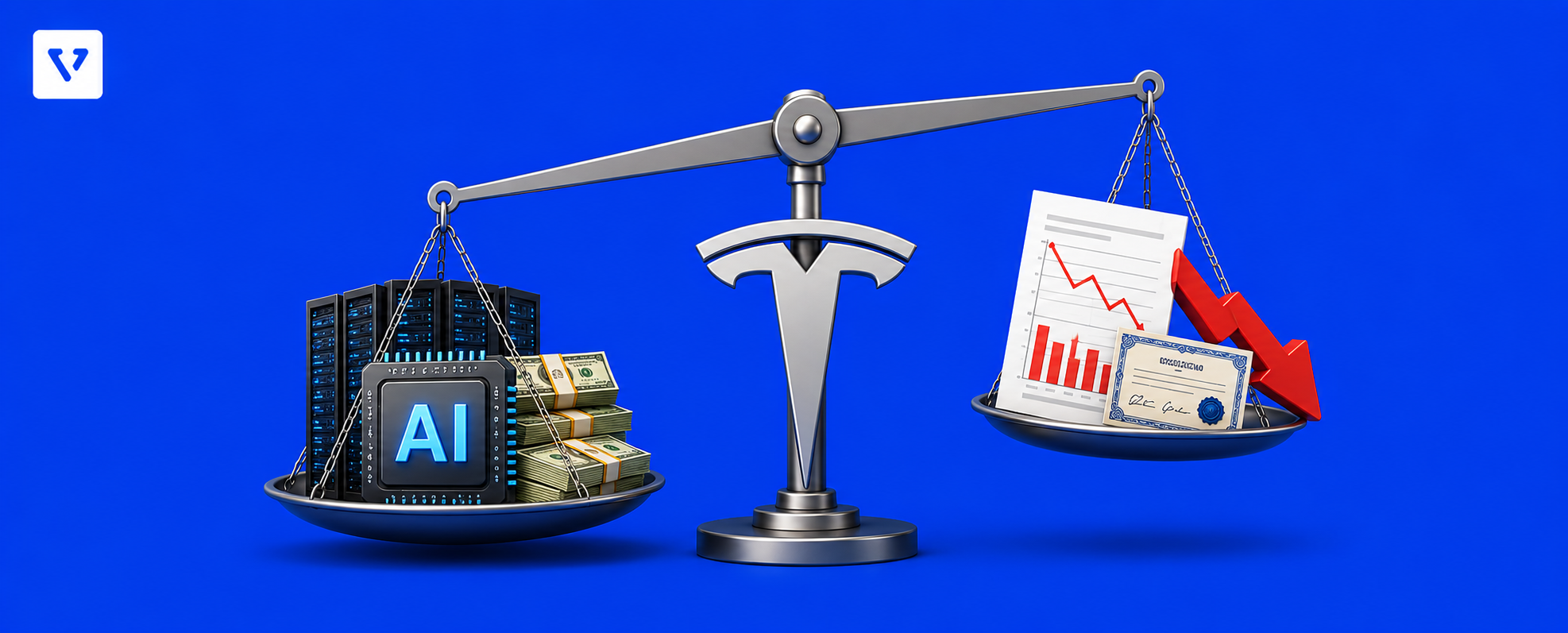
Deliveries hit a record and revenue beat estimates, but profit missed and free cash flow flipped negative for the first time in two years, as Musk’s spending on AI, robots and self-driving accelerates.
Tesla’s Q2 earnings also landed with a mixed reaction from the market. Shares fell about 4% in after hours trading even though the company beat estimates on revenue and posted its best delivery quarter ever, extending a rough stretch that has already seen the stock down 11% for the month and 17% for the year.
The pattern here is a familiar one this earnings season: a business doing better than expected on the surface, paired with a spending number underneath it that worried investors more than the beat reassured them.
For Tesla specifically, the twist is that the core car business actually looked healthy this quarter. It’s the money being poured into everything beyond cars, AI compute, robots and self-driving, that changed the picture.
The number that beat
Tesla delivered 480,126 vehicles in the quarter, a record, up 25% from 384,122 a year earlier and comfortably ahead of Wall Street’s estimate of roughly 397,000. Production came in at 451,758 units, meaning deliveries actually outpaced production, working down the inventory buildup from earlier in the year.
Revenue followed that strength up 26% year on year to $28.24B, well past the $25.71B analysts had modeled. Europe did much of the heavy lifting, helped by high fuel prices pushing buyers toward EVs, alongside aggressive price cuts and a fully ramped Model 3 and Y lineup after the changeover disruption of the prior year.
| Segment | Revenue | YoY growth |
| Automotive | $20.52B | +23% |
| Energy (solar & storage) | $3.14B | +13% |
| Services & other | $4.58B | +50% |
The number that didn’t
The beat didn’t carry through to profitability. Gross margin slipped to 16.8% from 17.2% a year ago, missing the 19.4% analysts expected. Strip out regulatory credits entirely and automotive margin was just 16.3%, well below the 18.7% the Street had modeled.
Two things drove that gap. Average selling prices fell as Tesla leaned harder on discounts to win back buyers, and income from selling regulatory credits to other automakers collapsed to $146M from $439M a year earlier, a direct hit from the rollback of federal EV incentives in the US.
Operating expenses climbed 47% to $4.35B, largely on AI and R&D spend, which pulled operating margin down to just 1.4% from 4.1% a year ago. Adjusted net income fell 17% to $1.2B, short of the $1.9B expected, while GAAP net income, which includes swings in Tesla’s crypto and SpaceX holdings, was down a smaller 5% to $1.11B.
The number that spooked the stock
Capital expenditure jumped 142% year on year to $5.79B, up from $2.39B in the same quarter last year. That single number is what flipped free cash flow negative, to a deficit of $1.09B, compared with a positive $146M a year ago and a positive $1.44B just last quarter. It’s Tesla’s first negative free cash flow quarter in more than two years.
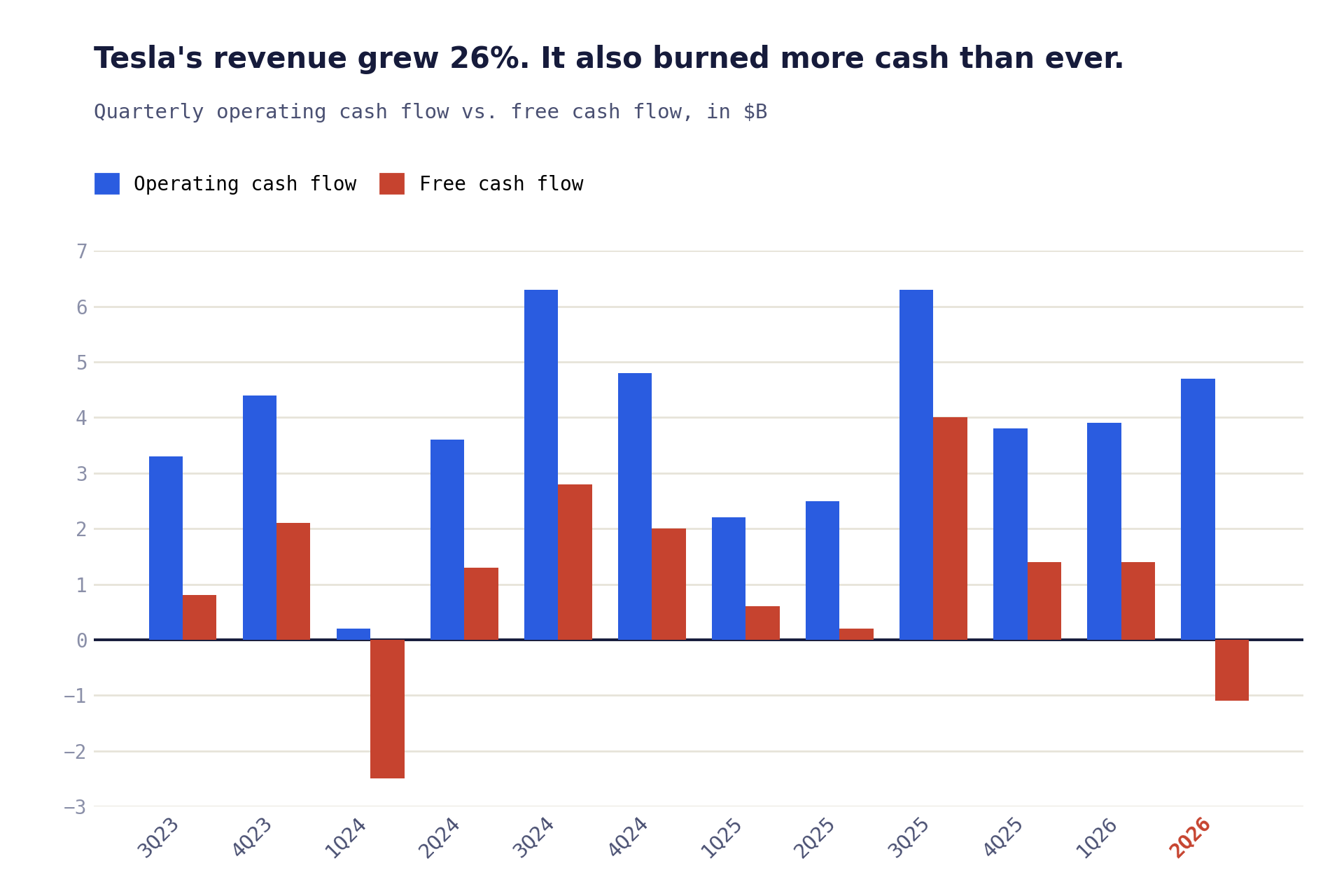
The capex figure for this quarter is only the start. Tesla has guided to more than $25B in capital spending for all of 2026, nearly triple the $8.5B it spent in 2025, and management has said spending will keep growing over the next two to three years. To help fund it, Tesla has secured a debt facility allowing it to borrow up to $30B, on top of drawing down its own cash pile, which stood at $43.5B and fell by just $1.2B this quarter.
Where the spending is actually going
The bulk of it is aimed at things that aren’t the car business at all. Tesla has started production on its first Optimus humanoid robot lines, though the initial units are being used for training data collection rather than sold to anyone. Production of the two-seat driverless Cybercab has also begun, alongside a semiconductor plant being built jointly with SpaceX under the Terafab project, and a supercomputer cluster called Cortex 2 to train self-driving and robotics models.
On the self-driving side, active FSD subscriptions climbed 56% to 1.48 million, and the robotaxi service has expanded to seven US metro areas, though it remains limited to smaller service zones outside city centres in most of them, well behind the more deliberate but broader rollout from Alphabet’s Waymo.
| Metric | Q2 FY26 | Q2 FY25 | Change |
| Revenue | $28.24B | $22.5B | +26% |
| Gross margin | 16.8% | 17.2% | -40 bps |
| Operating margin | 1.4% | 4.1% | -270 bps |
| Adjusted net income | $1.2B | ~$1.45B | -17% |
| Capex | $5.79B | $2.39B | +142% |
| Free cash flow | -$1.09B | $146M | Turned negative |
It’s worth separating the two stories sitting inside this one earnings report. The auto business is genuinely recovering, deliveries are up, inventory is being worked down, and Europe is coming back. But that recovery is being bought partly with discounts, and the credit revenue cushion that used to flatter margins has largely disappeared.
Layered on top of that is a second, much larger bet: AI compute, robots and self-driving infrastructure, spending that’s now big enough on its own to swing free cash flow from comfortably positive to negative in a single quarter.
The takeaway
Tesla’s delivery and revenue numbers say the core car business is stabilizing after a rough stretch. Its margins and cash flow say that stabilization is coming at a cost, and that cost is only going to grow, given management’s own guidance for capex to keep rising over the next two to three years.
The bet being made is that Optimus, Cybercab and robotaxi eventually become large enough businesses to justify all of this spending. Right now, none of them contribute meaningful revenue yet. That’s a very different setup from a cloud business already booking tens of billions in backlog, and it’s a big part of why a record delivery quarter still ended with the stock falling after hours.
