






Somewhere in the last year, the AI buildout stopped being a story about chips and started being a story about debt. Tech companies now need so much capital to fund data centers that they’re issuing bonds at a record pace, and increasingly at long maturities of 20 and 30 years. That detail matters more than it sounds like it should, because those are exactly the maturities governments rely on to fund themselves too.
The result is showing up in bond markets around the world right now. US 30-year Treasury yields just touched their highest level since 2007. French 30-year borrowing costs hit levels last seen in 2008. German long bonds are trading like it’s 2011. UK gilts are edging toward 6%. Japanese long-dated yields are creeping close to their all-time highs.
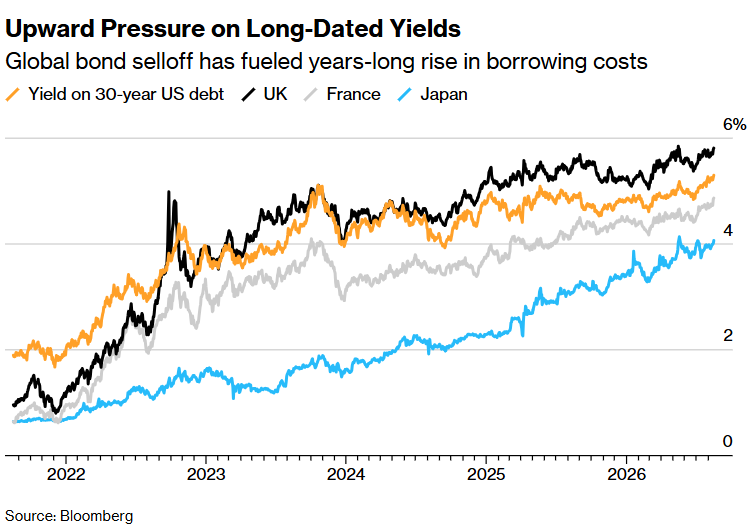
None of these are small, isolated moves in minor markets. They’re happening simultaneously, in the four or five bond markets that anchor the entire global financial system, and AI financing is one of the reasons why.
The crowding-out problem
When the biggest, most creditworthy corporate borrowers in the world all try to lock in long-term financing at the same time governments need to sell their own long-dated debt, someone has to pay a higher price to get deals done. Right now, that’s showing up as higher yields across the board.
Some of this borrowing isn’t even staying within home markets. Alphabet, for instance, recently marketed its first-ever Australian dollar bond issue, tapping an entirely new pool of investors just to keep financing costs manageable. When a company that size starts shopping for capital in currencies it’s never borrowed in before, it’s a fairly clear sign of how much competing supply is hitting the usual channels.
The other forces stacking on top
AI debt isn’t the only thing pushing yields up, but it’s compounding problems that were already building.
The most immediate one is geopolitical. Persistent conflict in the Middle East has kept energy prices elevated, and that’s reviving fears of stickier inflation, which pushes central banks toward tighter policy for longer.
The deeper issue is fiscal. Governments have been running large deficits for years, and investors are increasingly asking who’s actually paying for it. In the US, interest payments on public debt have become one of the biggest drivers of the deficit itself, a self-reinforcing loop where more debt means more interest, which means more debt. The country’s total debt load is now closing in on $40 trillion.
Then there’s a quieter, structural shift in who buys these bonds in the first place. For decades, long-dated government debt was scooped up by relatively price-insensitive buyers, largely pension funds matching long-term liabilities and central banks running policy operations. That base has been shrinking as pension systems move away from defined-benefit structures and regulations push funds toward equities instead. What’s stepped in to replace them is a more price-sensitive, more demanding class of private investors, and Barclays estimates this single shift explains roughly 90 basis points of the extra yield investors now demand on 30-year Treasuries.
Should this worry you
Not every strategist is pushing the panic button. Some see the higher real yields on long-dated bonds, as opposed to rising inflation expectations, as a genuinely attractive entry point for new money, since it suggests investors are being paid more in actual purchasing-power terms, not just compensated for expected inflation.
But the direction of travel matters. Higher long-term government borrowing costs eventually filter into everything else, corporate loans, mortgages, and the discount rates used to value every long-duration asset, including growth stocks. If you’re holding US equities, particularly the high-growth, long-duration names that dominate a lot of index-level returns, this is the kind of macro backdrop worth watching even when it doesn’t show up in daily headlines. Rising 30-year yields don’t crash markets overnight. They quietly raise the bar for what counts as an attractive return, and that bar has been moving up all year.
Views expressed are for informational purposes only and should not be construed as investment advice.
