





Here’s a number that sounds fake but isn’t: 8.66 yuan to 49 yuan. Before lunch. On day one.
That’s what happened to anyone who got shares in CXMT’s IPO last Monday. By the time the Shanghai Stock Exchange rang its closing bell, this once-obscure memory chipmaker had rocketed 466%, briefly overtaken Tencent as China’s most valuable company, and settled in as the biggest onshore-listed firm in the country. All in a single trading session.
So today, let’s break down how a decade-old chip company most of the world had never heard of pulled off one of the biggest debuts in stock market history, and what it actually tells us about where the AI trade is headed next.
Wait… Who Even IS This Company Nobody’s Heard Of?
CXMT, formerly known as ChangXin Memory Technologies, makes DRAM chips. Think of DRAM as your computer’s short-term memory. Every laptop, smartphone, and AI server needs it to function, and right now, the world simply doesn’t have enough of it.
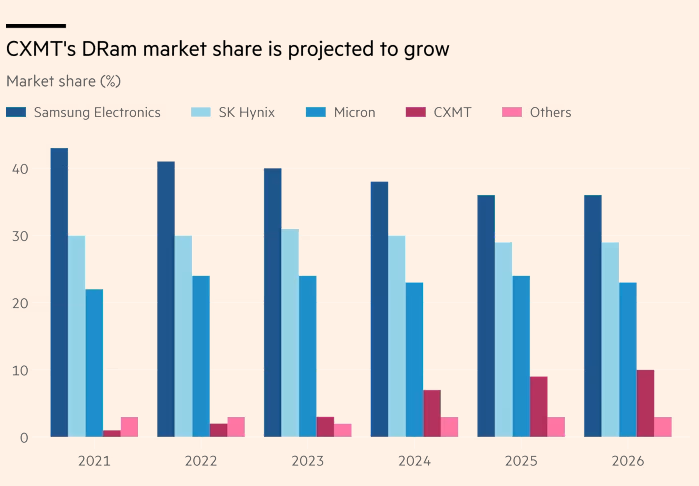
The company is based in Hefei, China, and it’s the world’s fourth-largest DRAM maker. But more importantly, it’s China’s only real player at scale in this space. If Beijing wants to stop depending on foreign chipmakers for something as fundamental as memory, CXMT is pretty much the only horse in that race.
That single fact, being the sole credible domestic option in a strategically vital industry, is doing a lot of the heavy lifting behind this rally.
Okay But WHY Did It Explode 466%?
A few things collided at once.
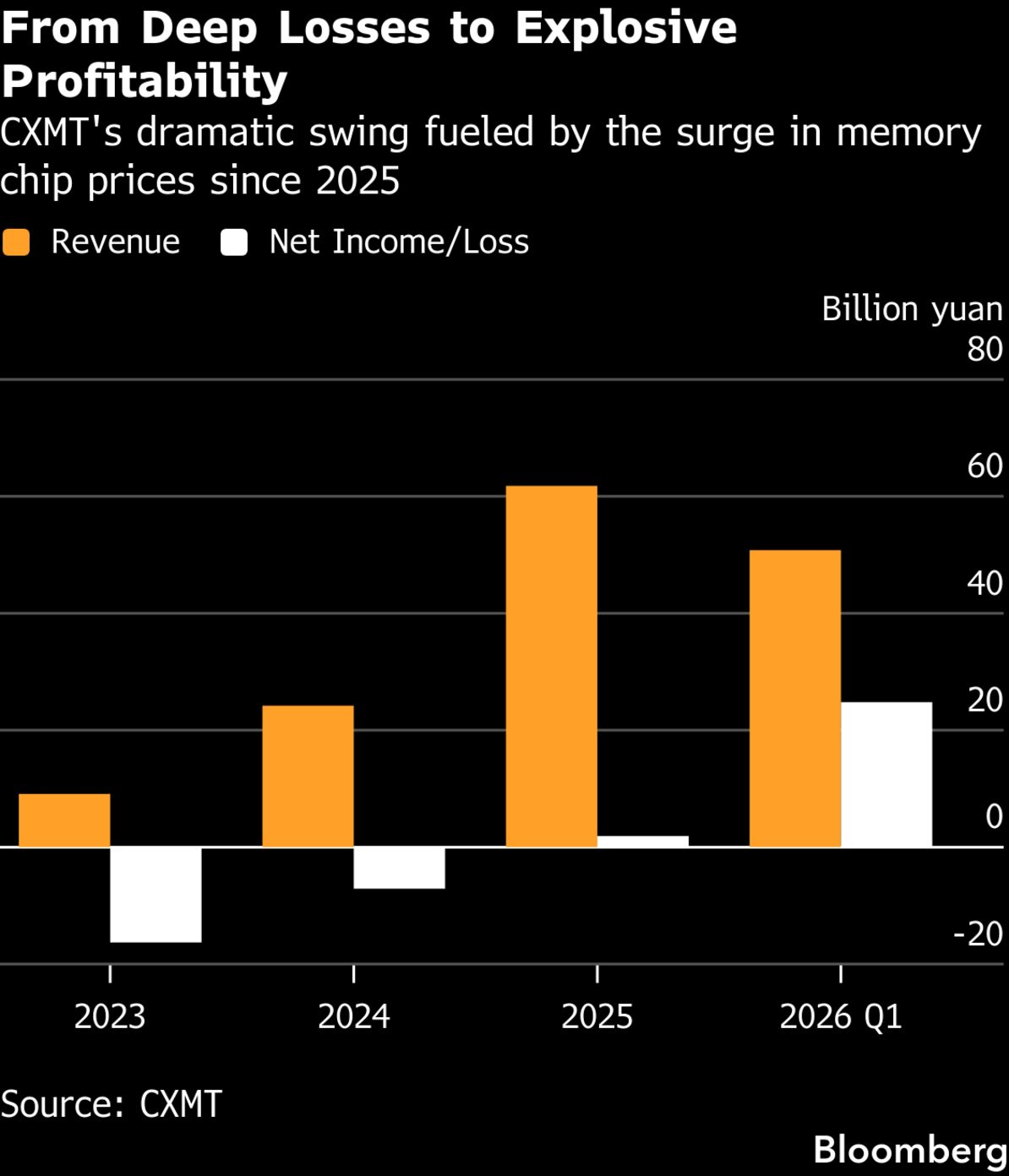
First, the memory shortage is real. DRAM prices have surged roughly 93-98% in a single quarter, driven by AI companies buying up every chip they can get their hands on to build servers. CXMT’s own prospectus admitted as much: its explosive turnaround from losses to massive profitability is almost entirely a story of AI-driven demand outrunning supply. The company expects first-half revenue to jump more than sevenfold, with net profit swinging from a loss last year to as much as 75 billion yuan.
Second, retail investors went absolutely wild for it. The IPO was oversubscribed 212 times over. To put that in perspective, individual investors placed 9.4 million orders worth 7.07 trillion yuan, about ten times the order book SpaceX generated during its own record-setting listing.
When that much demand chases a stock with barely any float (only about 6.73% of CXMT’s shares were actually tradable on day one), price discovery basically breaks. A small number of buyers and sellers can swing the stock wildly, and that’s exactly what happened.
Third, this is a “self-sufficiency” stock, not just a chip stock. With the US tightening export controls on advanced semiconductor technology, China has been pouring political and financial capital into building a domestic chip supply chain it can’t be cut off from.
CXMT sits right at the intersection of two of the biggest narratives in markets right now: AI infrastructure demand and tech self-reliance. Investors were willing to pay a steep premium for exposure to both.
Fourth, timing. CXMT’s listing rode on the coattails of a string of similarly explosive Chinese semiconductor debuts over the past year. Semight Instruments jumped 876% in April, MetaX Integrated Circuits rose 693% in December, and Moore Threads climbed 425%, also in December.
Investors have essentially learned to expect this pattern from AI-chip IPOs and pile in accordingly.
Is This Company Actually Worth Half a TRILLION Dollars, Though?
That’s where opinions get a lot more divided.
On one hand, sell-side analysts are genuinely bullish. Huaxi Securities is projecting CXMT’s revenue could more than double to 572.7 billion yuan by 2028, with net profit climbing to 290 billion yuan, numbers that would justify a 5 trillion yuan valuation.
Nomura initiated coverage with a buy rating, arguing CXMT deserves to trade at roughly double Micron’s valuation multiple, simply because of how much market share it stands to gain domestically.
Even Apple is reportedly in talks to buy chips from CXMT for devices sold in China, a huge vote of confidence from one of the pickiest supply chains on the planet.
On the other hand, plenty of seasoned investors think this is a classic case of a good company priced like a great one.
Morningstar’s analysts pointed out that CXMT was priced at roughly one times its estimated 2027 book value, a steep discount to the 2.1-2.3 times multiple global peers like Micron and SK Hynix trade at, but argued the first-day pop had already erased that discount and then some. Others were blunter.
One hedge fund manager flatly called the stock “too expensive” and said it “smells of speculation.”
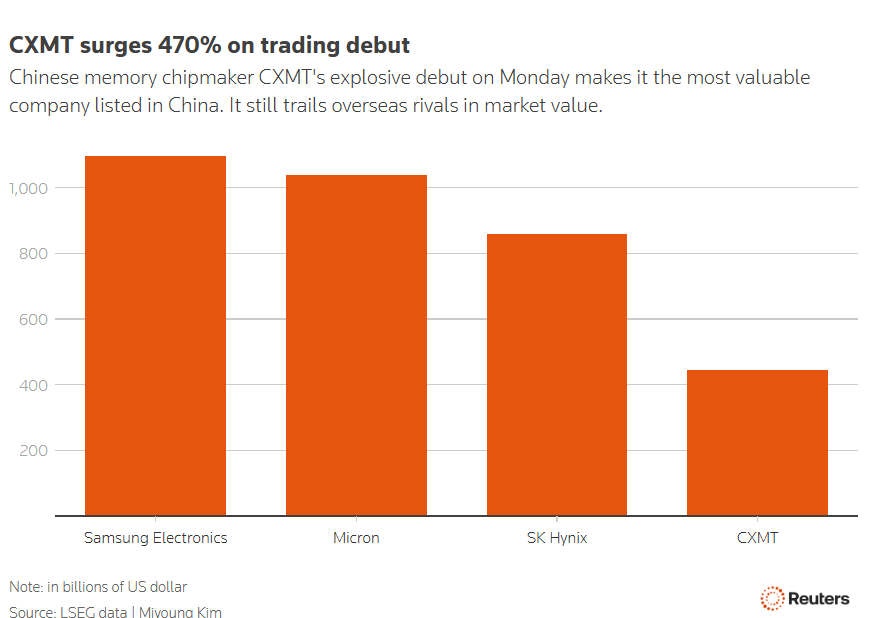
And there’s a structural reality nobody disputes: even after this monster rally, CXMT’s roughly $488 billion valuation is still less than half of Micron’s ($1 trillion) and well below SK Hynix’s ($881 billion), despite CXMT being the smaller, less technologically advanced player of the three.
The bulls read that as room to run. The skeptics read it as a warning that the stock has gotten ahead of the fundamentals it’s supposed to represent.
5 Things This Wild Rally Is Secretly Telling You
- Scarcity value is its own currency. CXMT isn’t necessarily the best memory chipmaker in the world, it’s the only large-scale one China has. In markets, being the sole pure-play way to bet on a massive theme (AI self-sufficiency, in this case) can matter more than the underlying fundamentals, at least in the short run.
- Tiny free floats create fireworks, not accurate prices. With less than 7% of shares actually tradable, a flood of retail demand had almost nowhere to go but up. A 466% surge says more about the supply of shares than it does about a 466% improvement in the company’s actual prospects overnight.
- Retail mania is a recurring feature of China’s AI-chip IPOs, not a one-off. From Moore Threads to MetaX to Semight to now CXMT, the pattern of oversubscription-fuelled triple-digit debuts has become almost routine. That’s useful context: it tells you this is a market structure story as much as a company-specific one.
- Geopolitics has become a genuine pricing factor. Export controls designed to slow China down are, in a roundabout way, supercharging valuations for the domestic champions built to route around them. Investors aren’t just pricing in earnings, they’re pricing in strategic necessity.
- Big first-day pops have a mixed track record. History is littered with blockbuster Chinese IPOs that preceded broader market pullbacks.
That doesn’t mean CXMT is destined to follow the same script, but it’s exactly why analysts like Morningstar are urging caution even while acknowledging the company’s long-term relevance.
So… Bubble or Breakthrough?
CXMT’s debut wasn’t just about one chipmaker having a great day. It was retail investors, a genuine global memory shortage, a scarcity of pure-play options, and Beijing’s tech self-sufficiency ambitions all crashing into a stock with almost no free float, at the exact same time.
Whether that adds up to a company worth nearly half a trillion dollars, or a speculative frenzy waiting to cool off, is going to depend on whether the AI memory boom keeps running as hot as it has been.
For now, though, CXMT has given the world a pretty vivid reminder of just how much money is chasing the AI trade, and how far investors are willing to stretch to get a piece of it.