






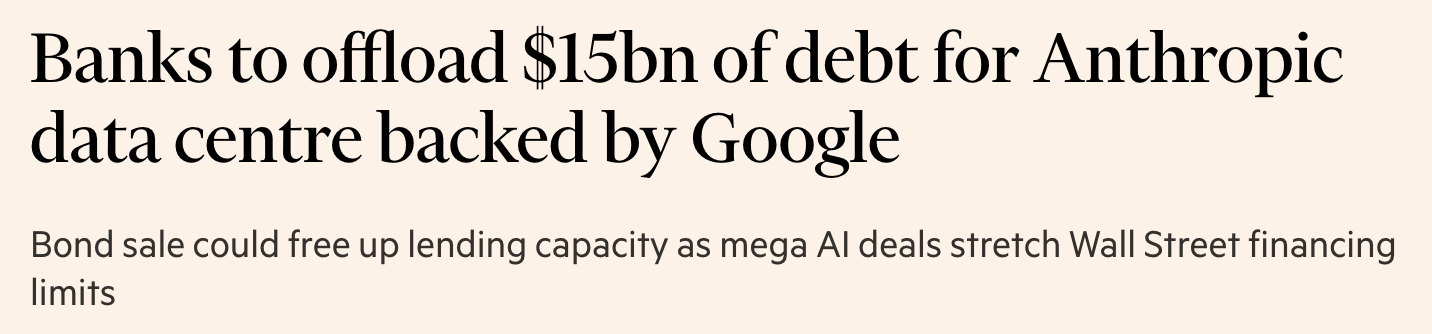
The FT reported something this week that is the most important detail in the whole story; it is easily missed.
Source: Financial Times
Here’s what’s actually happening
Anthropic needs an enormous amount of computing power.
To make that happen, a relatively unknown developer called Nexus Data Centers is building a 2,000-acre AI campus in Hubbard, Texas. It’ll be packed with Google’s custom TPU chips. And because getting access to the power grid can take years, the project is even getting its own natural gas power plant.
Now comes the obvious question: Who’s paying for all this?
A group of banks led by Morgan Stanley has stepped in with around $15 billion in financing. Most of it is a bridge loan, with a smaller revolving credit facility.
But here’s the interesting part.
The loan isn’t going to Anthropic. It’s going to Nexus, the company building the campus. And since Anthropic doesn’t have a public credit rating, Google has agreed to backstop Anthropic’s rent and power payments.
This week’s headline is that these banks now want to offload the loan.
That sounds dramatic. It isn’t.
The plan is to refinance it in the bond market once the money is drawn, passing the debt on to long-term investors instead of keeping it on their own books. In fact, other banks have already done something similar with more than $50 billion of loans tied to Oracle-leased data centers.
A lot of headlines are framing this as banks getting nervous about AI.
That probably isn’t what’s happening.
The bonds are expected to receive a junk rating. Surprisingly, that’s despite Google’s backing.
Why?
Because Google’s guarantee only starts once the data center is built and operational.
Until then, investors are exposed to the biggest risks: construction delays, cost overruns, or the project simply taking longer than expected.
And that tells you almost everything you need to know.
Banks selling the loan isn’t the story
A bridge loan is exactly what the name suggests. It’s temporary.
Banks provide the money upfront, collect their fees, and then sell the loan to investors who are happy to own it for years. That was always the plan.
There’s another reason too.
Banks have to keep aside capital for every loan they hold. The riskier the loan, the more capital they have to lock up.
Now think about this loan.
It’s funding a massive construction project. The building doesn’t exist yet. The borrower is a developer. The tenant doesn’t have a credit rating.
That’s about as capital-intensive as it gets.
Keeping that loan on the balance sheet ties up capital the bank could use for its next deal.
So the choice was never “hold it or sell it.”
It was “sell it or don’t do the deal in the first place.”
That’s why the fact that banks want to sell the loan isn’t particularly interesting.
The real question is much simpler.
How quickly do investors buy it? And what yield do they demand?
That’s where the market tells you what it really thinks.
There’s a useful comparison here.
Source: Financial Times
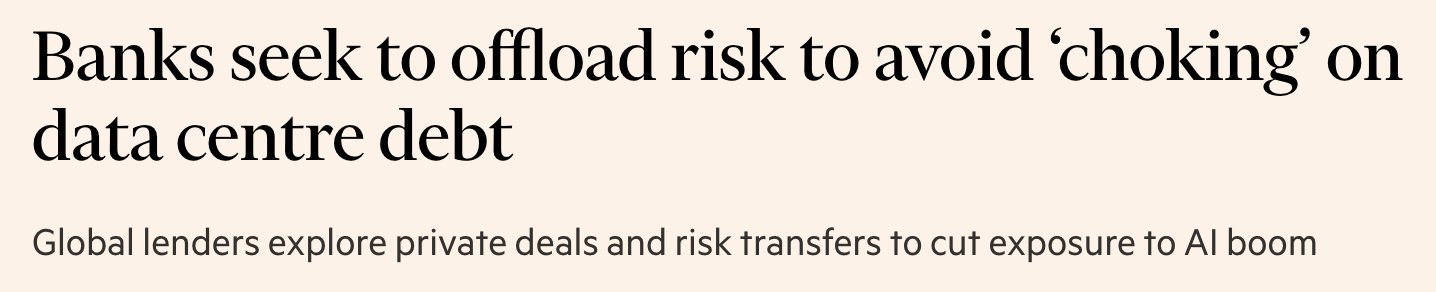
Banks spent months trying to offload more than $50 billion of construction loans tied to Oracle-leased data centers.
Some of that debt was eventually sold. Some had to be moved through risk-transfer deals because there weren’t enough buyers.
What’s interesting is that these bonds were already rated investment grade. That’s unusual for a building that hasn’t even been completed.
The rating certainly helped.
It just didn’t make investors rush to buy.
So what are investors actually buying?
Forget Google’s guarantee for a moment.
For the first couple of years, it doesn’t even apply.
What investors are really financing is a construction project.
Actually, two construction projects.
Alongside the data center sits a 1.6-gigawatt natural gas power plant, built so the campus doesn’t have to wait years for grid access.
That solves one problem.
It creates another.
Lenders are no longer financing just a data center. They’re financing a data center and a power plant, both of which have to be completed on time.
The Financial Times notes that Meta’s Project Walleye, which also included on-site power generation, had to offer investors a higher yield for exactly this reason.
There’s little reason to think the Hubbard project will be treated differently.
The way the financing is structured adds another layer of risk.
Nexus doesn’t borrow the entire amount upfront. The money is drawn in stages as construction progresses.
That means the bonds won’t hit the market all at once.
The first bonds will be backed by the least-complete buildings, where investors face the longest wait before Google’s guarantee kicks in.
The last bonds will be backed by projects that are almost finished.
That makes each issuance slightly different.
In many ways, the changing spread across those bond sales will be one of the clearest indicators of how investors actually price AI infrastructure risk.
Everyone is trying to pass the unrated risk to someone else
Step back and look at the bigger picture.
There’s a common theme running through every part of this deal.
Nobody wants to be left holding the credit risk of an unrated company.
Google guarantees Anthropic’s rent and power payments across four leases. In return, it receives roughly a 20% stake in the project.
The chips are financed separately.
According to the Financial Times, a special-purpose vehicle purchased around one gigawatt of Google’s TPUs—roughly a million chips—for about $35 billion.
That vehicle was financed through a layered debt structure led by Apollo and Blackstone.
Broadcom then guarantees around $31 billion of the safest debt tranches. If Anthropic defaults and the chips are sold for less than the outstanding loans, Broadcom covers the difference.
Apollo, meanwhile, contributes about $800 million of equity.
Put everything together and the numbers become enormous.
Roughly $200 billion worth of contracts ultimately depend on Anthropic continuing to grow and pay its bills.
About $150 billion of that is tied to chips.
Google is also backing another 2.4 gigawatts of AI capacity being built by former Bitcoin miners like TeraWulf, Cipher and Hut 8.
The pattern is hard to miss.
The risk hasn’t disappeared.
It’s simply been shifted onto investment-grade balance sheets, sliced into different pieces and distributed across the market.
And as the Hubbard financing shows, that transfer isn’t seamless.
Google sits on both sides of the trade
Google sells the chips.
Google guarantees the rent.
Google owns roughly 14% of Anthropic and agreed earlier this year to invest up to another $40 billion.
Google receives about a fifth of the project.
Google is also supporting several of the power projects supplying AI infrastructure.
Individually, none of these decisions looks unusual.
Together, they create an interesting dynamic.
If Anthropic continues growing, Google benefits almost everywhere.
But if Anthropic stumbles, Google’s exposure doesn’t show up in just one place.
The same event that reduces Google’s revenue from Anthropic could also trigger the guarantees backing Anthropic’s infrastructure.
Those exposures sit in different parts of Google’s business, even though they’re ultimately tied to the same underlying risk.
The question isn’t whether Google can pay
Google’s ability to honour its guarantees isn’t really in doubt.
The more important question is whether those guarantees ever need to be used.
That depends almost entirely on Anthropic’s growth.
Reported annualised revenue reportedly climbed from about $9 billion at the end of 2025 to $14 billion in February, $19 billion in March, $30 billion in April and roughly $47 billion by late May.
Those are run-rate numbers.
They’re calculated by taking one month’s revenue and multiplying it by twelve.
That works well when a company is accelerating.
It becomes much less informative if growth begins to slow, because the headline figure can remain impressive long after momentum has faded.
If Anthropic keeps growing, this entire financing structure probably works exactly as planned.
The guarantees never get triggered.
The bonds pay investors on time.
Everyone earns their fees.
But one thing stands out.
Nearly every participant in this ecosystem gets paid to arrange the financing—not to hold the long-term risk.
Morgan Stanley originates and distributes.
Apollo and Blackstone syndicate.
Broadcom provides guarantees.
Google books chip sales, owns equity and provides credit support.
The construction risk ultimately lands with long-term investors.
That doesn’t make the structure fraudulent.
And it isn’t a repeat of 2007.
The guarantees are explicit, and the companies standing behind them generate real cash flows.
But when these Hubbard bonds eventually price, the market won’t be delivering a verdict on AI.
It will simply be putting a price on roughly two years of construction risk in a Texas field before Google’s guarantee finally takes over.