


Picture this.
You own the busiest toll plaza on the busiest highway in the country.
Every car that passes through the flyover pays you a little fee. It’s been that way for 20 years, and it has made you very, very rich.
Then one day, you build a shiny new flyover right next to it.
Drivers love it because it’s faster and smoother. However, there’s just one small problem.
The flyover skips your toll booth.
That, more or less, is what’s happening at Google right now.
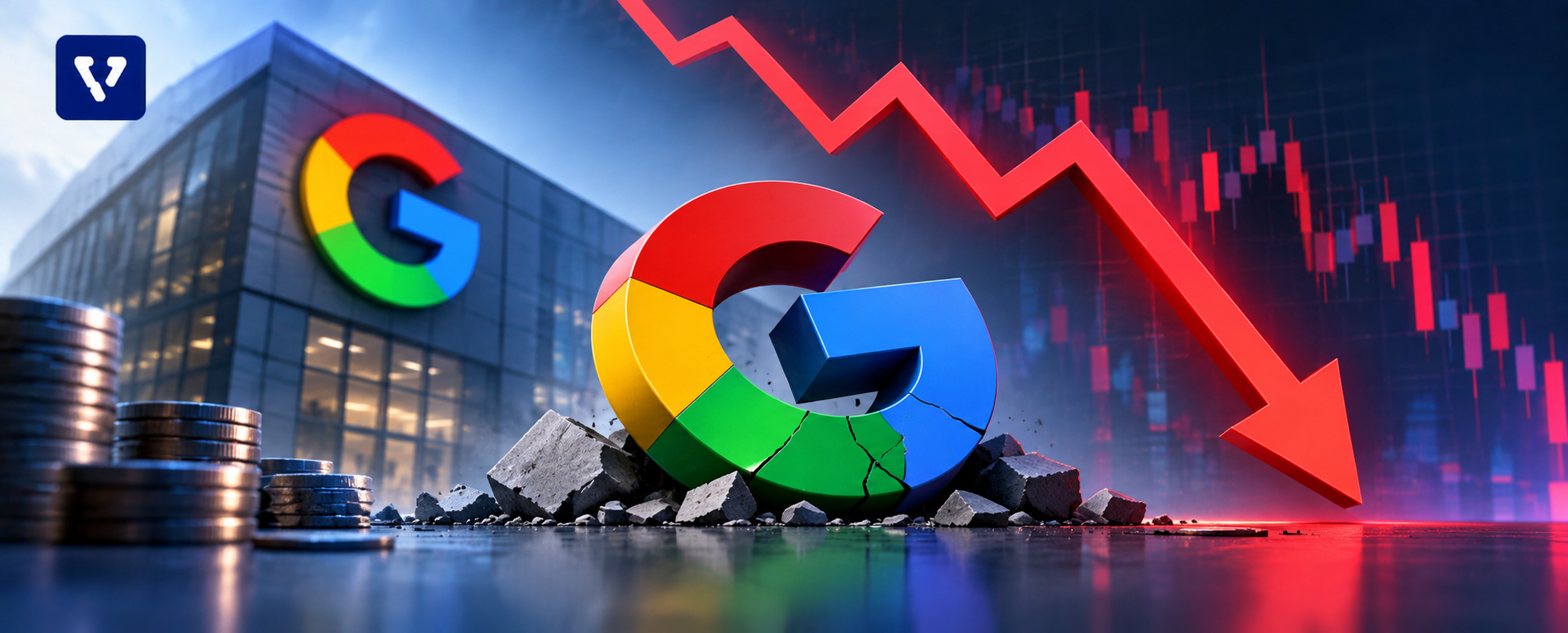
On Thursday, Alphabet’s stock fell 13%. In one day.
That wiped out roughly $500 billion in market value. Only one company in history has lost more in a single session, and that was Nvidia back in January 2025.
So what spooked the market?
Well, Alphabet put out its results for the July to September quarter, and investors spotted two problems. Its money machine is slowing down. And it’s spending money faster than it’s making it.
Let’s start with the money machine.
You see, Google makes most of its money from search ads.
You type “best phone under 30k”, Google shows you a bunch of links, and somewhere around them are ads from brands who’ve paid to be there. Every click puts money in Google’s pocket.
But over the last couple of years, people started asking AI chatbots instead. So Google had to respond. It built AI Mode, which skips the list of links and just writes you an answer.
Great for you. Not so great for the toll booth.
This quarter, search revenue grew 12% to $63.4 billion. Analysts were expecting $64.9 billion. And just earlier this year, this same business was growing at nearly 20%. Google’s chief business officer, Philipp Schindler, even admitted on the earnings call that AI Mode is eating into regular search and earns less from ads per query.
Now, Google did offer a few other excuses. Currency swings. Asia-Pacific advertisers hurt after the EU scrapped its de minimis import exemption. And ad budgets cooling off after the FIFA World Cup. Fair enough. But those are temporary. AI Mode isn’t going anywhere.
Here’s the weird part though. People aren’t using Google less. According to Pivotal Research, search queries are at a five-year high and Google’s AI has about a billion users. So the cars are still coming. They’re just not paying the toll.
Google is trying to fix that. It’s taking ads in AI Mode to international markets for the first time and testing ads in the US that pop up during a back-and-forth conversation. It says people click on these sponsored AI results about as often as normal ones. If that holds, phew. If it doesn’t, Google’s most profitable business has a long-term headache.
Oh, and YouTube? Steady. Ads up 9%, subscriptions up 11%. Nothing to write home about.
Now for problem number two. The spending.
To stay in the AI race, Google needs chips. Mountains of them. Plus data centres to house them and electricity to run them. This quarter alone, Alphabet spent $51.4 billion on this stuff. That’s more than double what it spent a year ago. And it expects to spend up to $205 billion this year, which means the next three months could cost around $73 billion.
And that’s just the near-term bill. Google has also signed up for more than $1 trillion in future commitments for data centres, equipment and energy.
So when you take all the cash Google made from its business and subtract all this spending, what are you left with? Minus $9.1 billion. Analysts had expected a smaller hole of $3.5 billion. It’s only the second time since Google went public in 2004 that this number has turned negative.
To be fair, a couple of things made it look worse than it is. Google paid $5.2 billion to settle an old 2018 EU fine over Android. And it built up inventory for TPU systems (its own AI chips) that it has sold but not yet delivered. As CFO Anat Ashkenazi put it on the call, the cash goes out first and the revenue comes later.
But here’s what really caught investors’ attention. Alphabet didn’t buy back a single share this quarter. Instead, it borrowed $28.7 billion and sold $12.4 billion worth of new shares. That’s part of a roughly $85 billion share sale it announced in June, its first in over 20 years.
For a company that used to have so much spare cash it didn’t know what to do with it, that’s quite a U-turn.
Now, Alphabet isn’t broke. Not even close. It has $265.1 billion in cash and securities against $125.1 billion in long-term debt. But the Fed raised interest rates last month and may not be done, so borrowing to build data centres is only getting pricier.
And then there was the earnings miss. Wall Street expected earnings of $3.02 per share. Alphabet delivered $2.12.
Ouch, right? But here’s a twist. A big chunk of that miss came from SpaceX. Alphabet owns a stake in Elon Musk’s rocket company, and when SpaceX shares fell during the quarter, Alphabet had to book an $8.2 billion loss on paper. It didn’t actually lose that cash. And last year, the same stake gave it a gain.
If you look at operating income, which ignores all that, it actually grew 30% to $40.6 billion. Margins even got better, rising to 31.8%. The catch? Analysts had pencilled in $43.2 billion. So it was still a miss, just a smaller one.
But it wasn’t all gloom. Google Cloud had a blockbuster quarter. Revenue doubled to $30.7 billion, and profits more than tripled to $11.1 billion.
Some of that came from a new business. Google has started selling entire TPU systems to customers who run them in their own data centres. It also rents out computing power to other AI companies, including Anthropic, one of its own rivals. Funny how that works.
The really eye-popping number, though, is the backlog. Google Cloud has $561 billion worth of contracts already signed but not yet delivered. It expects to turn about 55% of that into revenue within two years. That’s roughly $300 billion in the bag.
And demand is crazy. Google’s AI models are now processing almost 32 billion tokens (think of them as chunks of words) every minute. That’s four times what it handled last year. It’s so stretched that it has started renting computing power from other companies just to keep up.
CEO Sundar Pichai also showed off two new Gemini models, Argon and Carbon, which he says have caught up with rivals in coding, finance and cybersecurity.
So why didn’t Cloud save the day?
Because it’s still less than half the size of search. Even if it keeps doubling, it can’t fully make up for search slowing down. At least, not yet.
And if you want to see what investors actually want, just look at Microsoft. It reported results on the same day and also spent big on AI, $45.2 billion. But after all that spending, it still had $18.6 billion in free cash left over. Its stock barely budged, down just 0.2%.
The message is pretty clear. Spend as much as you want on AI. Just don’t run out of cash doing it. Meta found that out the hard way earlier this month. Apple, which has been far more cautious with AI spending, has been rewarded for it.
So is the market overreacting?
Some analysts think so. Strip out SpaceX and the business looks pretty solid. The EU fine won’t repeat. The TPU inventory should turn into revenue once it ships. And after the fall, the stock trades at about 15.6 times its expected earnings, cheaper than its five-year average of around 22.8. Wall Street’s average price target of about $404 is more than 40% above where it trades today.
But there are risks too. Google could raise its spending plans again for 2027. TPU deliveries could get delayed. Ads in AI Mode might never earn as much as old-school search ads. The SpaceX stake will keep swinging the numbers every quarter. And if other big tech companies start posting the same mix of huge spending and weak cash flow, this could become an industry-wide headache.
So yeah, Google isn’t in trouble the way a $500 billion headline makes it sound. It’s still growing at 25% a year and sitting on more than half a trillion dollars in cloud contracts.
But for the first time in a long time, it’s having to choose between growing fast and holding on to its cash. And whether the stock bounces back will depend on one simple question. Can Google make an AI answer as profitable as ten blue links?
We’ll be watching.
Until then…
If you know someone who owns Google stock and spent Thursday staring at their portfolio in disbelief, share this story with them.
Disclaimer: This article is for information and education only and is not investment advice or a recommendation to buy or sell any security. Investing in US stocks involves risks, including currency risk. Please do your own research or consult a qualified advisor before investing.