



Netflix had a busy week. It laid off about 1,000 people, swapped out its chief content officer, and then reported earnings on Tuesday.
The stock closed at $68.69 and slipped another 5 to 6% after hours to around $65. It is now down roughly 25% this year and about 48% from its June 2025 high.
The quarter itself was fine on paper. The trouble sits in what the company said about the next one.
The numbers
| Reported / Guided | Street estimate | |
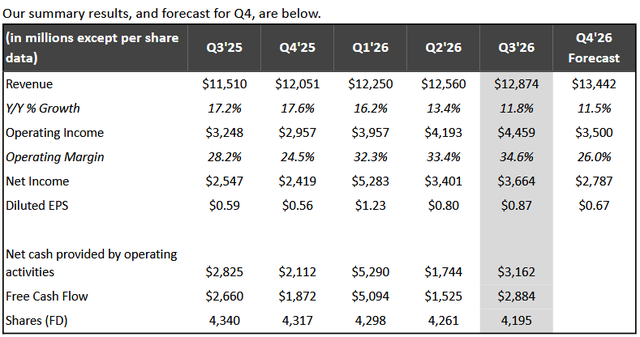
| Q3 revenue | $12.87 billion | In line |
| Q3 EPS | $0.87 | $0.82 |
| Q4 revenue guidance | $13.44 billion | $13.51 billion |
| Q4 net income guidance | $2.79 billion | $3.07 billion |
| Q4 EPS guidance | $0.67 | $0.73 |
Third-quarter revenue grew 11.8% year on year. That matched expectations but was the slowest pace in nearly three years. The EPS beat was clean.
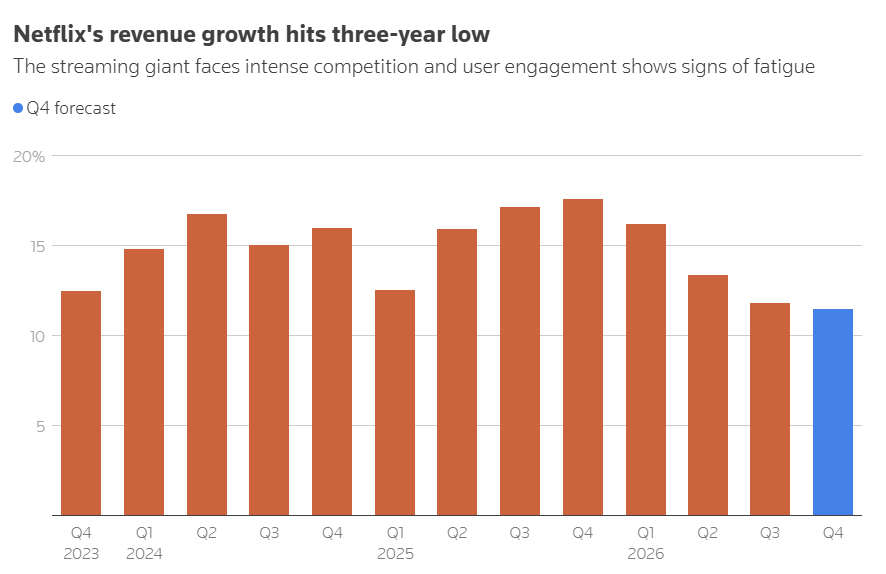
The Q4 guide is where it gets interesting.
Revenue is only about 0.5% below consensus, which is a rounding error.
Net income is roughly 9% below and EPS roughly 8% below.
So the market is not mainly worried about a revenue shortfall.
It is worried that Netflix expects to spend more or earn less per dollar of revenue than anyone had modelled. Content spend and restructuring costs are the obvious places to look when the full letter and call details are parsed.
The ad number that moved
Netflix cut its 2026 advertising revenue forecast from about $3 billion to about $2.7 billion. The company said some ad product capabilities rolled out slower than planned.
A 10% cut sounds small until you see how much of the story rides on it.
Against a full-year revenue outlook of roughly $51.1 billion (about 13% growth, with an operating margin near 31.5%), ads are about 5% of the pie.
They are also the line that investors have leaned on to explain how Netflix keeps growing after the password-sharing crackdown has run its course. A delay here matters more for the narrative than for this year’s income statement.
Growth from price, not people
Netflix stopped reporting subscriber numbers last year, so investors piece together the user picture from outside data. Antenna, which tracks US subscription purchases through sources like credit card transactions, shows no net additions in any month of 2026 through September. It excludes subscriptions that come through wholesale bundles, and Netflix has said the data does not reflect its business performance.
What Netflix does disclose points the same way. Price hikes have done a lot of the work this year, including a 33.4% increase on the cheapest UK plan to £7.99 and roughly 20% in Brazil.
Management says churn improved even after these increases, which suggests people are staying. But price-led growth has a ceiling.
Over a long horizon, annual increases tend to settle near inflation, so sustained double-digit revenue growth needs more members and new revenue lines like ads, live events and games.
Management’s own words on the US were that engagement is solid but execution needs to be better. It also said no fundamental change in strategy is needed. That is a measured way of saying the content slate in its biggest market has not been landing the way it used to.
The shake-up
The sequence of last week’s announcements reads like a reset:
- About 1,000 jobs were cut, which is 6% of the workforce and the largest reduction since 2022.
- Bela Bajaria, chief content officer since 2023 and at Netflix for nearly a decade, was replaced by Peter Rice, formerly of Disney and Fox.
- Film chief Dan Lin is leaving. Rice will oversee films until a successor is found.
Netflix has framed Rice’s hiring as a talent play. The company argues that creators have options, and that someone with deep relationships across studios can keep Netflix on the shortlist.
The competition is not just other streamers
Netflix is now competing for the same hours as YouTube, TikTok and Instagram Reels. A lot of recent video growth has come from short-form content built for phones, and Netflix has responded with games, podcasts and live events. It has also said it will license more third-party content, a notable shift for a company that built its brand on originals.
On the M&A side, Netflix lost the bidding for Warner Bros. Discovery to Paramount, whose revised deal of about $111 billion including debt won shareholder approval in April. Some observers think Netflix may look at other assets, with NBCUniversal mentioned as a possibility once Comcast spins it off. That remains speculation.
The India and international angle
The letter had some good news outside the US. Netflix said India view hours grew 24% year on year, helped by the daily show Lock Upp. Local-language hits also did well elsewhere, with a Mexican series at 23 million views, a Brazilian film at 18 million and a Korean series at 22 million. This is the model Netflix has run for years: make local content cheaply, let it travel, and keep spending efficient. For an Indian investor holding NFLX through a platform like Vested, it is a reminder that the growth runway sits mostly outside the US.
For 2027, Netflix says it is aiming for sustained double-digit revenue growth, wider margins and higher free cash flow. That is a target, and this quarter’s guide shows how much room there is between a target and a delivery.
What to watch next
- Whether the ad product rollout catches up, since the $2.7 billion figure is now the bar.
- Whether Q4 profit lands closer to the guide or the old consensus once restructuring costs are visible.
- The first slate that carries Peter Rice’s fingerprints, and whether US viewing picks up.
- Whether Netflix makes another large acquisition move, given it already missed out on Warner Bros. Discovery.
The stock has already given back close to half its peak value, so much of the pessimism is in the price. What the market wants now is evidence that growth can come from members and new revenue lines as well as price increases.