





On Thursday, 16 July, TSMC reported the best quarter in its history.
Revenue of $40.2 billion, up 33.7% from a year earlier. Net profit up 77.4%, the highest quarterly profit in the company’s history and, reportedly, its tenth straight quarter of earnings growth. A gross margin of 67.7%, above the top of the company’s own guidance.
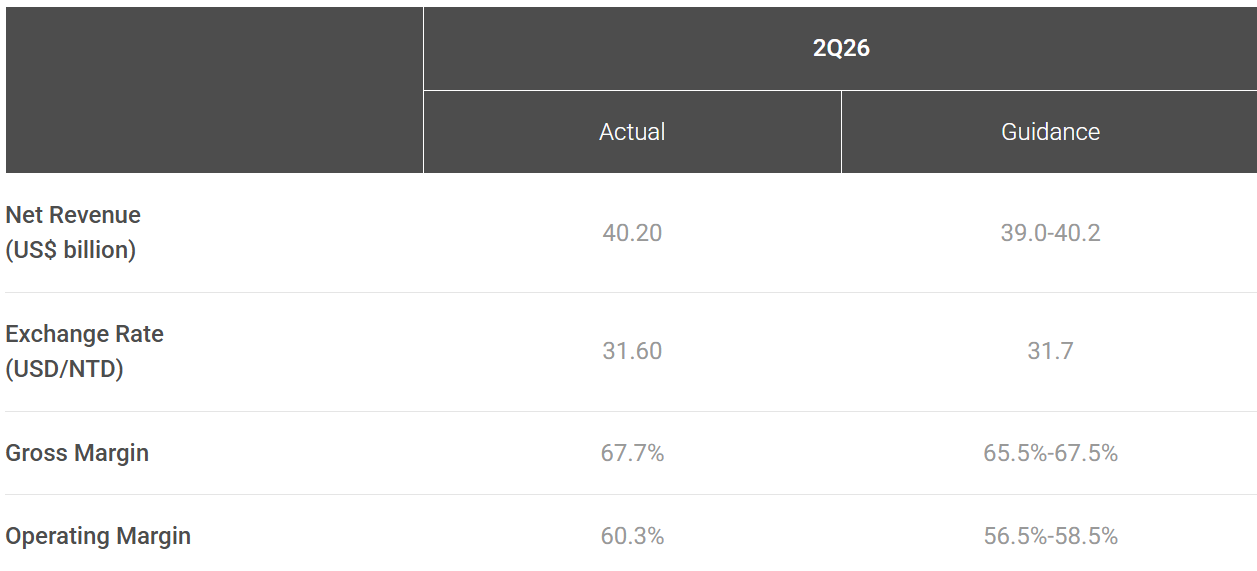
Source: TSMC Q2 2026 Results
Then TSMC raised its full-year growth forecast from above 30% to slightly above 40%, lifted its spending budget to as much as $64 billion, and announced $100 billion of fresh investment in Arizona.
Now, pause here for a bit.
What would you reasonably expect to happen to TSMC’s shares? Have a blockbuster jump, right?
The stock fell.
It kept falling on Friday, when the US-listed shares closed at a two-month low, and the Taipei-listed shares reportedly dropped about 7%.
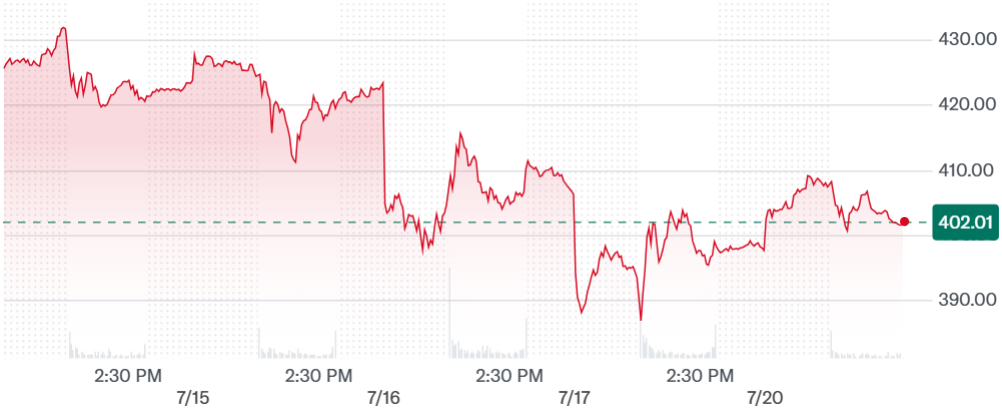
Source: Yahoo Finance (TSMC US-listed shares: ADS)
The selloff was a verdict on the price, not the business.
When a stock is priced for perfection, perfection stops being impressive. It becomes the minimum passing grade.
Start with what actually happened, because the details are stranger than the headline.
What drove the blockbuster results
High-performance computing, the segment that includes AI chips, grew 20% in a single quarter and now makes up 66% of TSMC’s revenue.On one analyst calculation, HPC supplied more than all of the quarter’s sequential revenue growth, offsetting declines in smartphones and IoT.
Two years of AI buildout have turned a diversified foundry into a business where two of every three dollars come from computing. Smartphones, once the engine, are down to 22%.
The company’s newest technology, the 2-nanometre node, produced revenue for the first time, 3% of wafer sales. Its CFO, Wendell Huang, told CNBC it becomes the main growth driver from the third quarter.
One honest footnote. Of the NT$27.25 (NT$: New Taiwan Dollar) in quarterly earnings per share, NT$2.24 came from one-off gains on the sale of Vanguard shares, which the company disclosed after the call. Even stripping that out, the operating business beat every target TSMC set for itself.
And demand is so far ahead of supply.
C.C. Wei, the chairman and chief executive, told analysts the gap is very big, and said the company now physically inspects its customers’ AI data centre construction, the buildings, the locations, the racks, to make sure TSMC chips are not piling up in anyone’s inventory.
A supplier auditing its buyers’ garages is not a company worried about demand.
So why did the TSMC stock fall?
99/100 isn’t enough
A 99 is an excellent mark by any measure. But think of the school topper whose parents expect a perfect score. In that house, 99 is a disappointment, because the expectation was already cent percent.
TSMC’s shares reportedly came into the week up more than 50% for the year and roughly 97% over twelve months, trading near 20 times forward earnings against a five-year average of 18, per Bloomberg.
Past performance is not indicative of future returns, but that run-up matters here for one reason: the market had pre-paid for a flawless report.
Then, the flawless report duly arrived, and there was nothing left to buy.
Reportedly, there was no real negative news to blame, only a bar for chip stocks that months of outperformance had raised beyond reach.
The evidence for that reading came a day earlier.
On 15 July, ASML, the Dutch company with a monopoly on the machines that make advanced chips, beat estimates, raised its full-year outlook, and announced a 30% capacity expansion. Its stock fell too.
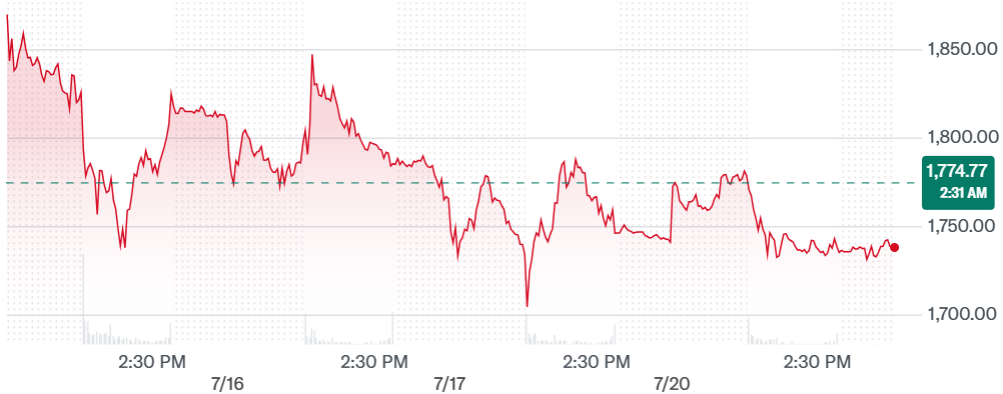
Source: Yahoo Finance (ASML US-listed shares: ADR)
Two record reports, two selloffs, reiterating the same message:
When a stock is priced for perfection, perfection stops being impressive.
However, one number in TSMC’s report gave the bears real fuel.
The $265 billion American dream
TSMC has now raised its 2026 capital budget twice this year, from $52-56 billion in January to $60-64 billion in July. Huang gave two reasons on the call: demand keeps rising, and equipment now comes at inflated prices.
Morgan Stanley reportedly flagged that second part, cost inflation, as a genuine negative for margins.
The strain is already visible in the cash. TSMC generated $24.79 billion from operations in Q2, up from $22.13 billion in Q1. It spent $15.7 billion on factories and equipment, up from $11.1 billion. What was left, the free cash flow, fell 17.5% to $9.09 billion.
The business is earning more and keeping less, because the money is going into the ground in Arizona and Hsinchu.
Besides, the market noticed something odd that supports the worry: even TSMC’s own equipment suppliers, companies that directly earn that capex, reportedly fell after the announcement.
Then there is America. The fresh $100 billion for Arizona takes TSMC’s total US commitment to $265 billion and, per company statements, its planned chip factories count in the state from six to ten.
Huang told CNBC that building a chip factory in the US costs four to five times what it costs in Taiwan, and the company itself expects overseas plants to shave 2 to 3 percentage points off gross margin in their early years, widening to 3 to 4 percentage points later.
Add the 3 to 4 point dilution from ramping 2-nanometre production in the second half, and you realise why its record 67.7% margin could be the ceiling for a while.
TSMC’s own third-quarter guidance says it plainly. Revenue is guided to rise about 12.4% from Q2. Operating income is guided to rise about 6.2%. Operating margin drops from 60.3% to around 57%. Revenue growing at twice the pace of profit is a company telling you, in advance, that the next batch of sales costs more to deliver.
That is the sober case for the selloff, and it runs on arithmetic rather than fear.
Now the genuinely strange part.
Bullish analysts, bearish investors
While the shares fell, Wall Street’s analysts moved in the opposite direction.
Barclays reportedly lifted its price target to $650 the morning after results, DA Davidson to $500, TD Cowen to $440, all while the price sank toward $398.
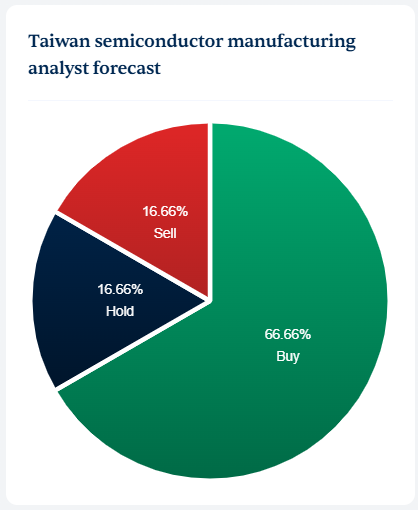
Source: TSMC’s US-listed shares on Vested
These targets are opinions, not forecasts of fact, and past performance is not indicative of future returns. But the split is the story:
The people paid to value the business got more positive on the same news that made the people holding the stock sell.
Each side has a serious argument.
The bull case is chairman Wei’s own: he called AI a new industry on the call, said demand looks strong all the way to 2029 or 2030, and described how the company cross-examines every customer forecast before spending a dollar. His summary of that process deserves its own frame:
“[…] all the truth together, it’s not a truth.”
The bear case belongs to economists like Apollo’s Torsten Slok, who warned on Bloomberg TV:
“We need to see profit margins go up outside the Magnificent 7.”
His maths: the four biggest cloud companies are expected to spend over $700 billion in 2026 while their free cash flow shrinks, and if the payoff arrives late, the repricing gets painful.
Friday handed his side fresh ammunition when Chinese startup Moonshot released Kimi K3, an open model it claims rivals the best American systems at a fraction of the price.
The claims are unverified until the model weights are released on 27 July, but markets sold first and decided to verify later, just as they did with DeepSeek in January 2025.
The referee arrives this week. Alphabet reports on 22 July, the first of the big spenders to reveal whether AI budgets are still growing.
Step back and look at what the week did to portfolios that never bought a single chip stock.
The Domino Effect
The Philadelphia Semiconductor Index fell roughly 10 to 11% over five days, reportedly its worst week since April 2025, and ended more than 20% below its late-June record.
That is a bear market inside what everyone still calls a bull market.
The pain travelled by supply chain. SK Hynix reportedly fell about 12% in Seoul in one session. Micron, SanDisk, Western Digital, and Seagate dropped between 4 and 8%. Nvidia reportedly lost its title as the world’s most valuable company to Apple.
None of those companies reported bad news. They were repriced because TSMC was repriced, and TSMC was repriced because the market changed its mind about what certainty costs.
That is the concentration problem in practice.
An investor holding a global index fund, a US technology fund, and a few individual AI names may believe they hold three separate positions. But in reality, they might not.
The practical response is not to guess whether the chip correction has further to run. It is to know the exposure before the next repricing arrives.
TSMC’s shares are listed in New York and Taipei, so investors get the opportunity to buy US stocks like TSMC on Vested.
Also, Vested’s Global Funds hold the chipmakers, the equipment suppliers, and the companies, which gives the exposure with more diversification.
When a winner stumbles…
Come back to Thursday. A company reported numbers with no visible flaw, committed $100 billion to its future, and lost value for two straight days.
Huang, asked about the share price, said the company cannot control financial markets and can only mind its fundamentals, which is both the only honest answer and an admission that the two have separated for now.
That separation is the takeaway.
Nothing in this selloff says AI demand fell; TSMC’s order book, capex, and its CEO’s decade-long view all point the other way.
What fell was the market’s willingness to pay any price for certainty about that demand.
Whether that willingness restores may be decided this week as earnings results of big-tech companies are released. Stay tuned!
