


The Story
Picture this. You’re the board of the world’s most valuable chipmaker. Your founder-CEO is caught in a scandal involving an alleged Chinese spy. You push him out. Six days later you tell the world, on an earnings call, that you “do not intend to reinstate” him.
And then, six days after that, you hire him back.
That’s exactly what Nvidia did. On October 29, the New York Times reported that Jensen Huang had been the target of a spy plot linked to the Chinese government. On November 8, he apologised to employees for marital infidelity. On November 12, he resigned. On November 17, chair Harvey Jones said the board would not bring him back. And on Monday, November 23, the board voted unanimously to do exactly that.
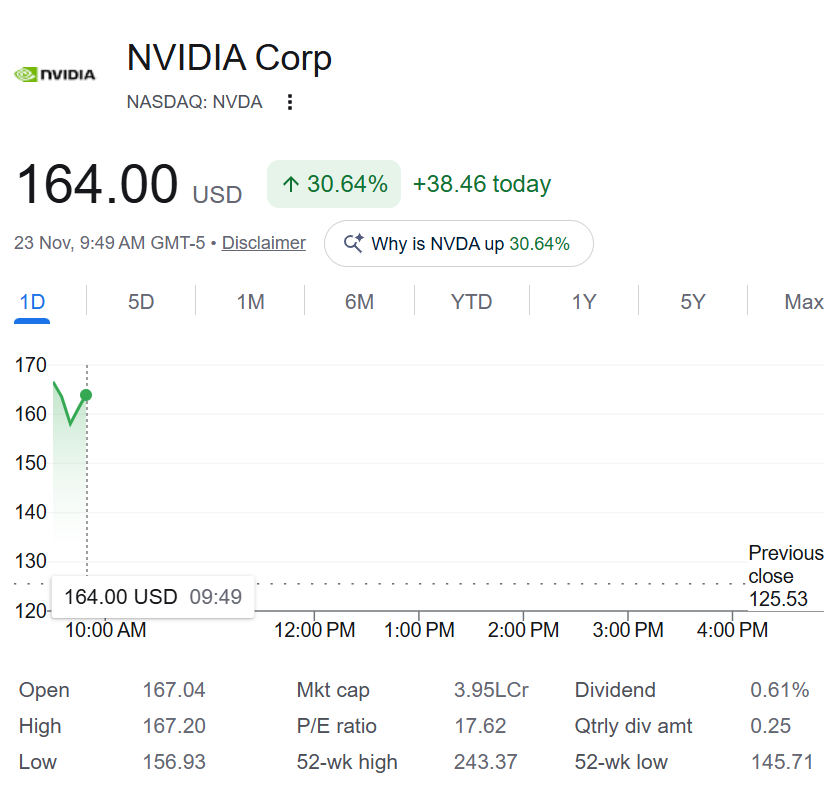
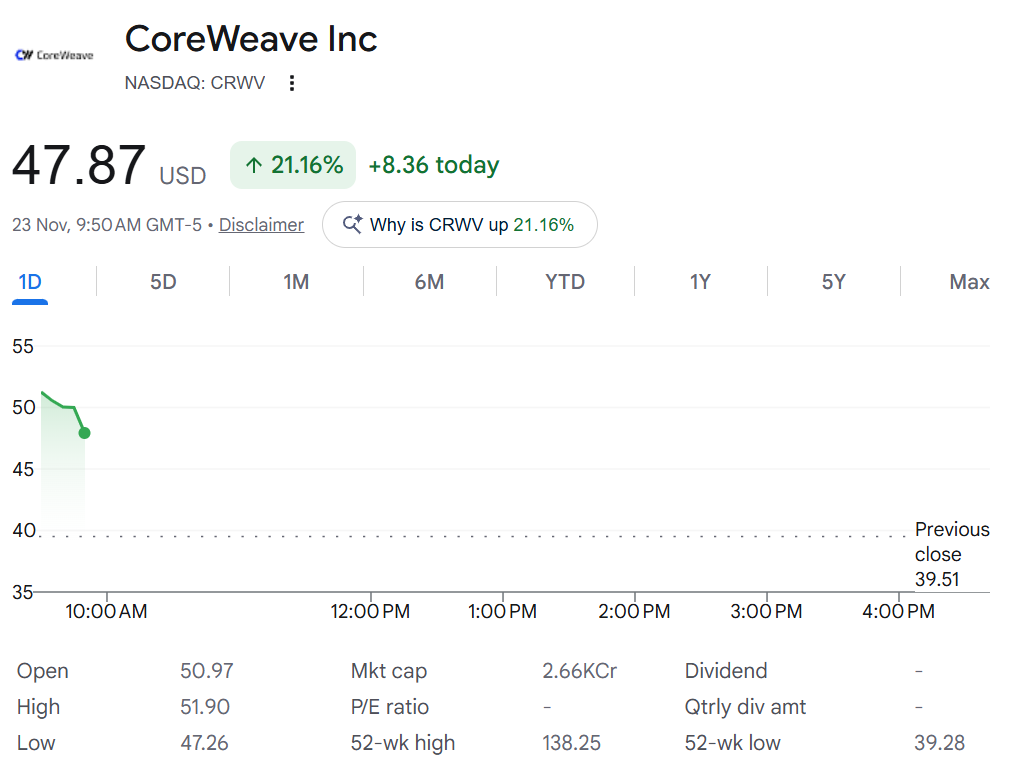
The market’s loved it, Nvidia shares ran as high as 35%. The Nasdaq Composite opened up about 7%. And some of the biggest winners weren’t Nvidia at all. Nebius jumped 35%. CoreWeave, 29%.
Now, the obvious explanation is “founder’s back, investors are relieved.” That’s true. But it’s only half the story.
To understand why a cloud company moved as much as Nvidia did, you need to understand two things: key-man risk, and a money loop that runs straight through Jensen Huang.
Key-man risk, live and in colour
Key-man risk is a simple idea. If one person leaving can break a company’s plans, that person is a risk the market has to price.
Most big companies insist they don’t have one. Nvidia clearly did. Huang co-founded it in 1993 and has run it ever since. He owns the chip roadmap. He personally holds the relationships with the biggest buyers. He’s the company’s voice in Washington and Taipei. Reuters put it plainly on Monday: the reversal raises questions about how dependent Nvidia remains on its co-founder.
Here’s how you know the market priced that dependence. On November 17, Nvidia’s first quarter without Huang came in excellent: revenue of $115.8 billion, up 103% year on year, and Q4 guidance of $130 billion, ahead of expectations.
The stock barely cared. Between its October 6 record of $239.24 and November 13, it fell about 32%. Nvidia lost roughly $450 billion in market value in the days after Huang’s apology alone, had its worst week since 2008, and briefly slipped below Alphabet in market value.
So demand wasn’t the problem. The business was booming. What investors couldn’t price was who would make the big calls next. And at Nvidia, the biggest calls lately haven’t been about chips. They’ve been about money.
The money loop
Here’s a question. If you sell shovels in a gold rush, what’s the fastest way to sell more shovels? Lend money to the miners.
That, roughly, is what Nvidia has been doing. It invests in its own customers, guarantees their deals, and in some cases promises to rent back their unused capacity. Those customers then use the money, and the cheaper loans Nvidia’s backing unlocks, to buy more Nvidia GPUs.
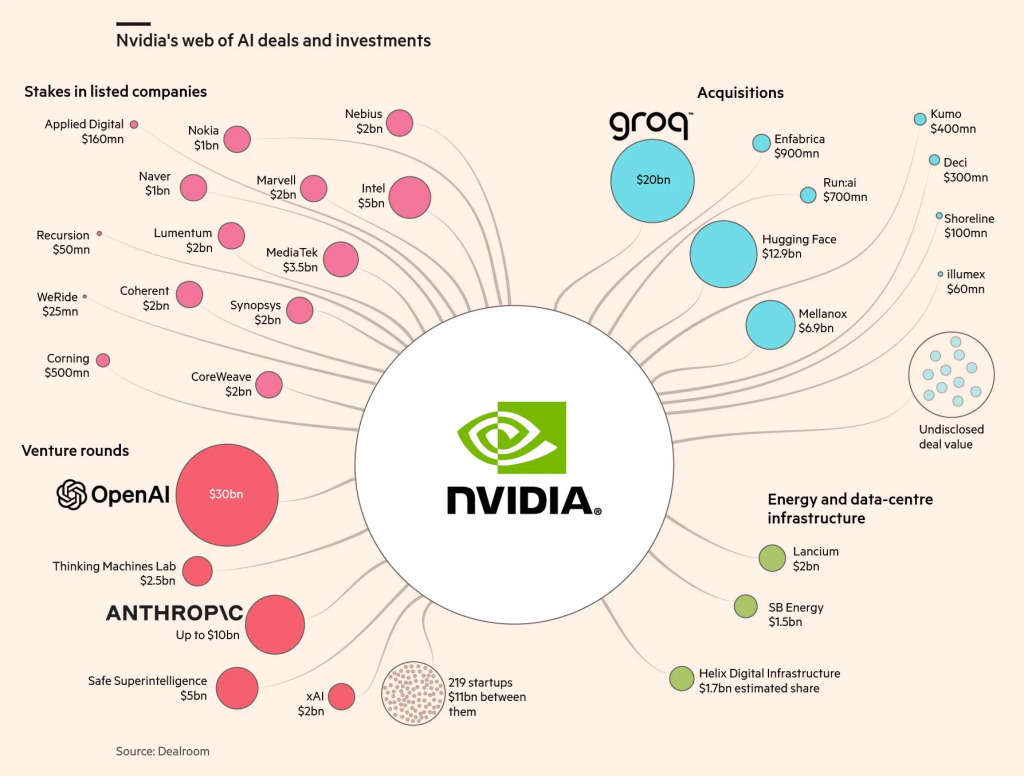
The numbers are enormous. As of October 26, Nvidia held about $110 billion in equity investments and had up to $118 billion in maximum guarantees outstanding.
The biggest single piece is a $105 billion guarantee for OpenAI’s Ohio data center campus. Smaller ones include a $6.3 billion deal to buy any CoreWeave capacity it can’t sell and a roughly $2 billion stake in Nebius. Since July, Nvidia has also offered to rent back unused GPUs from neocloud partners at a fixed rate, a floor designed to make banks more comfortable lending.
Why does that backing matter so much? Because AI startups building data centers can pay as much as 15% to borrow.
With Nvidia behind them, companies like CoreWeave have borrowed at rates much closer to what a Microsoft or Google pay.
Nvidia’s name is the collateral.
The loop works beautifully while it spins. The question is what happens when the person spinning it leaves.
Why Jensen is the loop
The loop was Huang’s strategy. And the person who stepped in when he left was reportedly its biggest internal sceptic.
According to the Wall Street Journal, CFO Colette Kress questioned how Nvidia picked its guarantee deals, how it valued them and how it calculated returns.
Nvidia had considered a guarantee of about $250 billion for OpenAI’s Ohio campus; Kress reworked it and roughly halved the first commitment before the $105 billion version was signed in August. Reuters separately reported she clashed with Huang over AI infrastructure financing. Neither report has been confirmed by Nvidia.
So when Huang resigned on November 12 and Kress became interim CEO, the market did the maths. Lynx Equity Strategies said it expected Kress to unwind Nvidia’s circular financing. On the earnings call, she said Nvidia would stay “disciplined and selective” in its support. To a lender, that sounds a lot like “less”.
And the neoclouds can’t afford less. Look at their balance sheets:
- CoreWeave carried about $47 billion of debt at September 30. Its Q3 net interest bill was $846 million, against operating income of $207 million. Its 2032 bonds yielded more than 16% in early November.
- Nebius saw debt climb to about $14.2 billion, from about $4.1 billion at the end of 2025.
One AI infrastructure investor summed it up to Fortune the day Huang left: “That Nvidia guarantee is not worth what it was worth a week ago” (Fortune). For a company paying 16% to borrow, that’s existential.
That’s why the round trip looks like this:
| Stock | Nov 12 (Huang resigns) | Nov 23 (Huang returns, early session) | Tie to Nvidia |
| Nebius | -16.8% | +35.3% | ~$2B Nvidia investment |
| CoreWeave | -6.9% | +29.0% | Nvidia stake + $6.3B capacity backstop |
| Nvidia | -4.3% (-14% intraday) | +33.1% | The lender of last resort |
Nov 12 moves via Dave Manuel; Nebius also cut guidance that day. Nov 23 moves via Seeking Alpha’s early-session Nasdaq-100 leaders.
Monday’s rally, in other words, wasn’t just the founder coming home. It was the backstop coming home with him.
Who rallied, and why
Once you see the loop, Monday’s leaderboard makes sense. The closer a company sits to Nvidia’s wallet, the harder it jumped.
| Ring | Early-session moves (Nov 23) | Avg | Why |
| Neoclouds | Nebius +35.3%, CoreWeave +29.0% | ~32% | Directly financed and backstopped by Nvidia. Huang’s return = cheaper borrowing again. |
| Optics & connectivity | Lumentum +22.3%, Astera Labs +20.1%, Marvell +19.4% | ~21% | Every GPU cluster the loop funds needs optics, retimers and custom networking chips. |
| Memory & storage | Sandisk +24.4%, Seagate +21.0%, Western Digital +16.3%, Micron +16.2% | ~20% | HBM ships with each GPU; AI data sets fill drives. |
| Chip equipment | Lam +18.5%, KLA +18.3%, Applied Materials +16.3% | ~18% | One step removed: they sell tools to the fabs that build Nvidia’s chips. |
| Compute peers | Arm +20.3%, Intel +15.2%, AMD +12.4% | ~16% | Arm rides Nvidia’s Grace CPUs. AMD moved least: a stronger Nvidia is also a stronger rival. |
| Power & analog | Monolithic Power +14.8%, Analog Devices +11.6% | ~13% | Power delivery for GPU racks, but a smaller slice of revenue. |
| Pure risk appetite | Strategy +17.1%, Rocket Lab +14.8% | ~16% | No AI link at all. Just high-beta money coming back. |
Source: Seeking Alpha’s
The pattern cuts both ways, though. The ring that rose most on the way up is the one that would fall hardest if the loop wobbles again.
But here’s the catch
The reinstatement settles who runs Nvidia. It doesn’t settle much else.
The investigations are still open. The SEC and the Department of Justice are probing the company on issues ranging from accounting to alleged chip smuggling. Nvidia’s own board has formed an independent committee to examine whether foreign intelligence targeted Huang, and it is hunting for a new chief compliance officer.
The China question hasn’t gone away. The woman at the centre of the scandal, Alice Huang (no relation), once ran Megaspeed International, a Singapore firm behind billions in Nvidia chip sales. Investigators requested Nvidia’s Megaspeed sales records in May 2025, and Nvidia put the firm on its “no sell” list a month later. None of this is proven, and Huang hasn’t been accused of wrongdoing. Beijing denies the spying allegation.
Washington isn’t speaking with one voice. Trump lobbied for Huang’s return and called Monday’s decision “correct and proper”. But Treasury Secretary Bessent said on Sunday the government wants to know who ran compliance at Nvidia and wants answers on China chip sales.
December 1 is the next test. Huang is expected to testify on Capitol Hill, with questions on Alice Huang and Megaspeed likely. Meanwhile, Commerce has tightened rules on Chinese access to chips through third-country data centers.
And the loop is still a loop. Huang’s return restores the backstop. It doesn’t make CoreWeave’s 16% bond yields or its interest bill disappear. If AI demand ever slows, the same web of guarantees that lifted everything on Monday becomes the channel that spreads the pain.
So what does this mean for you?
If you own a US tech ETF like QQQ, you just learned how big your Nvidia bet really is. One boardroom decision moved the whole Nasdaq about 7% at the open. That isn’t diversification; it’s a single-company story wearing an index’s clothes.
And if you own the neoclouds or the wider AI supply chain, you’re not just betting on AI demand. You’re betting on Nvidia’s willingness to keep lending its balance sheet, and for now, that willingness has a name: Jensen Huang.
The business never broke. The governance did, and Monday reversed a big chunk of that discount. What’s left is regulatory and financial, and the next chapter starts on December 1.
Until then…