





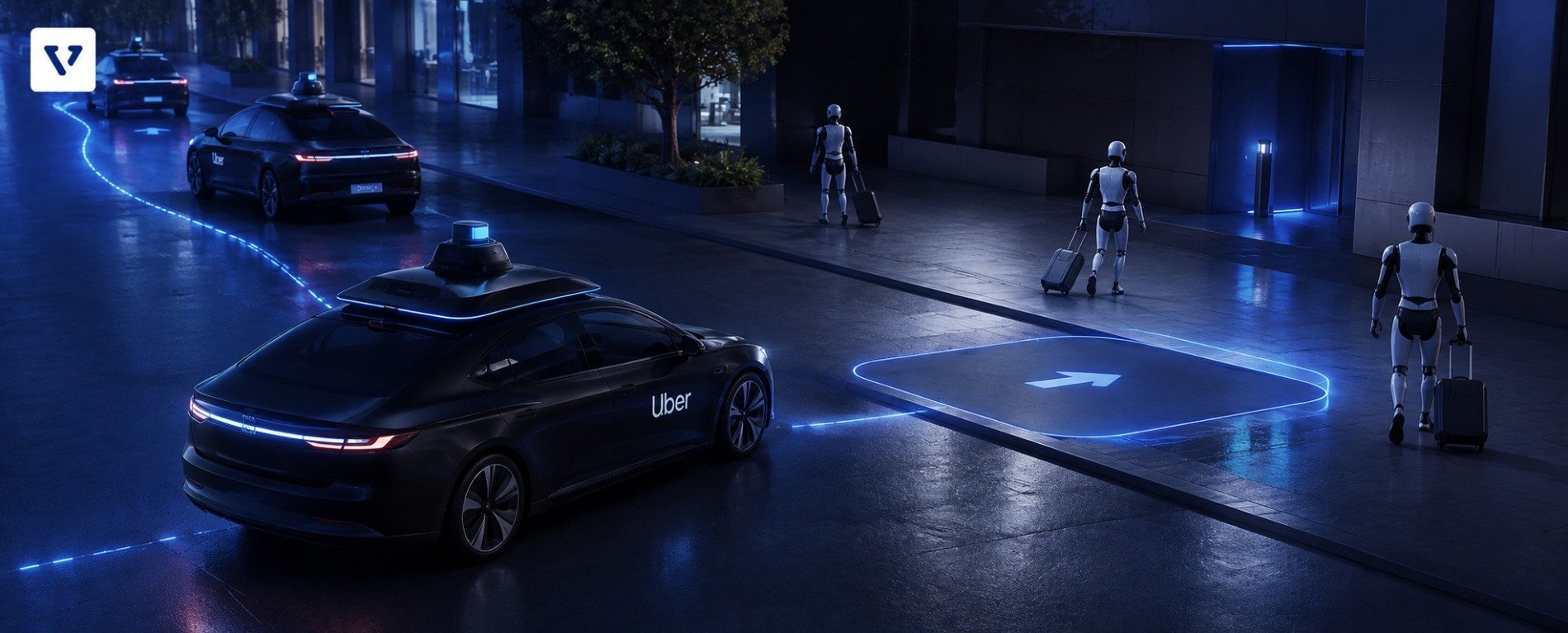
On August 7, Uber signed a 13F listing seven equity positions. Serve Robotics was not one of them. Uber had sold its entire stake in the sidewalk delivery company it created inside Postmates, spun out, seeded, and then made its anchor customer.

Source: Bloomberg
The day before, Serve had reported Q2.
CEO Ali Kashani told investors that delivery volume through Uber grew for seventeen consecutive quarters starting in early 2022, then fell for the first time.
He blamed robot utilization and, more pointedly, “differing views about the operating model.” His conclusion: “we don’t currently expect that it would make sense to renew.”
The damage was immediate.
Serve cut full-year 2026 revenue guidance from $26 million to $9-10 million, roughly 63 per cent at the midpoint, because the old number assumed a second-half Uber ramp that is not coming.
Q2 revenue was $3.24 million on a gross loss of about $8.8 million. Daily active robots fell from 812 to 792.

Source: Yahoo! Finance
And this is the second autonomy partner to walk away from Uber in three months, and the first one was Waymo.
Both fleets ended up at DoorDash
In late June, Waymo ended its Phoenix arrangement with Uber and pulled the vehicles back. It redeployed them into three places: its own app, its transit partnership with Via, and its delivery partnership with DoorDash.

Source: CNBC
The cars that left Uber’s app went to Uber’s largest delivery competitor.
A month later Waymo notified Uber it will launch its own app in Austin and Atlanta in January 2028, ending exclusivity in the only two cities where Waymo rides run solely through Uber. The contract holds through May 2028, so the cars stay for now.
But Waymo is in eleven US metros doing over 500,000 paid trips a week, and has not announced a new Uber city since Atlanta.
Two possibly key partnerships ended in the span of eight weeks.
In both, the stated reason was operational: routing, dispatch, fleet coordination. In both, the fleet ended up at DoorDash.
Build versus partner
The common understanding or interpretation is that Uber should have built its own robots. I don’t think that survives contact with what either company does.
DoorDash partners with everyone: Serve in Los Angeles, Coco in LA and Chicago and Helsinki, Wing’s drones, Waymo across 315 square miles of Phoenix, plus its own FAA-certified drone programme.
That is a wider mix than Uber’s.
And Uber is spending.
Its Q2 call disclosed roughly $10 billion for autonomy over several years, equity in partners plus off-take on 120,000 vehicles, with launches lined up with Nuro and Lucid, Zoox, Wayve, Baidu and Pony. It has built AV Labs, an internal unit making sensor cars to gather data for its partners.
So the question isn’t build versus buy. It’s what each thinks it is buying.
Who owns the dispatcher?
DoorDash treats every fleet as a supply type inside a routing system it controls, the Autonomous Delivery Platform, which decides inside a hundred-millisecond budget whether an order goes to a Dasher, a Dot, a Coco, a drone or a Waymo.
Tony Xu put the thesis plainly on DoorDash’s call: “It’s really the complexity of marrying the operations with the technology that actually allows you to even have a chance at delivering scaled autonomous delivery.”
He listed the problems: loading at the merchant, estimating restaurant prep time, a doorman in a high-rise, a gate code at an apartment.
Uber’s Serve arrangement did not work that way, and the failure is unusually legible.
Per Bloomberg’s reporting, Serve shared its robots’ arrival estimates with Uber, and Uber did not display them accurately to customers.
Robots were assigned orders they had insufficient time to complete. Serve declined those orders. Uber saw unreliability and sent fewer. Serve saw utilization collapse.
That is the class of problem that only arises when two companies own opposite sides of one interface.
Which reframes Dot, which is DoorDash’s first autonomous delivery robot.

This changes why Dot matters.
I don’t think DoorDash built a robot because it needed a robot. It built one to find out what the dispatcher has to handle, and the only way to find that out is to run a fleet yourself and absorb the failures.
Aggregation is a bet that supply stays fragmented
Here is the second-order point.
Uber’s model rests on supply being fragmented, interchangeable and individually powerless. Against millions of couriers, aggregating demand is close to absolute leverage. No single courier can negotiate, build a demand channel, or walk.
Autonomy inverts that.
Millions of atoms become roughly six capitalised firms. Waymo is a subsidiary of a multi-trillion-dollar company with its own app and eleven metros of direct consumer relationship. Nuro, Zoox, Wayve, Baidu, Pony: these are counterparties, essentially.
So “hedged” has it backwards. Uber isn’t hedged across many suppliers. It is exposed to supply consolidating into a handful of firms, each of which is a material share of the fleet and each of which can go direct.
Waymo just ran the full sequence: pilot on Uber, learn the market, take the fleet back, launch your own app. Phoenix was the trial run.
Serve can’t go direct, so it did the other available thing. Asked which channel matters now, Kashani (CEo of Serve) said the company wants “control over our destiny” and to avoid the turbulence of large partners, pointing to DoorDash volume up 50 per cent sequentially in Q1 and another 50 per cent between June and July.
Test the claim this way.
If demand aggregation were still sufficient leverage, Uber would not need to fund its own suppliers. But it does: equity stakes, where Uber says every dollar catalyses $2.50 of outside capital, off-take risk on 120,000 vehicles, and AV Labs collecting data on partners’ behalf. You subsidise suppliers when you are worried they will not need you.
Set that beside liquidating the Serve stake entirely and you have a company that has not settled on what the autonomy stack is worth owning.
Dara Khosrowshahi tweeted “Building is fun” on August 12. He should probably mean it.

The strongest case for Uber
Uber’s quarter was excellent.
Gross bookings over $58 billion, up 22 per cent, a fourth straight quarter above 20. Mobility bookings $28.99 billion, and delivery $27.46 billion up 26 per cent. Segment operating income $2.2 billion and $1.1 billion. Trailing free cash flow passed $10 billion for the first time.
More importantly, delivery is the smaller prize. Mobility has a labour cost line autonomy can erase. Delivery does not, and DoorDash’s own founders say so.
Stanley Tang (co-founder of DoorDash) recently argued that as autonomy scales “you’re going to see even more humans as well.” If that holds, autonomous delivery is a margin story, not a cost-base replacement. Uber prioritising mobility is arithmetic, not error.
And the volumes are trivial today.
DoorDash did $33.1 billion of Marketplace GOV across 970 million orders in Q2. Dot is expected to handle a high single-digit share of orders in Phoenix by year-end, in one metro, with expansion held until execution is nailed.
Where the uncertainty is
I hold the mechanism with conviction: delivery autonomy fails on operations before hardware, and as supply consolidates the aggregator’s leverage falls. I hold the timing and the winner with none.
What would falsify me: Uber’s fifteen-city footprint converting into delivery integrations that don’t reproduce the ETA problem, or Waymo’s own app underperforming its Uber-distributed volume in 2028.
What would confirm it: Serve’s mix after early 2027. If DoorDash volume plus direct merchants replaces the Uber line cleanly, switching costs between aggregators are low, which is bad for both apps and good for the robot makers.
The conclusion that DoorDash has won autonomous delivery is wrong.
What is settled is narrower. Uber built a decade on the premise that aggregating demand is durable because supply is fragmented. That premise is being tested for the first time against a supply base of six companies, two of which have now walked, and it has not passed.