


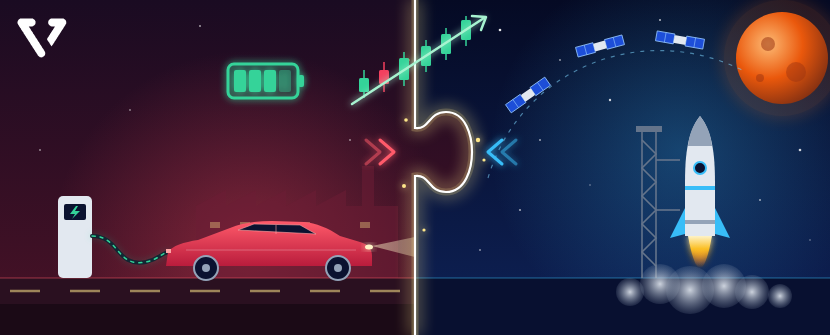
In today’s story, we break down why Elon Musk wants to fuse Tesla and SpaceX into one giant company, and what it means for everyone who isn’t Elon Musk.
The Story
What do you get when you mix an electric car company with a rocket company?
No, this isn’t the setup to a bad joke. It could soon be the biggest corporate deal in history.
Picture the scene. It’s Tuesday evening and Tesla is wrapping up its quarterly earnings call. Analysts have asked their usual questions about car deliveries, margins and robotaxis. Then the conversation drifts to the question everyone has been whispering about for months: will Tesla and SpaceX ever become one company?
Most CEOs would dodge that with a polite “no comment”. Musk did the opposite. He said he thinks it’s a good idea.
And just like that, an idea that lived mostly in investor chat groups and late-night speculation became very real.
The numbers involved are staggering. Put the two together and you get a company worth somewhere between $3.5 and $3.7 trillion, depending on who’s doing the maths. To put that in perspective, that’s roughly the size of India’s entire economy in a year. One company. One CEO.
Now, to be clear, this is still an idea and not a done deal. Both companies have set up special committees of independent directors to study it. Musk says he’ll step aside from those talks and let them work out the details. He even admitted that convincing Tesla shareholders might not be easy. And nobody has agreed on terms yet.
But here’s the thing. Musk doesn’t usually float ideas he doesn’t intend to chase. So let’s unpack what’s going on.
Musk has done this before
If this all sounds dramatic, it helps to know that Musk has a habit of folding his companies into each other.
Back in 2016, Tesla bought SolarCity, a solar panel company run by Musk’s cousins, for about $2.6 billion. Critics called it a bailout. Musk called it a step towards a single sustainable energy company. SolarCity eventually disappeared into Tesla as Tesla Solar.
Then in 2025, his AI startup xAI bought X, the social network formerly known as Twitter, in a deal that valued X at $33 billion. Earlier this year, SpaceX bought the AI coding startup Cursor.
See the pattern? Musk’s universe has slowly been collapsing inward, like a star getting denser. Tesla and SpaceX are simply the two biggest planets left orbiting separately.

Why would Musk want this?
Start with the boring reasons. Right now, Musk runs two listed companies. That means two earnings calls, two boards and two sets of shareholders who all want different things from him.
And his projects don’t stay in their lanes anymore. A chip plant here, a robot there, a data centre somewhere in between.
Every time a project crosses company lines, it needs separate approvals, separate contracts and careful lawyering to make sure one company isn’t unfairly helping the other.
One company means one decision-maker.
Then there’s money. SpaceX has enormous AI ambitions, and AI eats cash for breakfast.
Both companies are expected to burn billions of dollars every quarter for the foreseeable future. That’s a big shift for Tesla, whose car business has quietly thrown off cash for years.

Tesla has become a slower-growing but cash-rich company with a strong balance sheet. SpaceX is a hyper-growth company with enormous spending needs. Put them together and one pays for the other’s dreams.
And finally, control. Musk owns about a fifth of Tesla, and he’s complained for years that it isn’t enough to steer its AI and robotics future. At SpaceX, he holds over 80% of the voting power. A merger brings everything under the roof where his grip is tightest.
Does it actually make business sense?
On paper, yes. And the biggest reason is chips.
Think of chips as the brains of everything Musk wants to build. Tesla needs them to help its cars drive themselves and its Optimus robots walk, talk and fold laundry.
SpaceX needs them for its AI models and for data centres, including some it hopes to put in orbit one day. Both companies are hungry customers. Very hungry.
Today, most of those high-end chips come from Nvidia.
And Nvidia is in a very happy position. It makes some of the fattest profit margins in the corporate world, because when everyone wants your product and few others can make it, you get to set the price.
Musk, being Musk, doesn’t like paying someone else’s markup.
So Tesla and SpaceX have teamed up to build their own chip plant in Texas, called Terafab. Musk hopes it will start mass production by late 2028.
A reckon a chip that costs $30,000 to buy from someone else could be made in-house for about $3,000. That’s a 90% discount.
Now multiply that across millions of cars, robots and servers over many years, and the savings could run past $1 trillion. As two separate companies, they have to negotiate who pays for what. As one, they just build.
The Henry Ford playbook, but in space
There’s an old story in business about Henry Ford. In the 1920s, his River Rouge plant took in iron ore, coal and rubber at one end and pushed out finished cars at the other. Ford owned the mines, the ships and the steel mills. He didn’t want to depend on anyone.
Musk seems to want the same thing, only bigger and stranger.
Imagine a Tesla robotaxi driving through a remote mountain road with no mobile signal. It stays online because a Starlink satellite overhead keeps it connected. Imagine a SpaceX data centre running on Tesla’s giant battery packs. Imagine Tesla’s factory automation experts helping SpaceX build Starship rockets the way Tesla builds cars, on an assembly line.
And for those who like to dream big, imagine SpaceX rockets carrying Optimus robots and Tesla batteries to a colony on Mars.
The two companies have already started blurring the lines.
On October 15, Tesla unveiled a new Roadster prototype designed with SpaceX. It came with air thrusters that let the car climb an upside-down ramp and do a kickflip over the rest of Tesla’s lineup. Yes, a car doing a skateboard trick.
Behind the scenes, the overlap goes deeper.
Tesla engineers have reportedly been nudged to use Musk’s own AI models for coding.
Tesla employees were given early access to test X Money, the payments app. And the two companies have worked together on teaching robots new skills.
Put simply, Musk wants one company that does it all: makes the chips, builds the robots, launches the satellites and connects everything together. It’s vertical integration on a scale nobody has ever tried.
So what’s the catch?
The catch is simple. When a company gets bigger, the average shareholder’s voice usually gets smaller.
Today, an investor has a choice. If someone owns Tesla and skips SpaceX. Their money goes exactly where their conviction lies.
After a merger, that choice disappears. Their Tesla shares turn into shares of a rocket-car-robot-satellite-AI company. They get Starship whether she wanted it or not. And the decision of how much cash flows into cars versus rockets versus orbital servers is no longer hers to make by picking a stock. It’s Musk’s call.
Now, the vote. Tesla shareholders today have some say, however limited, over how Tesla is run. But SpaceX has super-voting shares that give Musk outsized control. Fold Tesla into a structure like that, and Priya’s vote counts for even less. By some estimates, even if Musk gave up his special shares entirely, he’d still control roughly 40% of the combined company. That’s enough to win almost any vote that matters.
Then there’s the visibility problem. In the US, companies only have to report a business line separately if it makes up more than 10% of revenue, profit or assets. In a $3.5 trillion giant, plenty of real businesses would fall below that bar.
Tesla’s battery business could quietly vanish into a single line item. And this isn’t a hypothetical. X, the social network Musk bought for $44 billion in 2022, has already disappeared inside SpaceX’s numbers this way. Priya would know less about what she owns, not more.
And what could go wrong?
The trickiest problem might not be business at all. It’s geopolitics.
To understand why, travel a few thousand kilometres from the smoke and strobe lights of the Roadster launch, to the front lines in Ukraine.
Ukraine’s military relies on a special version of SpaceX’s Starlink to communicate on the battlefield.
Recently, Ukrainian forces noticed that their connection had slowed down. President Volodymyr Zelenskyy accused Trump and Musk of ordering it throttled. Musk deflected, saying any limits were up to Trump.
Whatever the truth, the episode shows just how much power now sits with one of Musk’s companies. A satellite network owned by a private firm can shape how a war is fought.
And SpaceX’s ties to the US government go far beyond Ukraine. It works with the military, intelligence agencies and NASA. This year alone, it won a $2 billion contract to supply satellites for the Golden Dome missile-defence programme, a project that could eventually cost over $1 trillion. Some observers compare Musk’s position to that of Howard Hughes, the eccentric billionaire whose companies helped build America’s aerospace and defence muscle during the Cold War.
Now look at Tesla. It leans heavily on China. Its Shanghai factory is one of its most important plants for both making and selling cars.
So here’s the awkward question. What happens when you put America’s go-to defence contractor and a company deeply tied to China under one roof?
Officials in Washington would want to know who has access to what. Beijing would ask its own questions. JPMorgan analysts have flagged exactly this tension as one of the biggest hurdles to any deal.
Then there’s execution risk. Robotaxis, humanoid robots, Starship, AI data centres, satellites in orbit. Each of these is expensive and technically hard on its own. Merging the companies doesn’t make any of them easier. It just means one set of shareholders now carries every bet at once. If one goes badly wrong, everyone feels it.
Why now?
Because windows don’t stay open forever. And Musk knows that better than most.
Rewind a little over a year. Musk had spent months in Washington co-leading DOGE, the government efficiency drive that cut tens of thousands of jobs.
His public image took a beating. Tesla sales suffered as some buyers recoiled from his politics. Then his friendship with Trump collapsed into an ugly public feud. For a while, it looked like Musk had been pushed away from the levers of power.
But Musk has a knack for climbing out of holes, including the ones he digs himself.
He stepped back from the spotlight, focused on his companies and quietly mended fences. Earlier this month, Trump handed him the National Medal of Science. And this midterm season, Musk has spent around $369 million to help keep a friendly political environment in place.
His companies bounced back too. SpaceX went public in June at $135 a share, a listing that made Musk the world’s first trillionaire. The shares then slumped well below their offer price in a bumpy debut. But they’ve since climbed about 47% from early August.
So right now, Musk has two things going for him: friends in the White House and investors who still believe. Neither is guaranteed to last.
The US midterm elections are less than two weeks away. If Democrats win control of either chamber of Congress, Musk’s businesses could face investigations, and Trump would head into his final years with less clout.
Markets matter too. A strong SpaceX share price is great currency for buying Tesla. But worries are growing that the AI boom may take longer to pay off than hoped. If AI and chip stocks fall, the deal maths gets much harder.
That’s why, according to Bloomberg, there’s a push to announce a deal by the first half of 2027, so it can close while this administration is still in office. The clock is ticking.
The bottom line
So will shareholders push back? Probably not much.
The day after Musk’s comments, the two companies were together worth roughly $300 billion more than the day before. That’s hardly a revolt. That’s a cheer.
And remember, this is the same Tesla shareholder base that approved a trillion-dollar pay package for Musk less than a year ago. These are not people who bet against Elon.
If the deal goes through, Musk could add over $110 billion to his fortune, by Bloomberg’s estimate.
He would sit at the top of a company that makes cars, robots, rockets, satellites, chips and AI. And he’d have even more control over it, relative to everyone else, than he does today.
Which brings us back to Priya. Will she sell? Probably not. Because if she’s honest, she was never really betting on electric cars alone.
The truth is, for a lot of investors, Tesla and SpaceX were never two separate bets. They were two different tickets to the same show.
And that show is called Elon Musk.
Until then…
Don’t forget to share this story with your friends, family, and that one colleague who’s convinced Tesla will be on Mars by 2030.