





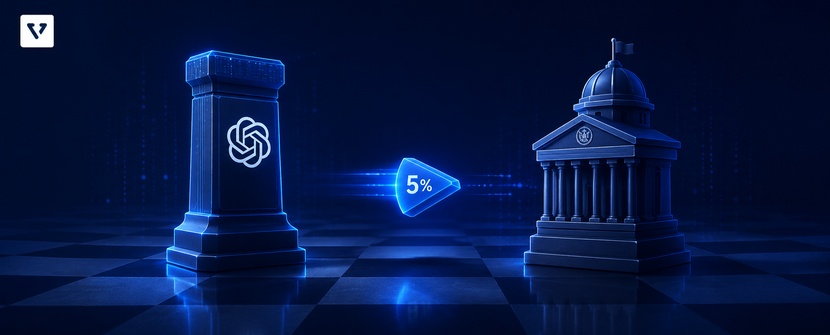
Imagine a company worth $852 billion, and the government owns a slice of it, but so do you, indirectly, through a fund that pays you dividends every year.
That is roughly the pitch OpenAI is making to Washington right now.
According to a Financial Times report, OpenAI has been in early conversations with the Trump administration about handing over a 5% stake in the company to the US government.
Sam Altman, the man behind ChatGPT, has argued this is the best way to share AI’s upside with ordinary Americans. And he wants company.
The proposal calls for other big US AI players, think Anthropic, Google, Meta, to fork over a similar 5% cut too.
Now, why would a company that just crossed the $850 billion mark want to give away a chunk of itself for free?
To understand that, you need to understand the mood in Washington right now.
AI companies are having a rough time with regulators.
Just last month, Anthropic had to suspend access to its most advanced models after the government flagged national security concerns about foreign nationals using the technology. That ban got lifted only this week.
OpenAI faced its own scare too, delaying the wider release of its GPT-5.6 model after a request from the administration.
Add to this the growing anxiety among ordinary Americans, a Reuters poll from June found that half of them worry AI could cost someone in their household a job, and you have a political minefield that AI companies desperately want to defuse.
This is where the 5% stake idea comes in. Both OpenAI and Anthropic are gearing up for IPOs that could value them well over a trillion dollars combined.
Neither company wants regulatory uncertainty hanging over that moment. Handing the government a stake, and by extension the public, is a way of saying “we are not just building this for ourselves, we are building it for the country too.”
The structural model being discussed is not new.
Think of Alaska, a state that sits on enormous oil wealth.
Decades ago, Alaska set up the Alaska Permanent Fund, a sovereign wealth vehicle that invests the state’s oil revenues and pays out a dividend to every resident, every year, just for living there. OpenAI’s proposal borrows this exact idea. Instead of oil, the resource is AI. Instead of Alaskans, it would be every American getting a small, steady payout as AI reshapes the economy.
Altman has reportedly discussed this directly with Trump, commerce secretary Howard Lutnick, and Treasury secretary Scott Bessent.
He has also met Bernie Sanders, who has pushed for something even bigger, a 50% government stake in big AI companies, arguing the technology was built on human knowledge that was never paid for.
Here is the thing though.
None of this is close to a done deal. The talks are described as “conceptual,” and any actual arrangement would likely need an act of Congress to become real. Google has already declined to comment, and nobody knows if Anthropic or Meta would sign up to give away a slice of themselves too.
There is also a bigger question lurking here.
If the US government becomes a shareholder in the world’s most powerful AI companies, what does that mean for how those companies are regulated, or protected, going forward?
The US already holds stakes in Intel and MP Materials, so this would not be unprecedented.
But AI is not semiconductors or rare earth minerals.
It is the technology many believe will define economic power for decades.
A Forrester analyst pointed out that if the US strikes this kind of deal, other countries may demand similar arrangements before letting American AI companies operate in their markets.
So here’s the so what.
This proposal is OpenAI trying to buy political goodwill using something that costs it nothing but future profit, a small slice of a company whose value keeps climbing.
Whether it turns into an actual policy, or just a headline that fades away, it tells you something important.
The world’s biggest AI companies know that public trust is now as valuable as their model performance.
And in the race to grow, some of them are willing to let the public own a piece of the machine.
