




Last week, SpaceX pulled off something nobody had done before. It raised $75 billion in an IPO, making it the largest in US history. Elon Musk’s rocket company debuted on the stock market at $135 a share, and in the days that followed, retail investors went absolutely berserk.
They bought more SpaceX stock in the first five sessions than they did across all the Magnificent Seven stocks combined.
And then the hangover set in.
By Monday, SpaceX had lost 16% in a single day, erasing roughly $400 billion in market value. To put that in perspective, only Nvidia’s $590 billion single-day crash last year was bigger.
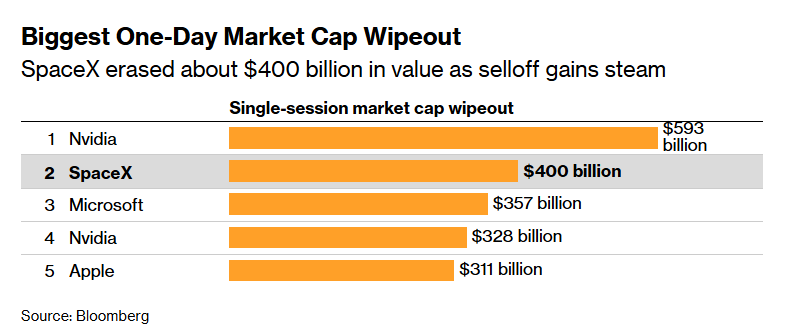
Over three sessions, the stock shed more than $600 billion. The company that was flirting with a $3 trillion valuation is now sitting just above $2 trillion.
So what happened?
The Fed came back into the room
The first part of the story has nothing to do with SpaceX specifically.
US government bond yields have been climbing sharply. The Federal Reserve, under chair Kevin Warsh, has been signaling that interest rate hikes are back on the table, driven by inflation from the ongoing Iran war.
Nine of eighteen Fed officials now expect rates to rise by the end of the year. In March, not a single one did.
Why does this matter for a rocket company?
When interest rates rise, ultra-safe US Treasury bonds start paying out more. Suddenly, the math on owning a highly speculative, loss-making AI company becomes a lot less attractive. SpaceX trades at over 100 times its revenue from last year.
That is the kind of valuation that requires near-zero rates and near-infinite optimism to hold up. When rates climb, valuations like that compress.
This same dynamic hit the broader tech sector.
The Nasdaq fell 1.3% on Monday. Google, Amazon and Broadcom all dropped more than 4%. Asian markets followed, with South Korea’s Kospi triggering a trading halt after sinking more than 8%.
Then came the bond sale
The second part of the story is SpaceX’s own doing.
On Monday, the company announced it is planning to raise at least $20 billion through its debut investment-grade bond offering, with banks like Goldman Sachs, JPMorgan, Bank of America and others arranging calls with investors. The proceeds would refinance a $20 billion bridge loan that SpaceX took out earlier this year when Musk merged his AI startup xAI and social media platform X into the company.
For bond investors, this is unusual territory. Investment-grade bond markets are typically the preserve of carmakers and insurance companies, not rocket startups that are expected to burn cash through 2029. SpaceX received BBB-tier ratings from all three major agencies, just three notches above junk.
Here is the thing about a bond offering that stock investors do not love: it signals that more debt is coming.
Analysts at Oppenheimer are modeling for SpaceX to accumulate more than $400 billion in net debt by 2031. That is more than almost any other US company currently carries, and it would more than triple what Oracle has on its books today.
So is the story falling apart?
Not exactly.
SpaceX still has over $100 billion in cash and equivalents on its books, bolstered by the IPO proceeds. It holds investment-grade credit ratings.
And its commercial logic is intact.
The company has secured contracts worth roughly $75 billion to supply computing power to Google and Anthropic. It also signed a fresh multibillion-dollar deal this week with Reflection AI to provide computing resources from its Colossus 2 data centre.
In other words, SpaceX is essentially building out the AWS of AI compute, leasing server capacity to the companies building the next generation of AI models.
That is a real business. The question is whether the price tag the market assigned it last week was reasonable.
And that is where the trouble starts.
Everyone who wanted to buy already bought
SpaceX’s entire valuation rests on the assumption that its AI division, which lost $6.4 billion in 2025, is chasing a total addressable market of $26.5 trillion.
That is not a modest bet. It requires things to go very right for a very long time. And when the Fed starts signaling that money is about to get more expensive, investors start questioning bets like that.
Even after all of this, SpaceX shares are still roughly 10 to 15% above their IPO price. The stock has not collapsed. It has corrected.
But for those who bought in during the frenzy of the first few trading days, the lesson is an old one. The greatest story in the world can still make for a very bad trade if you buy at the wrong price.