





Here’s a story that sounds backwards at first. Alphabet and Tesla just reported strong revenue growth. And investors punished both stocks anyway. Alphabet lost nearly $293 billion in market value in a single day, its worst ever. Tesla fell 15%, also a record post earnings drop.
So what’s going on? Shouldn’t good numbers make a stock go up?
Usually yes. But this time, investors weren’t looking at revenue. They were looking at something else entirely. Free cash flow.
The cash flow problem
Free cash flow is basically the money a company has left after paying its bills and making its big investments. It’s different from profit, which spreads out big expenses over several years through depreciation.
For years, Big Tech’s superpower was that it made enormous profits and still had piles of cash sitting around. That let these companies buy back shares, pay dividends and fund new bets, all at once. Investors loved this. It’s part of why the “Magnificent Seven” traded at such rich valuations. They weren’t just growing. They were minting cash while doing it.
Now that’s changing.
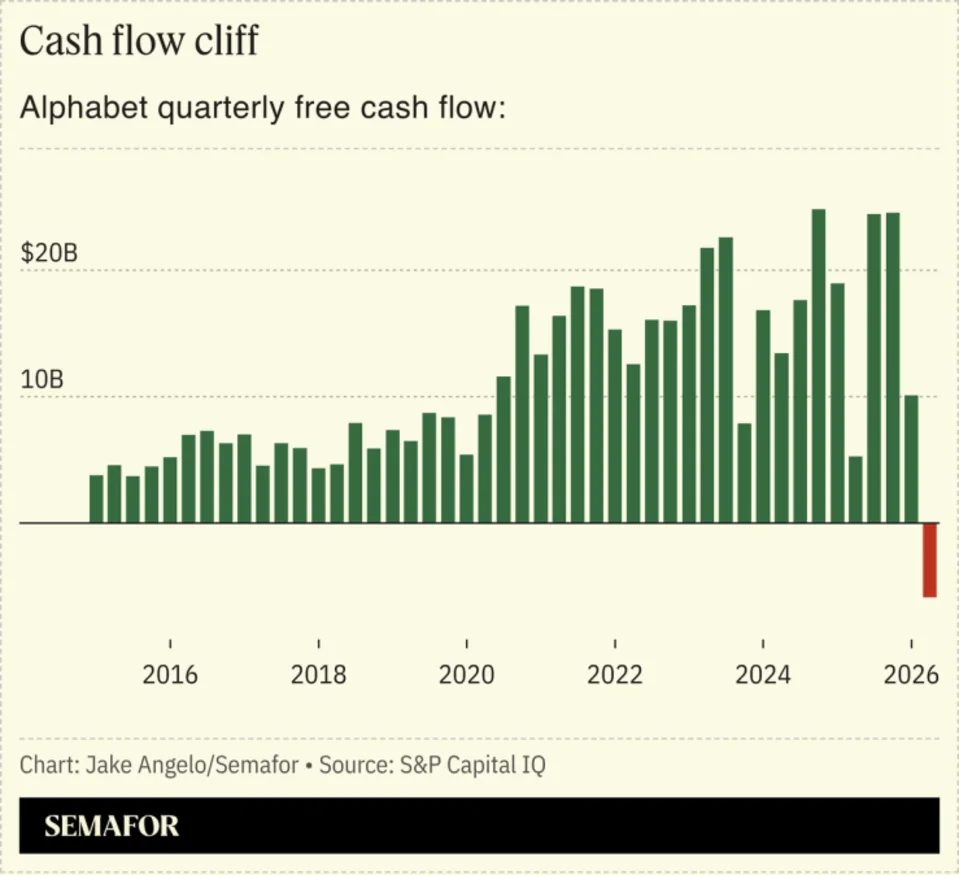
Alphabet posted negative free cash flow of $5.9 billion last quarter. That’s its first negative print since it went public in 2004. Management said this isn’t a one time blip either. The pressure will continue as AI investment deepens. The company also raised its full year capex guidance to $195-205 billion, up from $180-190 billion, with an even bigger jump expected in 2027.
Tesla told a similar story. It’s spending big on self driving cars and robots, including a new chip factory built with Intel and SpaceX. Its free cash flow also turned negative for the first time in over two years.
And it’s not isolated. Analysts expect Meta to report negative free cash flow next week too. Amazon already slipped into negative territory earlier this year. Across the industry, hyperscalers are now expected to spend over $750 billion on capex this year, and that estimate keeps climbing every earnings season.
Why this scares investors more than a bad quarter would
A single disappointing quarter is easy to explain away. But investors are worried about something structural. These companies are racking up debt to fund AI infrastructure, betting the payoff will be worth it eventually. Meanwhile, cheaper open source AI models are emerging that could undercut the very compute heavy systems being built.
Microsoft is the one exception here.
Despite planning to double its own capex this year, it’s still expected to generate over $16 billion in free cash flow for the quarter. That makes it the only major AI spender still comfortably printing cash.
It’s bigger than two stocks, and bigger than AI too
This selloff spread well beyond Alphabet and Tesla.
The semiconductor index has now fallen over 20% from its highs, technically a bear market. Chip heavy markets like Korea and Taiwan have been hit even harder, with Korean stocks down 25% from their June peak.
Some of this is unrelated to AI at all. Rising Middle East tensions have pushed oil prices sharply higher, making energy the best performing S&P 500 sector this year. Higher oil feeds inflation worries, which pushes bond yields up, and higher yields hurt expensive growth stocks like tech even more, since their value depends heavily on future earnings that get discounted more harshly when rates rise.
Beyond energy, other themes are quietly doing well too. Near-shoring has kept industrials strong, and pockets of healthcare, financials and materials have performed solidly. Heading into this earnings season, ten of eleven S&P sectors are expected to post positive earnings growth, six of them in double digits. AI is a big theme. It just isn’t the only one working right now.
A useful sign for portfolios
One encouraging data point rarely gets talked about. On days when semiconductor stocks have had sharp risk-off moves this year, the rest of the S&P 500 hasn’t necessarily followed.
That’s a healthy sign. It means a portfolio isn’t automatically wrecked just because chips have a bad week.
There’s also a quiet but important shift happening within tech itself. For years, semiconductor stocks and software stocks moved almost perfectly together. That correlation has broken down over the past year, as markets start asking a sharper question. Not “does AI win” but “who specifically wins from AI.” Software companies now face their own separate scrutiny, partly because AI tools are starting to challenge parts of the traditional software business itself.
Even within hyperscalers, the market is no longer treating everyone the same. For years, the formula was simple. Hyperscalers spend more, the market rewards them for growth, and the AI ecosystem benefits alongside them. That formula is breaking. Alphabet delivered strong cloud revenue and a growing order backlog, yet investors zeroed in on rising capex and shrinking cash flow instead. Investors are becoming more selective, trying to separate the hyperscalers that will earn a real return on this spending from those that won’t.
Two ways to read this
There are two competing stories doing the rounds right now.
The bearish view says this is the beginning of a reckoning. Skeptics who’ve long warned AI capex can’t keep growing forever feel validated. The fear is that all this spending won’t earn back its cost, especially if cheaper AI alternatives eat into demand.
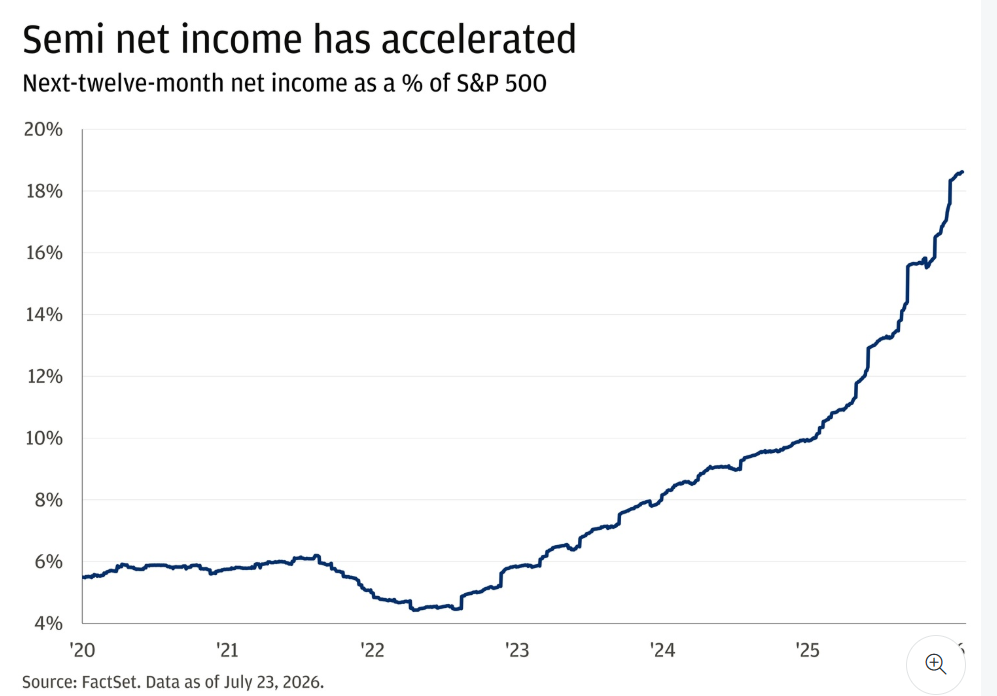
The bullish view says this is healthy, not scary. An equally weighted version of the S&P 500 actually hit an all time high the same week, meaning money isn’t leaving stocks. It’s rotating into healthcare, financials and other tech names instead. Chip sector profits are still expected to grow 133% year on year, and could account for nearly half of all S&P 500 earnings growth this quarter. That’s not the profile of a bubble bursting.
The real story
Strip away the noise and here’s what’s actually happening. This isn’t a growth story. Revenue at Alphabet, Tesla and the AI ecosystem broadly is still climbing. What’s being questioned is the cash flow story. Investors are asking whether they’re willing to keep funding years of heavy spending on a promise that the payoff is coming, without seeing proof in the numbers each quarter.
Some analysts think we’re still in the early innings of this cycle, especially as AI moves from simple chatbots into more autonomous, agentic use cases that touch far more of the economy than technology alone. If that’s true, today’s selloff is less an ending and more a stress test.
Either way, this is a very different, and much more precise, story than “the market doesn’t believe in AI anymore.” It believes in AI. It’s just no longer willing to pay for the belief without seeing the receipts.
