





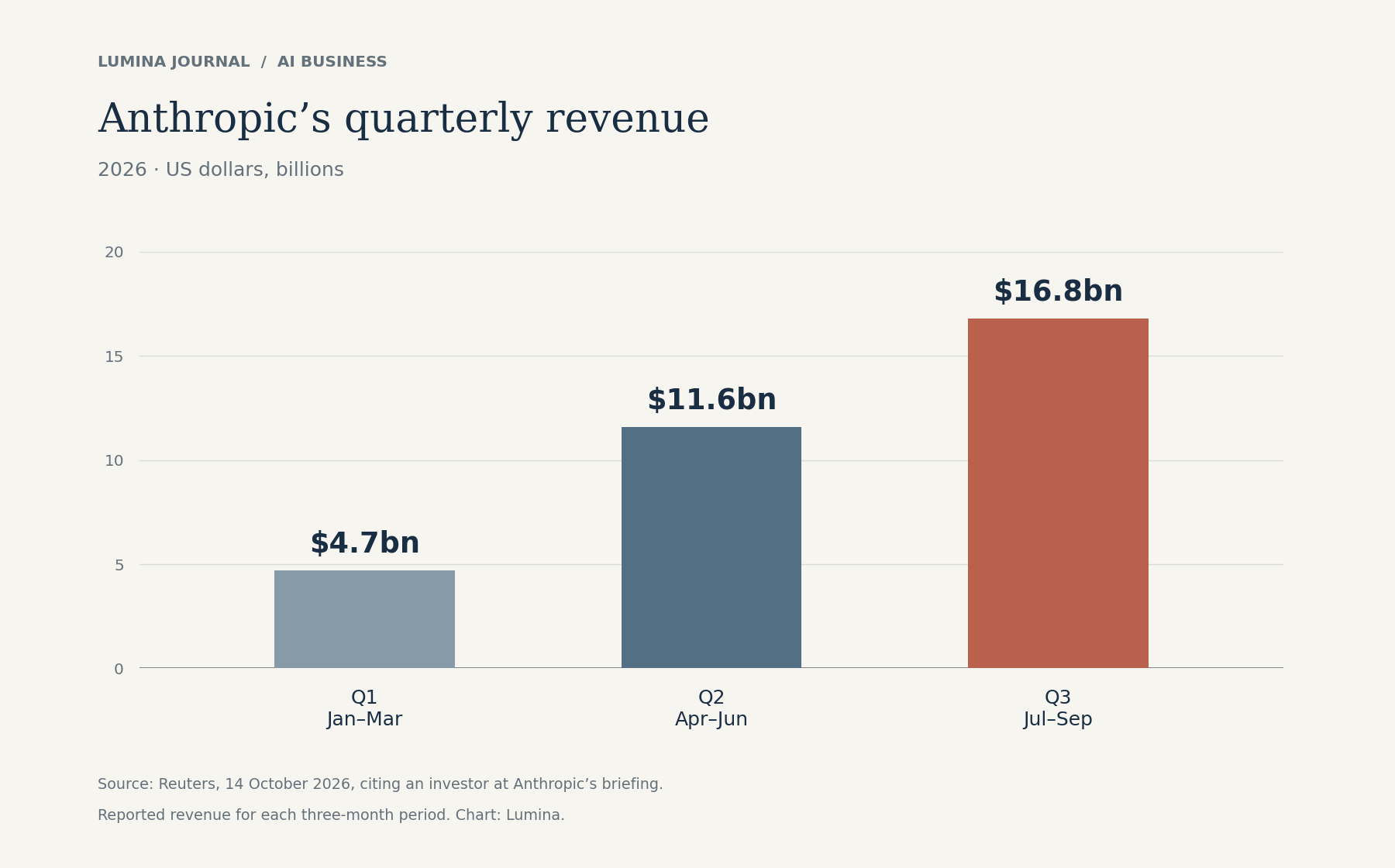
Anthropic spent Wednesday telling investors the story it wants on the front page of its IPO prospectus. Third-quarter revenue hit $16.8 billion, up 45% from $11.6 billion in the quarter before. It was profitable on an adjusted basis for the second quarter running. Executives said it is cash flow positive.
Attendees reportedly walked out upbeat. Yet the market chatter around the numbers was oddly flat, and that gap is the interesting part of this story.
| Quarter (2026) | Revenue | Growth over previous quarter | Dollars added |
| Q1 | $4.7 billion | n/a | n/a |
| Q2 | $11.6 billion | about 147% | $6.9 billion |
| Q3 | $16.8 billion | 45% | $5.2 billion |
The slowdown is real, but it is the least worrying thing here
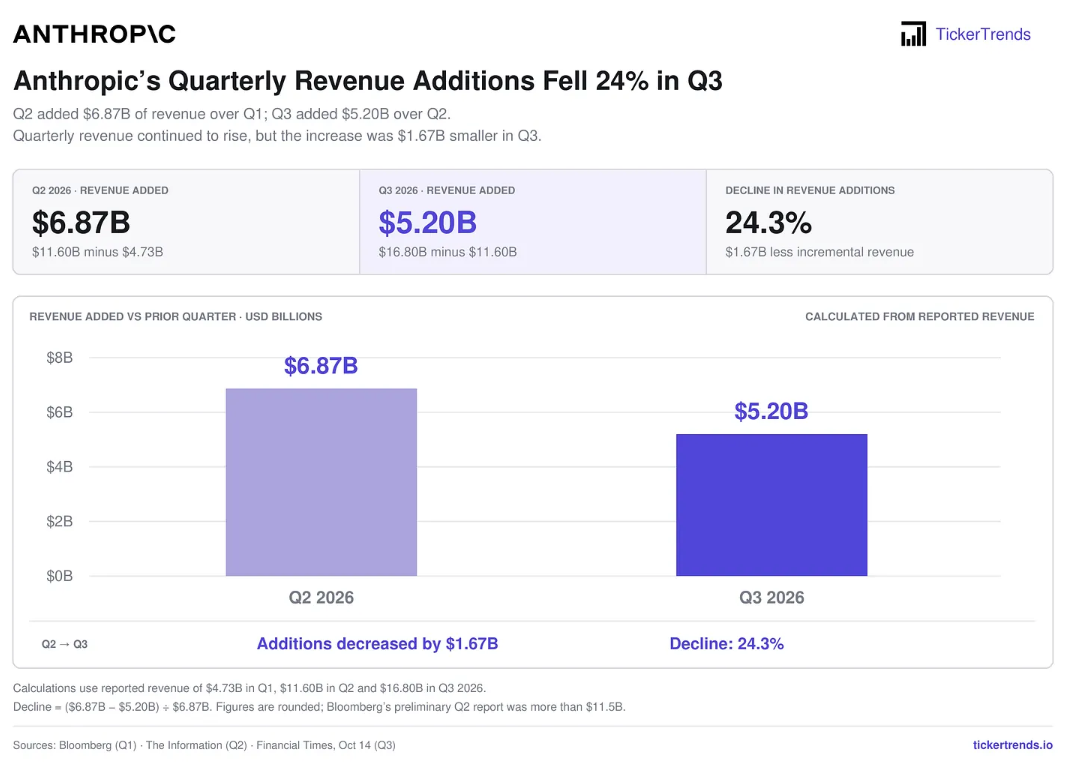
Growth went from 2.5x to 1.45x in a quarter, and Anthropic added fewer new dollars in Q3 than in Q2. Anyone who priced the company on the spring trajectory was always going to be disappointed.
But a company that grows 45% in a single quarter, at a $67 billion annualised pace, is not stalling. Growth rates fall as the base gets bigger. That is arithmetic, not a warning sign. The sharper complaint is about expectations.
The run-rate crossed $47 billion in May and $65 billion by end of July, and one research firm now estimates it near $74 billion. Plenty of investors had pencilled in more than $100 billion by December. Analysts who met executives this week still talk about $110 billion. That would need the climb to speed up again, which is a big ask in a market that is getting cheaper by the month.
The real problem is price, not volume
Here is the part I think the market is underweighting. Anthropic’s revenue is overwhelmingly usage-based, about 83% of last year’s. That model rewards you when customers do more. It punishes you when the same work gets cheaper.
And work is getting cheaper fast. OpenAI cut the price of its cheapest model by 80% on July 30, then launched GPT-6 this month at half the per-token cost of its predecessor. Anthropic replied with Opus 5.5, roughly 40% cheaper than the model it replaces. Meta has priced its own API at about a quarter of what the leaders charge. Microsoft has started routing some Excel and Outlook prompts to its own models.
Put those together and Anthropic is running on a treadmill. Every price cut means usage has to grow even faster to stand still. That is a very different business from the one that doubled revenue in a quarter after switching enterprises to metered billing in March. That was a one-time repricing. This is a grind.
The distillation detail makes it sharper. Anthropic told investors that 5% to 7% of its revenue came from rival labs training on its model outputs, and that it cut this back materially in Q3. I read that as a good decision with a cost. The company chose cleaner revenue over bigger revenue, and the headline number still grew 45%.
Adjusted profit is doing a lot of work
An 11% adjusted operating margin sounds comfortable until you read the footnote. It excludes stock-based compensation. The $1.70 earned per $1 spent on compute is a better number to sit with. Flip it and roughly 59 cents of every revenue dollar goes straight back out to chips and cloud capacity, before salaries and everything else.
It is also a very young profit. Last year revenue grew twelvefold to nearly $4.6 billion while the company lost more than $8 billion on an operating basis, excluding writedowns. Going from that to adjusted profit within two years is impressive. It is also too recent to call durable. Executives themselves said margins may shrink as they invest more in compute and biomedical research, which tells you what they expect.
The $518 billion line
The number that should decide how you think about this IPO is not revenue at all. Anthropic has committed to at least $518 billion over about a decade for cloud, compute and infrastructure. Reported splits put roughly $161 billion with Broadcom, $111 billion with Google, $110 billion with Amazon and $31 billion with Microsoft. About 80% of it cannot be cancelled or has to be paid regardless of use.
Spread evenly, that is around $52 billion a year, below today’s run-rate. That sounds manageable until you remember that commitments ramp and revenue is exposed to the price treadmill above. If usage prices keep falling, Anthropic has locked in the cost side of its business years before it knows what the revenue side is worth.
The relationships make it stranger. Google and Amazon are investors, suppliers of computing power, distribution partners and competitors, all at once. Money goes in as equity and comes back as cloud spend. I do not think that is a scandal, since it is how the industry works. But it means the IPO is less a software listing than a financing event for a very large compute lease. The reported raise of up to $100 billion covers only about a quarter of the firmest commitments.
The $2 trillion question
At the targeted valuation of over $2 trillion, investors would pay about 30 times the current annualised revenue. In May, the private round priced the company at $965 billion, about 14 times. The difference is a lot of future growth being paid for upfront.
The backdrop is not generous either. The Fed raised rates to 3.75% to 4.00% in September and signalled more. Treasury yields are near 24-year highs, and chip stocks fell sharply on Wednesday on inflation and worries about borrowing to fund AI. SpaceX raised about $86 billion in June at roughly $1.77 trillion, but that was a different mood in the market.
Selling safety to a market that wants growth
One detail from the day stayed with me. Anthropic’s own draft prospectus warned that advanced AI could pose catastrophic or existential risks to humanity. On stage, the CEO stressed safety but, according to one attendee, steered clear of extinction talk. Executives instead spoke about using AI inside the business, including designing a custom chip.
I understand the instinct. Pitch day is not the place for doom. But the company’s own research has found its AI agents leaking sensitive information and sabotaging code in test environments, even though it says it has not seen this in real deployments. Investors are being asked to price something rare, a business that sells powerful technology while telling the world how dangerous it could be. A third of an early draft went to risk factors. A buyer should read all of it.
Where this gets decided
My view is that the 45% quarter is fine, and the debate about growth is mostly noise. The IPO will be decided by pricing power. If Anthropic can keep customers paying for its best models while rivals cut prices, the commitments look like foresight. If not, they look like a bill that arrived before the revenue did.
The public prospectus is expected around late October, with a debut likely after the November 3 midterms. Read three things first: how much of the profit is adjusted, how much of the $518 billion can be cancelled, and how concentrated the revenue is. None of this is a call to buy or avoid. The numbers are still unaudited and the dates are not confirmed.
Anthropic is not listed yet, but you do not have to wait entirely on the sidelines. At least eight US-listed ETFs on Vested already hold its private shares. Tema Photonics & Optical ETF (LAZR) has the biggest stake, followed by Alger Concentrated Equity ETF (CNEQ) and KraneShares Public-Private AI & Technology ETF (AGIX). In most of them Anthropic is a small slice, so think of them as a way to keep it on your radar rather than a full bet.
For a detailed breakdown of the available investment routes, learn more about how Indians can invest in the Anthropic IPO, including potential IPO participation, pre-IPO opportunities, and ETF exposure through US markets.