





Key Takeaways
- This guide is for Amazon employees in India who receive or expect to receive RSUs as part of their compensation.
- Amazon RSU grants have historically used a back-loaded vesting structure, although the exact schedule can vary by grant and employee
- Employees may receive multiple RSU grants during their tenure.
- RSUs are generally taxed at vesting and again on subsequent capital gains.
- Sell-to-cover can help meet taxes on vested RSUs.
- Diversification can reduce Amazon stock concentration risk.
Amazon employees may receive RSUs as part of their compensation. Over time, these RSUs can become a significant part of an employee’s wealth as grants vest across multiple years.
But Amazon’s historically back-loaded vesting structure makes it especially important to understand when your shares vest, how they’re taxed, and how much of your portfolio is exposed to Amazon stock.
What are Amazon RSUs?
Amazon RSU, or Restricted Stock Unit, is a promise by Amazon to its employees to deliver equity shares once vesting conditions are met. Amazon RSUs are converted into actual Amazon shares that can be held or sold like any other ordinary company shares.
The number of RSUs granted generally depends on the grant value and the share price or valuation methodology specified in the grant agreement. However, not all the shares are delivered at once. Instead, the RSUs vest over time according to the vesting schedule, with the shares being delivered gradually as each portion vests.
What is Amazon RSU Vesting Schedule?
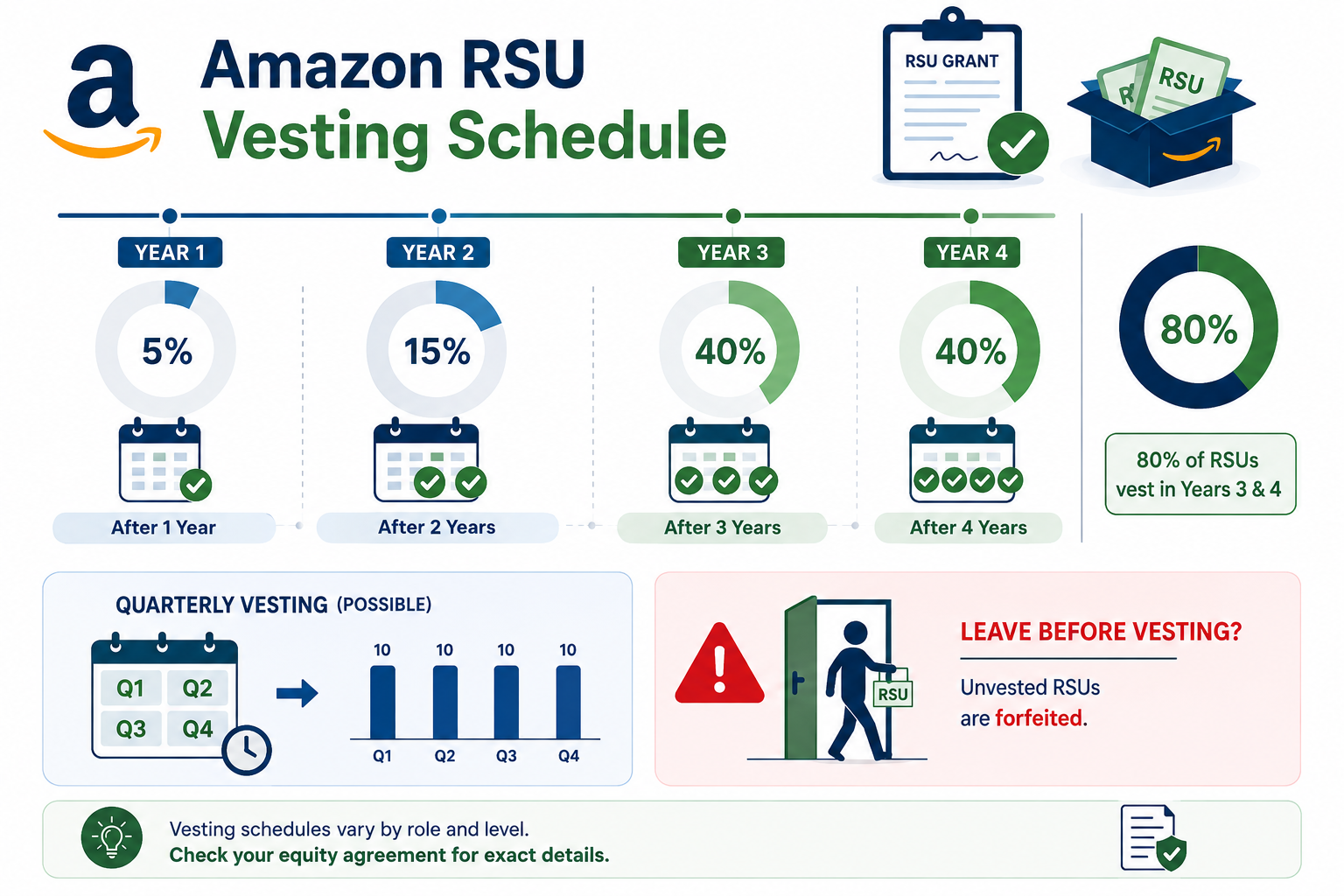
Amazon generally follows a longer vesting schedule for its RSU grants to employees compared to other tech giants. One of the distinct features of Amazon’s RSU vesting schedule is that the grants are backloaded. This means the larger part of the RSU grant vests closer to the end of the vesting schedule. Amazon has historically used a 5%-15%-40%-40% vesting schedule for many of its RSU grants. This is how it works:
- Year 1: 5% of the RSU grant vests after one year from the grant date
- Year 2: An additional 15% of the grant vests during the second year
- Year 3: An additional 40% of the grant vests during the third year
- Year 4: The remaining 40% of the grant vests by the end of the fourth year
Under this vesting schedule, Amazon vests 80% of the RSU grants in Years 3 and 4. This makes the schedule more backloaded than the standard frontloaded four-year vesting structure used by many technology companies. Senior management executives may have different and longer vesting schedules. Therefore, you should refer to your Amazon equity compensation agreement for the exact vesting schedule and dates.
For many employees, RSUs scheduled to vest in a particular year are released in quarterly installments. For example, if 40 RSUs are scheduled to vest during Year 3, 10 RSUs may vest each quarter, subject to the terms of the individual grant.
If you leave the company before the scheduled vesting date, any unvested RSUs are typically forfeited, subject to the terms of your grant agreement.
What are the Types of Amazon RSUs?
Amazon typically offers multiple RSU grants to employees during their tenure at the company. They are intended to form an important part of an employee’s long-term compensation and typically come with a multi-year vesting schedule.
New-hire RSU Grants: These are RSUs granted when an employee joins Amazon as part of their overall compensation package. However, not every employee necessarily receives a new-hire RSU grant. Amazon may offer these grants to attract and retain talent, particularly for roles where an employee’s skills, experience, or responsibilities are considered valuable to the company.
Annual or Refresh RSU Grants: Amazon may provide additional RSU grants to employees as part of its annual compensation review exercise. These RSU grants will have their own vesting schedule, and the terms of the grant and vesting schedule may differ compared to new-hire grants.
Additional RSU Grants: These are additional RSU grants that may be offered in connection with a promotion, retention, or other circumstances. The vesting schedule of these grants can be very different. For example, in 2021, Amazon granted its CEO, Mr. Andrew Jassy, a unique restricted stock unit in connection with his promotion to CEO. More than 80% of the grant is scheduled to vest from 2026 through 2031.
Source – Sec Gov
How are Amazon RSUs Calculated?
Amazon generally mentions the RSU grants in dollar value to employees in its grant agreement. The number of RSUs can broadly be calculated as:
Number of RSUs = RSU grant value / Amazon share price around grant date
Amazon does not publicly specify a single calculation methodology that applies to every RSU grant. The number of RSU units awarded is determined at the time of the grant, after which the shares generally vest according to the predetermined schedule.
For example, an employee receives an RSU grant award worth $50,000, and Amazon’s share price used for the grant is $220.
$50,000/ $220 = ~227 RSUs
The employee would therefore receive nearly 227 RSUs, subject to the terms of the grant.
What is the tax rate on Amazon RSUs?
Amazon RSUs can have two separate tax implications: taxation when the RSUs vest and capital-gains taxation when the shares are subsequently sold.
1. Perquisite tax on Amazon RSU vesting in India
For an employee in India, RSUs are generally taxable as a perquisite under the head of salary when the shares vest. The taxable value is generally based on the fair market value of the shares at vesting. The value of vested RSUs is converted into Indian rupees using the applicable exchange rate and valuation rules and added to taxable income.
For example, suppose 100 Amazon RSUs vest when the company’s share price is $250 per share. The total value of the shares at vesting would be $25,000. For an Indian employee, this amount would be converted into INR and included as taxable salary income, with tax payable at the applicable income-tax slab rate.
A portion of the shares may be withheld or sold by the company to meet the applicable tax withholding requirement. This is commonly referred to as the sell-to-cover method for Amazon RSU taxes. The employee receives the remaining shares after the required tax amount has been covered.
2. Capital Gains Tax When Selling Amazon RSU from India
When you sell the vested Amazon shares later, any change in their value after vesting is generally subject to capital gains tax.
For capital gains purposes, the value that was considered taxable as a perquisite at vesting generally becomes the cost basis of the shares. If you later sell the shares above that rate, the value represents a capital gain and is taxed accordingly. For example, if the fair market value of Amazon shares was $250 on the vesting day and you later sold them for $280, the $30 difference per share would generally be considered a capital gain.
For taxation purposes, the period of holding is considered important. If you sell the shares after holding them for more than 24 months after vesting, the gain is treated as a long-term capital gain. Long-term capital gains are currently taxed at 12.5% plus applicable surcharge and cess, as per the Income Tax Act 2025.
If the holding period is less than 24 months, the gains are treated as short-term capital gains and taxed as per your income tax slab.
How to Manage Amazon RSUs
Once Amazon RSUs vest, you need to decide how the shares fit into your broader investment portfolio. Some factors to consider include: 1. Don’t treat vested RSUs as separate from your portfolio: Once RSUs vest, they are part of your investment portfolio. They came as compensation but should not be the reason to hold them if they don’t fit into your investment goals.
2.Set a target allocation for Amazon shares: Many investment advisors suggest not holding more than 10 to 15% of your overall investment portfolio in a single stock. If the Amazon shares exceed that allocation, consider selling them to reduce concentration risk.
You can use Vested Finance to sell your Amazon RSU shares and diversify your holdings to other US stocks and global funds. You can easily manage your global investments on the platform.
3. Don’t ignore employer concentration risk: An Amazon employee already depends on Amazon for their salary and future compensation. Holding a large amount of Amazon stock adds another layer of financial exposure to the same company. If the stock price declines, it can impact your finances.
The decision to hold or sell Amazon RSUs should be based on your long-term financial objectives and portfolio status. It should not be based on the fact that shares are received as compensation; therefore, you will continue to hold them.
Amazon RSUs: From Vesting to Diversification
Amazon RSUs can contribute significantly to your wealth creation journey, but you should have a clear plan for managing them. From tracking each vesting date, how many RSUs will vest, to understanding the tax liability at vesting, you need to be on top of your RSU plan.
Since Amazon has historically used a back-loaded vesting structure, the value of shares vesting in later years can be significantly higher, potentially increasing the associated tax liability.
Once shares vest, treat them like any other investment. Hold them if they fit your portfolio strategy and sell enough to diversify if your Amazon exposure becomes too high.
Frequently Asked Questions
How to Diversify an Amazon RSU Portfolio Safely?
To diversify your Amazon RSU portfolio, first you need to set a target allocation for Amazon shares. If the allocation exceeds that limit, sell a portion of vested RSUs and invest the proceeds across diversified assets such as US stocks, ETFs, or global funds.
Are Amazon RSUs taxed in India?
Yes, Amazon RSUs are taxed in India as salary income when they vest. The value of the shares at vesting, converted into INR, is added to taxable salary income.
Should I sell Amazon RSUs when they vest?
There is no universal answer. The decision to sell should depend on your Amazon exposure, investment goals, risk tolerance, and overall asset allocation.