


With the Anthropic IPO approaching, one question keeps coming up among Indian investors: how can they invest in it?
Most investors in India are familiar with how an IPO process works in the domestic market. They usually check the price band, apply through their broker’s app using UPI, wait for the allotment, and track the stock on listing day. A few weeks ago, many investors followed exactly this process for the Jio Platforms IPO.
As a result, it is quite natural to assume that a US IPO works the same way, but it does not.
This raises several questions, such as whether Indian residents can apply at all, who sets the price, why there is no price band or lottery, which documents are worth reading, and when the stock starts trading in India.
The short answer is that a US IPO works very differently from an Indian one, and in most cases, Indian residents cannot get shares at the IPO price.
They can still invest in the company, but it helps to understand how the US process works first.
For context, Anthropic, the company behind the Claude AI models, made its IPO filing public in October and set a price range of $70 to $78 per share in November. Its shares are expected to start trading on Nasdaq later this month.
This guide explains each of these points step by step. It starts with how an IPO works in India, using the Jio Platforms IPO, and then explains how it works in the US, using the SpaceX IPO from June. It then compares the two systems point by point and ends with what Indian investors can do when a large US IPO, such as Anthropic’s, comes to market.
The quick answer
If you only have a minute, here is how the two compare:
| India | US | |
|---|---|---|
| Regulator | SEBI | SEC |
| Does the regulator approve the IPO? | No, it gives observations on disclosure | No, it reviews disclosure |
| Main documents | DRHP, then RHP | Form S-1, then the preliminary prospectus |
| Price | Price band, set by SEBI’s rules | Indicative price range; final price can fall outside it |
| Retail quota | At least 35% in most main-board IPOs | None |
| Who gets shares when demand is high | Lottery among retail applicants | Decided by the underwriters and brokers |
| How you apply | Through any broker, using UPI and ASBA | Only through brokers invited into the IPO |
| Subscription data | Published live by category | Not published |
| Time from closing to listing | Three working days (T+3) | Trading starts the morning after pricing |
| Can Indian residents apply? | Yes | Generally no; they can buy after listing |
Now let us understand each of these in more detail.
How an IPO works in the US: the SpaceX example
SpaceX listed on Nasdaq on 12 June 2026 and raised about $86 billion, the largest IPO in history.
Its journey covered the same broad ground as Jio’s, but almost every step worked differently, and it involved several people and terms that most Indian investors have never come across. Let us go through them one by one.
Here is the whole process at a glance:
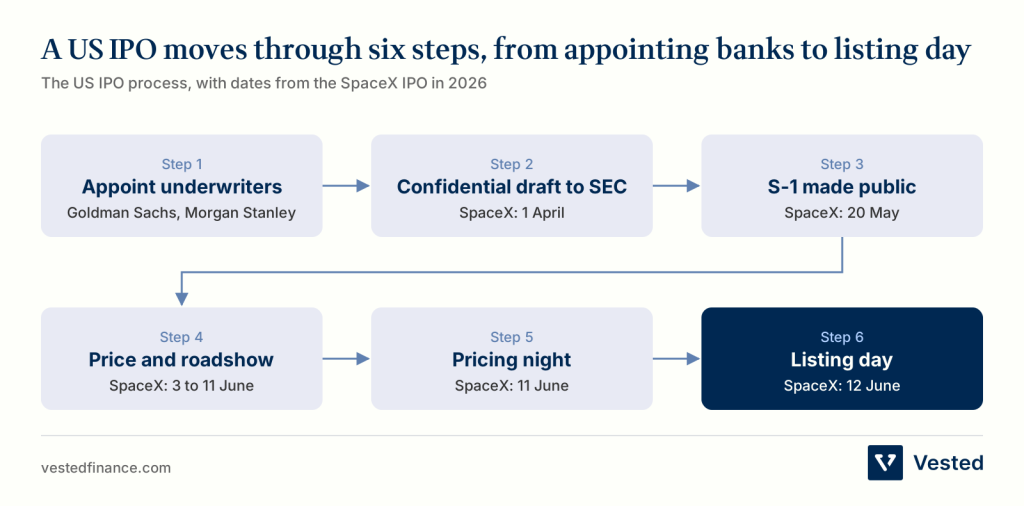
Step 1: Appointing the underwriters
A company going public hires investment banks called underwriters, the US equivalent of India’s merchant bankers.
They check the company’s accounts (due diligence), prepare the documents, value the company, market the IPO, set the final price and decide who gets the shares.
The name comes from how they take on risk.
In most US IPOs, the banks sign a firm commitment: they agree to buy all the shares from the company at a fixed price and resell them to investors.
For example, if a company sells 10 million shares at $20 per share, the banks might pay $19 per share and sell to investors at $20 per share, earning $10 million.
This difference is the underwriting discount, typically 5% to 7% of the money raised.
In practice, the commitment is signed only on pricing night, after the banks have seen the order book.
In India, merchant bankers usually carry far less risk. If an Indian IPO does not receive 90% of the shares on offer, it simply fails, and the money is returned.
A large IPO is run by a syndicate. SpaceX’s lead underwriters were Goldman Sachs and Morgan Stanley; co-managers included JPMorgan, Bank of America and Citigroup; and a selling group of retail brokers, Robinhood, Fidelity, Charles Schwab, SoFi and E*Trade, distributed shares to individual investors.
Step 2: A confidential filing
In India, the DRHP is public from the day it is filed. In the US, most companies first privately file a draft registration statement with the Securities and Exchange Commission (SEC).

The SEC reviews it and sends questions, called comment letters, and the company can quietly shelve its plans if markets turn. SpaceX filed confidentially on 1 April 2026.
Step 3: The public S-1
The company then makes its registration statement, Form S-1, public.
This is the US equivalent of the DRHP, covering the business, audited financial statements, risks, use of funds, ownership, and executive compensation.
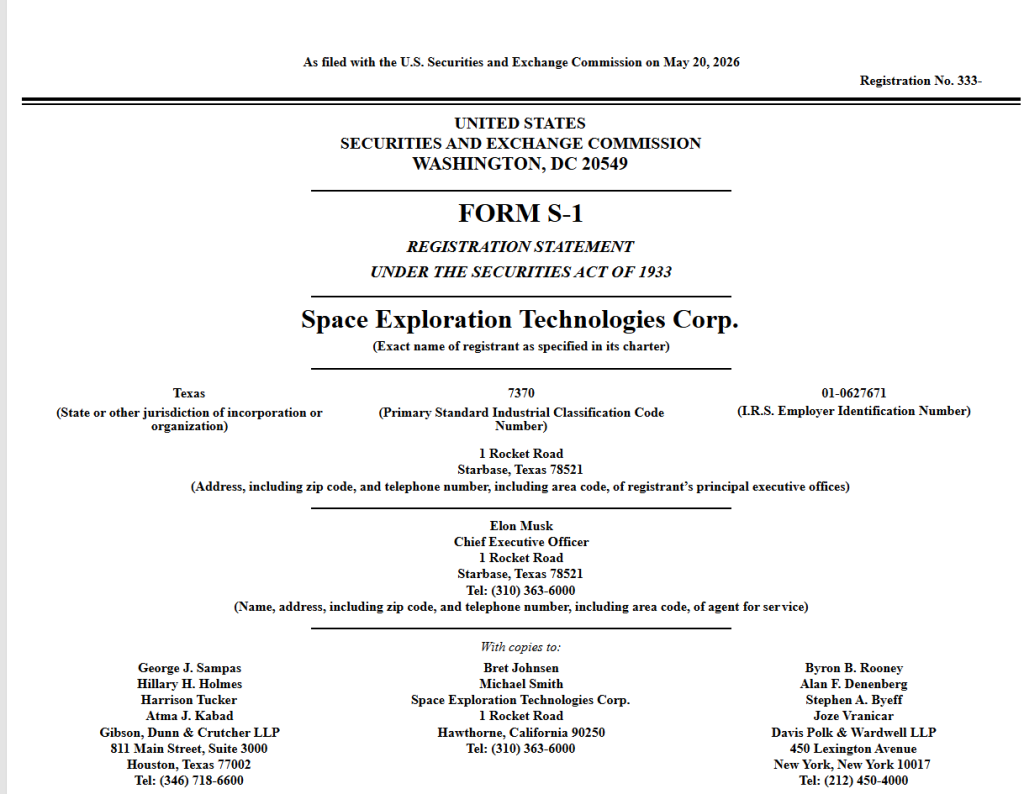
It must be public at least 15 days before marketing begins. SpaceX’s S-1 went public on 20 May 2026.
Step 4: The price range and the roadshow
The company updates the S-1 with an expected price range. This version, called the red herring, serves as India’s RHP.
Management then spends about five to nine days on a roadshow, pitching the IPO to large investors, who tell the underwriters how many shares they want and at what price.
Collecting these orders is called book building.
Unlike in India, there is no public bidding window; all orders go through the underwriters or the selling-group brokers. SpaceX skipped the range and set a fixed price of $135.
Step 5: Pricing night
At the end of the roadshow, the SEC declares the registration effective, and that evening the company and its lead underwriters fix the final offer price based on the orders received.
The underwriters then decide which investors get shares. There is no lottery. SpaceX confirmed its pricing on 11 June 2026.
Step 6: Listing day
The shares start trading the next morning.
However, a new IPO does not trade at the 9:30 am New York market open.
The exchange first has to find a price at which buyers and sellers agree. On Nasdaq, this happens through an auction called the IPO Cross:
- Nasdaq collects buy and sell orders from early morning without matching them.
- During a display-only period of about 10 minutes, it publishes a live indicative price, the number of shares that would be traded, and any imbalance between buyers and sellers.
- The lead underwriter, acting as the stabilization agent, decides when the stock is ready to open. This can take minutes or hours.
- Nasdaq matches all orders at the single price where the most shares change hands. This becomes the official opening price.
SpaceX opened at $150, about 11% above its IPO price. On the NYSE, a designated market maker sets the opening price instead.
None of this auction data is visible on a regular broker app.
During the IPO Cross, the stock simply shows as not yet trading, and most platforms accept orders only once it is active. After opening, a safety mechanism called Limit Up-Limit Down can briefly pause trading if the price moves more than 10% too quickly.
Underwriters can also use a greenshoe option to sell up to 15% more shares if demand is strong; SpaceX’s underwriters used it, taking the total raised to about $86 billion. Insiders are usually barred from selling for around 180 days under a private lock-up agreement.
The key differences
1. What the regulator does. Neither SEBI nor the SEC approves an IPO as a good investment; both review disclosure. The difference is in how many rules they set. SEBI decides who can list, how shares are divided, how wide the price band can be, and how quickly shares must list. The SEC sets very few such rules; the exchanges and the company’s bankers decide most of them.
2. Who can list. In India, a main-board IPO generally needs a three-year track record of profits under SEBI’s rules, along with exchange requirements such as post-IPO paid-up capital of at least ₹10 crore. Companies without that record must give at least 75% of the IPO to institutions. In the US, there is no profit test. The exchanges set size and liquidity standards instead, such as at least 400 to 450 shareholders and $40 to $45 million of shares in public hands on the NYSE and Nasdaq’s top tier, so loss-making companies can still list.
3. Documents. The documents map onto each other closely:

The key difference is timing: the DRHP is usually made public months before an Indian IPO, whereas a US S-1 is often made public only weeks before.
India also requires an abridged prospectus, a short summary, with every application; the US equivalent is the prospectus summary at the start of the S-1.
4. Price. In India, the upper end of the price band may be at most 20% above the lower end, and the final price must fall within that range. In the US, the price range is only a guide, and the final price can be above or below it.
5. Who gets the shares. This is the biggest difference.
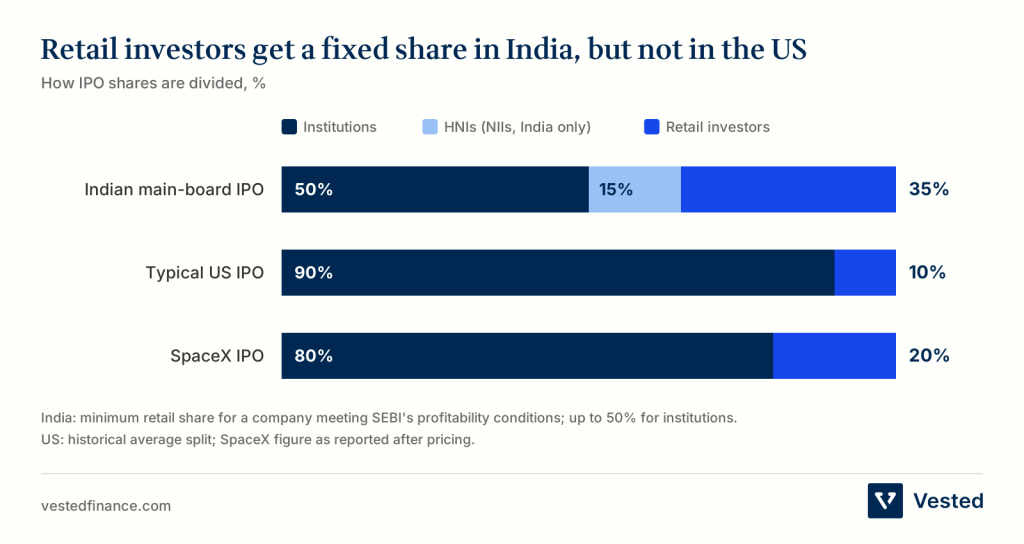
In India, SEBI reserves at least 35% of most IPOs for retail investors, and an oversubscribed retail portion is allotted by lottery, so applicants usually get one lot or nothing.
In the US, there is no retail quota. Underwriters typically give about 90% of shares to institutions, which buy in size and are seen as long-term holders.
Retail investors can get shares only through invited brokers, each with its own rules. SpaceX was unusual in giving about 20% to retail investors.
6. Applying, data and timelines. In India, any investor can apply through UPI, live subscription figures are published, and shares list within three working days. In the US, there is no official subscription data, US brokers often penalise investors who sell IPO shares quickly, and shares trade the morning after pricing.
7. Lock-ins. India’s lock-ins on promoters and anchor investors are set by SEBI. US lock-ups are private agreements, usually around 180 days, and their expiry can put pressure on the share price.
What this means for Indian investors
Indian residents will almost never get shares in a US IPO at the IPO price. They can, however, buy the shares once they start trading, through platforms that let you invest in US stocks from India under the RBI’s Liberalized Remittance Scheme, which allows up to $250,000 a year to be invested abroad.
A few practical points help on listing day:
- Timing: 9:30 am in New York is 7:00 pm in India from March to early November and 8:00 pm the rest of the year, and a large IPO can open hours later. Check the US market timings in India before listing day.
- Availability: a new stock may not be available to trade at first; orders are generally accepted only once it is active.
- Order type: prices can swing sharply early on, so a limit order gives more control over the price paid than a market order.
- Price: buying after listing means paying the market price, not the IPO price. SpaceX opened at $150 against an IPO price of $135, and a few months later the SpaceX share price was trading below its IPO price.
The Indian system is built to give small investors a fair chance at shares; the US system is built around the judgment of the company and its bankers. Understanding that difference is the first step to investing sensibly in a large US IPO such as Anthropic’s, or any of the other upcoming US IPOs in 2026.
This article is for educational purposes only and should not be considered investment advice or a recommendation to buy, sell or hold any security. IPO figures are based on publicly available information and may change.