


Update: Anthropic has priced its IPO at $83 per share, above the indicated range of $70–78, and is set to begin trading on Nasdaq today under the ticker ANT. Indian investors can access Anthropic shares through Vested Finance.
The valuation of around $1.5 trillion reflects investors’ confidence in the commercial potential of the company’s Claude AI models. But beneath the excitement, there lies a significant operational risk you cannot ignore.
The amended S-1 filing on 10 November shows a problem that money alone cannot solve.
The company has committed nearly $901 billion to secure computing capacity, but delays in data-centre construction and higher demand mean it is having to rely on expensive short-term rentals. Its latest quarter results show the first clear sign of stress.
Now the question is no longer whether Anthropic can raise enough capital. It is whether its partners can deliver the computing capacity they have already committed.
How Anthropic meets its computing needs
Training and running AI models requires enormous computing power. This comes from specialised chips housed in large data centres. Anthropic does not build or own all this infrastructure itself. It secures computing power from third-party providers such as Amazon, Google, Microsoft, SpaceX, Nscale, and Lambda.
Anthropic relies on two types of arrangements: long-term and short-term contracts.
Under long-term contracts with data-centre operators, Anthropic reserves computing capacity for several years, often before the infrastructure is ready. This means the company secures future supply in advance, but the capacity may take months or even years to become operational.
Short-term capacity, on the other hand, is available sooner and helps Anthropic meet immediate demand while it waits for those projects to be completed. The trade-off is higher costs.
This creates a timing gap: Anthropic has to secure future capacity well in advance while paying for computing power it needs today. If long-term projects are delayed or demand outpaces available supply, its reliance on expensive short-term capacity increases.
When securing computing power starts hurting margins
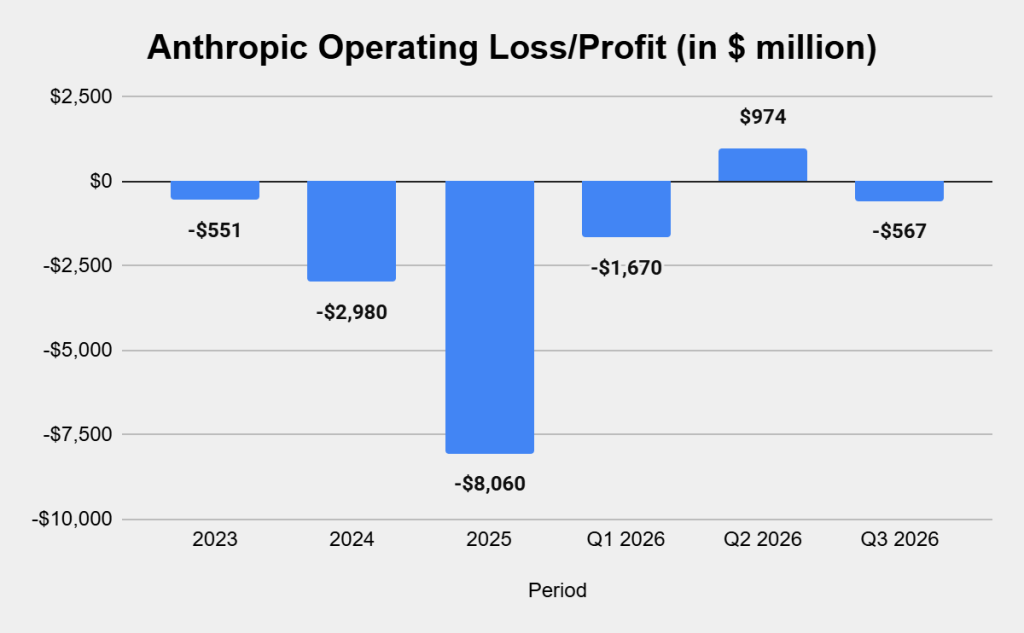
In Q2 2026, Anthropic posted its first quarterly operating profit of $974 million. A quarter later, it swung to an operating loss of $567 million, even as revenue climbed 46.7% sequentially to $16.96 billion.
The biggest pressure came from computing and infrastructure costs, which jumped 77.5% quarter-on-quarter, from $5.56 billion in Q2 to $9.86 billion in Q3. The reported loss was also affected by a one-time, non-cash charge of approximately $2 billion related to its donation-matching programme. Excluding this charge, Anthropic would have remained profitable at the operating level. However, the surge in computing expenses points to a more persistent challenge: the cost of securing enough capacity to meet growing demand.
The divergence is becoming more important when viewed against incremental revenue. Between Q2 and Q3, Anthropic added approximately $5.4 billion in revenue, but its computing expenses increased by $4.3 billion, equivalent to nearly 80% of incremental revenue.
$900 billion in commitments, but capacity takes time
Anthropic’s amended S-1 filing puts its aggregate long-term computing spending commitments at approximately $900.9 billion. Of this, around $70.7 billion is due over the next 12 months.
But long-term computing contracts don’t guarantee that capacity will be available on demand. There may be delays in delivery due to logistical issues. Simultaneously, customer demand can outpace the supply of operational computing capacity. Anthropic then has to fall back on short-term rentals to bridge the gap.
Recent developments have shown that the risk is real. Apart from Google, Amazon, and Microsoft, Anthropic has partnered with Neocloud providers Nscale and Lambda to secure additional computing capacity. Their agreements together account for approximately $85.9 billion.
Nscale is on schedule to meet the delivery timelines. But Lambda has already missed a key milestone. Under the August 2026 agreement, $34.9 billion of the $41.3 billion commitment is subject to termination if Lambda fails to secure the required facility lease by the agreed date.
While there is no financial loss for Anthropic from this delay securing the lease, the concern in forward looking. If demand keeps growing and Lambda’s capacity arrives late or never, Anthropic would have to buy more short-term compute.
Short-term rentals are adding to the cost burden
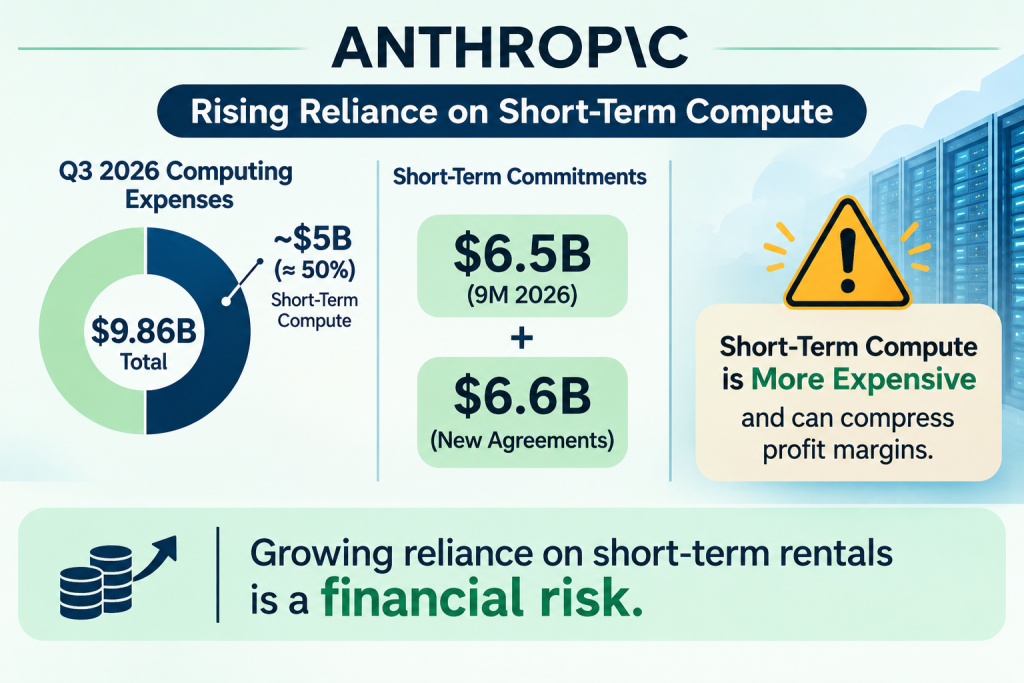
In Q3, Anthropic spent roughly $5 billion on such capacity, nearly half its total computing expenses. For the nine months ended September 2026, this spending stood at $6.5 billion. The company has since signed another $6.6 billion in short-term agreements, taking its short-term commitments to around $24 billion.
This is where the infrastructure bottleneck becomes a financial problem. Delays in contracted capacity can force Anthropic to rely on temporary alternatives, adding to its operating costs.
Anthropic has acknowledged that such short-term compute is more expensive on a per-unit basis and can compress profit margins.
The company does not disclose what the same capacity would have cost under long-term contracts, so the exact premium cannot be calculated. But the growing reliance on short-term rentals is difficult to ignore.
Anthropic’s SpaceX deal: the biggest bridge
Anthropic’s agreement with SpaceX’s Colossus cluster illustrates the financial cost of securing computing power before its long-term infrastructure is ready.
Colossus is a large-scale AI data centre originally built by xAI. It houses thousands of specialised Nvidia GPUs that provide the computing power needed to train and run AI models such as Grok.
SpaceX’s own filing mentioned that Anthropic is paying $1.25 billion a month through May 2029, with a reduced fee while capacity ramped up.
Anthropic’s S-1 describes a much larger arrangement: up to $120.5 billion over terms extending into 2029, about $3.1 billion a month once all capacity is delivered, which it expects in December 2026.
The initial arrangement covered more than 220,000 Nvidia GPUs and over 300 megawatts of capacity. SpaceX’s subsequent filing refers to around 325,000 GPUs across Colossus and Colossus II. The deal helps Anthropic secure computing power to meet immediate demand, but the financial commitment is substantial.
There is also a renewal risk. The initial contract periods end in January and March 2027, after which either party can terminate the arrangement with 90 days’ notice. This creates a potential negotiating risk. SpaceX’s AI model Grok also runs on the same Colossus infrastructure, and Elon Musk has publicly said that SpaceX is not committing to long-term leasing of Colossus.
If renewal pricing is negotiated, even a 20% increase in pricing at peak monthly rate would add approximately $7.4 billion to annualised costs.
Macro Realities: The Constraints Capital Cannot Solve
The bigger bottleneck is the infrastructure supply chain. Large electrical transformers, liquid-cooling skids, and industrial gas turbines currently require three to five years to procure. Chip supply remains concentrated among a handful of manufacturers. Grid constraints, local opposition to data centres, and export restrictions add to the delays.
This creates a timing mismatch. Anthropic plans compute procurement 12-18 months in advance, but the supporting infrastructure can take several years to become operational. If partners miss delivery milestones, finding replacement capacity will be difficult when other AI developers are competing for the same resources.
What investors should watch
The key indicators are not just the size of Anthropic’s commitments, but how quickly the company can turn them into usable capacity.
Is computing commitments arriving on time: Whether partners are delivering the contracted computing capacity on schedule, particularly after Lambda missed a key lease deadline. Delays could leave Anthropic short of long-term capacity and force it to rely on expensive short-term rentals.
SpaceX renewal: The pricing and terms when the initial contract periods expire in January and March 2027. The December capacity-delivery target is another milestone to watch.
Cost of incremental revenue: How much additional compute and infrastructure spending is required for every dollar of new revenue. In Q3, compute costs rose by $4.3 billion against incremental revenue of $5.4 billion. Whether this gap narrows will indicate if revenue growth is translating into better operating leverage.
Margins: Compute and infrastructure costs rose to 58.2% of revenue in Q3, while adjusted operating margin fell to 15% from 19% in Q2. Whether these numbers improve will show if capacity constraints are easing.
Delivery, not funding, is the next big test
Anthropic has secured compute commitments on an extraordinary scale. But signing contracts is only one part of the equation. The harder task is getting the capacity delivered, connected to power, and ready for use.
Q3 showed the cost of that gap. Anthropic’s revenue continued to grow, but spending on compute rose faster, pushing up its share of revenue and weighing on margins. Until long-term capacity becomes operational, the company may have to rely on expensive short-term rentals to meet demand.
For investors, the real measure of progress will be how quickly contracted capacity turns into usable compute. That will determine whether Anthropic can sustain its growth without letting infrastructure costs consume an increasing share of revenue.