






| Quick answer: Yes, Indian investors can invest in South Korea stocks from India through platforms like Vested, via ETFs like iShares MSCI South Korea ETF (EWY), subject to applicable LRS, tax and regulatory rules. |
South Korea is one of the few markets that offers exposure to AI, semiconductors, EV batteries, and automobiles within a single economy. It is home to several global leaders, including Samsung Electronics, SK Hynix, and Hyundai, giving investors access to businesses that are deeply integrated into global technology and manufacturing value chains.
Beyond these structural growth drivers, the country’s investment landscape is also evolving. Improving corporate governance, increasing dividend payouts & share buybacks, and the government’s value-up reforms are contributing to rising shareholders’ returns. The country’s primary stock market index, KOSPI, delivered nearly 75% returns in 2025, making it the best-performing major equity market globally.
For Indian investors, investing in South Korea provides an opportunity to benefit from long-term structural themes. In this blog, we will explain how to invest in the South Korean market from India.
Can Indians Invest in South Korean Stocks?
Yes, investing in South Korean stocks is legal in India via the Liberalised Remittance Scheme (LRS). Under this framework, resident Indians can invest up to $250,000 in foreign stocks, including South Korean stocks and ETFs.
Direct investment in South Korean-listed stocks is possible, but it is not as straightforward as investing in US stocks. Foreign investors must comply with local account opening, identity verification, and regulatory requirements, which can make the process more cumbersome for retail investors.
Ways to Invest in the South Korea Market
There is no single route to invest in South Korea. The right approach depends on how direct you want your exposure to be.
Korean Companies Listed Globally
While direct investment in Korean-listed companies remains difficult for foreign investors, some Korean companies are also listed overseas, making them easier to access.
Indian investors can buy South Korean companies listed on US exchanges as ADRs, such as POSCO and KB Financial Group.
Global Funds with Korea Exposure
One of the simplest ways to invest in top stocks in Korea is through a Korea-focused global UCITS fund. These funds typically include exposure to leading Korean companies, such as Samsung and Hyundai, as part of a broader allocation across markets such as China and India. Such funds are best suited for investors seeking diversification across multiple geographies, rather than pure South Korea exposure. The following are some examples of Korea-focused UCITS funds:
Schroder Emerging Asia UCITS Fund: The fund primarily invests in equities of companies in emerging Asian markets. It allocates at least two-thirds of assets to equity securities of companies in emerging Asian markets, including China, India, Korea, Taiwan, and ASEAN countries.
Morgan Stanley Asia Opportunity UCITS Fund: The fund follows a concentrated investment approach, targeting companies with strong competitive advantages and sustainable earnings potential. The fund’s South Korea exposure is nearly 30% of the portfolio, followed by China and India.
Franklin Global Technology UCITS Fund: It invests in technology companies worldwide, including firms that benefit from Asia’s growing electronics manufacturing ecosystem. The fund provides direct exposure to South Korea’s expanding role in global technology and semiconductor supply chains.
Korea-focused ETFs
You can also invest in leading Korean companies through Korea-focused ETFs listed on US exchanges. While these ETFs may not offer the same tax efficiency as global UCITS funds, they provide a simple way to gain diversified exposure by tracking indices such as the KOSPI.
Examples include iShares MSCI South Korea ETF and Franklin FTSE South Korea ETF.
ETFs that are partly exposed to the South Korean market include JPMorgan Beta Builders Emerging Markets Equity ETF, iShares MCSI All Country Asia ex Japan, and iShares Asia 50 ETF.
Disclaimer: The securities discussed in this article are for educational and informational purposes only and should not be construed as investment advice or a recommendation to buy or sell any stock.
Why Invest in the South Korea Market?
Three structural changes are reshaping South Korea’s investment story, a combination that is rare to find in a single market.
AI & Semiconductor Cycle
South Korea is a global leader in semiconductors, EV batteries, automobiles, and electronics manufacturing. As AI adoption accelerates, the country is well positioned to benefit because it dominates the global memory chip market.
According to industry estimates, the global AI semiconductor market is projected to grow from around $50-70 billion today to over $200 billion by 2030, driven by rising investments in AI data centres and high-performance computing.
South Korea dominates the global memory chip market, accounting for around 60% of DRAM and nearly 50% of NAND flash production through companies like Samsung Electronics and SK Hynix. As AI models require significantly more high-bandwidth memory and storage, demand for South Korean semiconductor manufacturers is expected to increase.
Korea Value-up Reforms
The Korea Value-Up Programme, launched by the South Korean government in 2024, aims to improve shareholder returns and reduce the long-standing “Korea Discount”.
Under the initiative, listed companies are encouraged to enhance corporate governance, improve capital allocation, increase dividend payouts and share buybacks, and disclose plans to boost shareholder value.
Export-Driven Growth Model
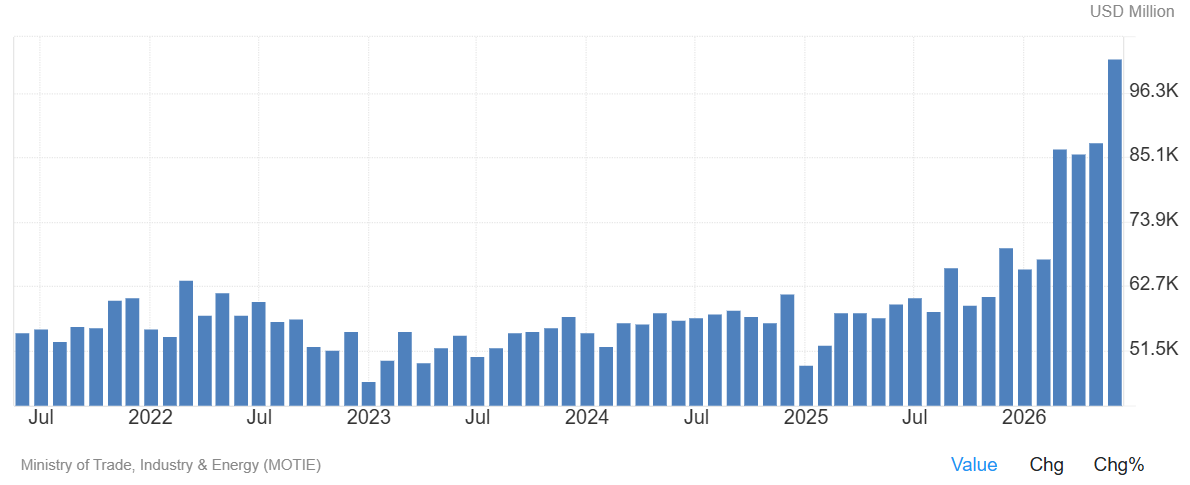
South Korea has one of the highest exports per capita in the world. In 2025, the country’s exports surpassed the $700 billion mark for the first time, reaching $709.7 billion.
South Korea Exports
Source: Trading Economics
This growth was driven by semiconductor exports, which surged 22.2% year-on-year to a record high of USD 173.4 billion.
Taxation
Profits earned from investments in South Korean stocks and ETFs are taxed in India based on the holding period.
Capital Gains
Gains from the sale of foreign securities are treated as capital gains in India.
- If the holding period is less than 24 months, the gains are classified as short-term and taxed as per the investor’s income tax slab.
- If the investments are sold after 24 months, gains are treated as long-term. Such gains are taxed at a flat rate of 12.5%.
Dividends
Dividends received from foreign securities are added to total income and taxed as per the investor’s income tax slab.
However, countries like South Korea and the United States may levy a withholding tax on such dividends at the source. In such cases, investors can claim relief under the Double Taxation Avoidance Agreement (DTAA) to avoid the amount being taxed twice.
Risks of Investing in South Korea
The following risks should be considered when you invest in South Korean stocks from India:
High Dependence on Global Trade
South Korea is an export-driven economy. It has global dominance in semiconductor and memory chip manufacturing, and primarily exports to the US and China. A large part of the Korean market is driven by chip giants Samsung and SK Hynix.
Any global slowdown or trade disruption can directly hit the earnings of such businesses and affect the growth of the economy.
Concentration Risk
The South Korean market is controlled by a few large conglomerates, known as chaebols. They not only raise the concentration risk, but a heavy reliance on such a small number of companies also skews market performance.
At the same time, corporate governance issues within some chaebols have been a long-standing concern in South Korea and a key reason behind the Korea discount. Practices such as cross-shareholding, opaque management structures, related-party transactions, and limited minority shareholder rights continue to weigh on investor confidence.
If these issues are not adequately addressed, they could limit the scope for valuation re-rating and constrain long-term stock market upside.
Currency Risk
When you invest in South Korean stocks from India, you are exposed to the volatility between the Indian Rupee (INR) and the South Korean Won (KRW).
Even if the Korean market performs well, adverse currency movements can reduce overall returns. For example, if the KOSPI index rises by 10% in KRW terms, but the KRW depreciates by 8% against the INR during the same period, your effective return in INR would be only around 2%.
Conversely, if there is favorable currency movement, it can enhance returns.
Geopolitical Risk
The South Korean economy is significantly exposed to geopolitical risks, particularly due to tensions with North Korea.
This remains a persistent overhang on the market. Any flare-up in tensions can lead to significant market volatility and capital outflows.
Step-by-Step Guide To Invest in the South Korea Market
Indian investors can access South Korean markets through global investing platforms such as Vested Finance. They provide easy access to securities and country-specific ETFs for investments. Here’s how to invest in South Korean stocks:
- Download the Vested Finance app to your smartphone and create an account
- Complete the KYC verification process. Submit the required KYC documents such as your PAN Card, AADHAAR, and identity proof.
- Once the account is verified, add funds via net banking.
- The funds transferred will be converted to US Dollars, which is the base currency to invest in all US-listed securities.
- You can start investing in South Korea ETFs listed in the US, or global funds with South Korea exposure.
Final Thoughts
South Korea offers a combination that few markets can match—global technology leaders, improving shareholder returns, and valuations that remain below many developed peers. For investors looking beyond the US, it can be an attractive way to gain exposure to Asia’s technology supply chain while diversifying geographically.
However, investors should also be mindful of export dependence, corporate governance challenges, and currency risk. For those with a long-term horizon, South Korea can serve as a valuable diversification opportunity alongside developed and emerging markets.
Want to invest in Global Markets from India? Read our blogs
| How to Invest in Global Markets from India | ||
| How to Invest in China | How to Invest in Taiwan | |
