






Over the past two years, the cost of running an AI model has collapsed.
A top-tier AI model cost about $30 for every million tokens (input) it processed when it launched in early 2023. By mid-2026, the same quality of output could be had for much less than $0.50, per pricing tracked across the industry. That is a drop of more than 95%.
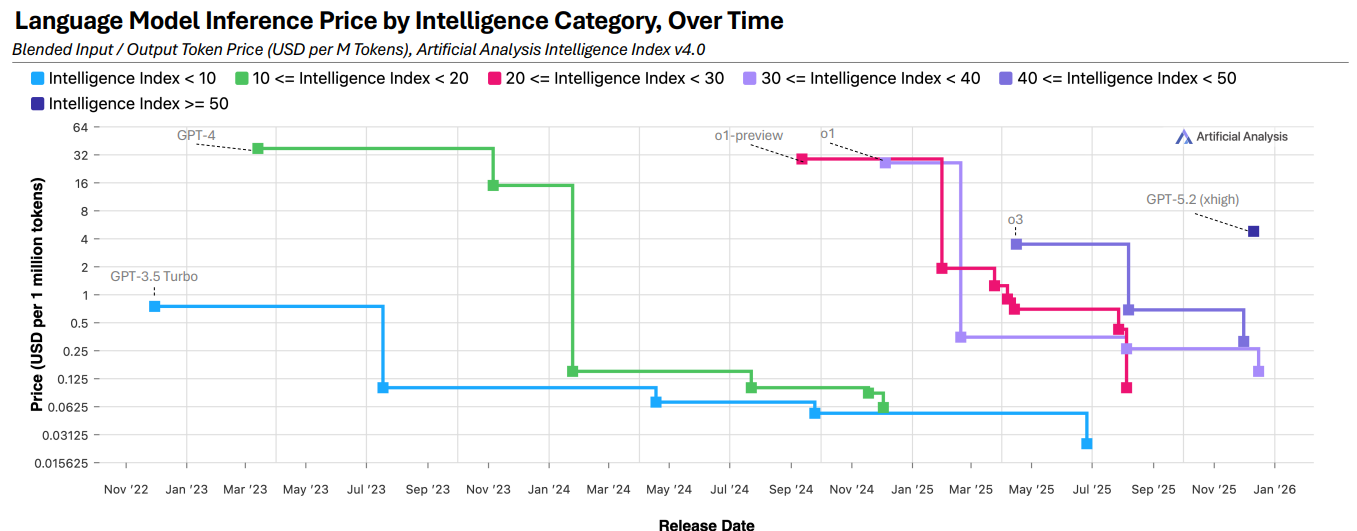
Source: Artificial Analysis
Silicon Valley even has a nickname for it:
“LLMflation”: Inflation, but running backwards.
Over the exact same two years, the memory chip that AI runs on went the other way.
DRAM is the working memory inside every phone, laptop, and server. Conventional DRAM contract prices reportedly rose about 90% in the first three months of 2026 alone, then climbed again the next quarter, according to research firm TrendForce, the steepest run the industry has on record.
In real terms: a 32GB desktop memory kit that sold for around $90-120 in early 2025 was reportedly priced above $350 by 2026.
Both of those sentences describe the same AI boom. And that’s where the paradox lies.
And no company sits at the center of that paradox like Micron. The US memory giant became one of 2026’s hottest stocks precisely because chips got pricier, right up until this week, when it fell 9% in a single day. We’ll come back to it.
But first, here is why memory got so expensive, and it is simpler than it sounds.
Every AI wafer is one less for your laptop
A memory factory makes silicon wafers. Each wafer can become one of two things: an ordinary chip for your laptop, or a special high-speed chip, called HBM, that goes into an AI server. It cannot be both.
The AI version pays far better. A single HBM chip reportedly sells for $60 to $100. The same amount of ordinary laptop memory sells for $5 to $10.
So the factories made the obvious choice. They built the expensive AI chips, and let ordinary memory run short.
IDC, a research firm, summed it up in four words: “This is a zero-sum game.” Every wafer that becomes an AI chip is a wafer that does not become your laptop’s memory.
This is not just talk. Micron reportedly shut down Crucial, a consumer memory brand it had run for 29 years, to send that capacity to AI customers instead.
The people inside the industry aren’t mincing words either. Gerry Chen, a general manager at memory maker TeamGroup, said prices had “doubled month over month” late last year, and warned the crunch “has only just started.”
And this is not just an industry problem. It reaches your next device.
What it costs the person buying a laptop
Memory can make up 10-20% of what it costs to build a smartphone, per IDC.
When that jumps, the phone maker has two choices. Raise the price, or quietly give you less.
Many are doing both. Some phones now ship at the same price with less memory inside.
Big PC brands, including Lenovo, Dell, HP, Acer, and ASUS, have reportedly warned of price rises of 15-20% in the second half of 2026.
And relief isn’t close. TrendForce, the research firm, expects memory prices to keep rising through the rest of 2026, with the steepest part of the climb only easing in 2027.
For buyers, that means the next two laptop-buying seasons land right in the squeeze.
There’s a small irony worth noting. For years, the cheapest way to speed up an ageing laptop was to add more memory. That upgrade just became one of the most expensive shelves in the store.
So, has AI “really” made computing cheaper?
This is the part worth slowing down for, because both halves are true.
The software got cheaper. Running an AI query keeps getting cheaper, year after year, as models get more efficient. That is real.
The hardware got more expensive. Every memory number above moves the opposite way.
And here is the twist that ties it together: even though each AI query is cheaper, total AI bills are still going up.
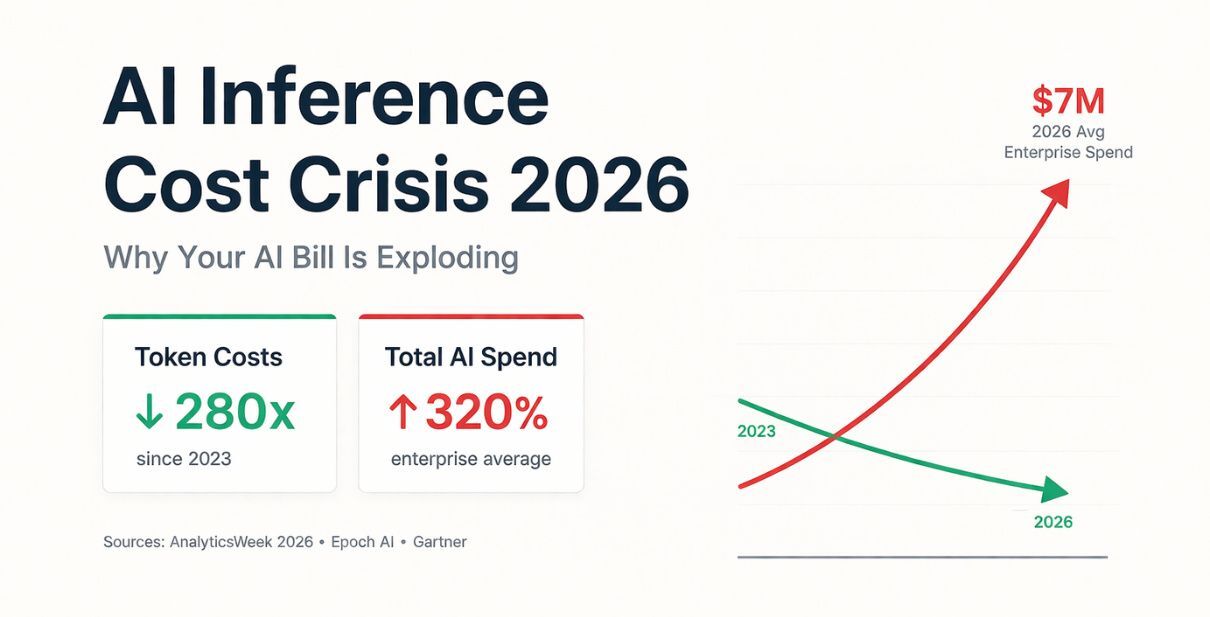
Source: Oplexa
Why?
Because when something gets cheaper to use, people use much more of it. The price per use drops, but the total bill climbs.
Put simply:
AI made thinking cheaper, because thinking is software.
It made remembering more expensive, because memory is a physical chip, and physical things run into real factories with only so many wafers.
Nowhere is this tension sharper than in Micron, the biggest US-listed memory company.
This year’s 8X-bagger loses 9% in a day
Micron reportedly gained close to 700% over the past year, as the memory shortage turned a boring, up-and-down business into the hottest chip stock around.
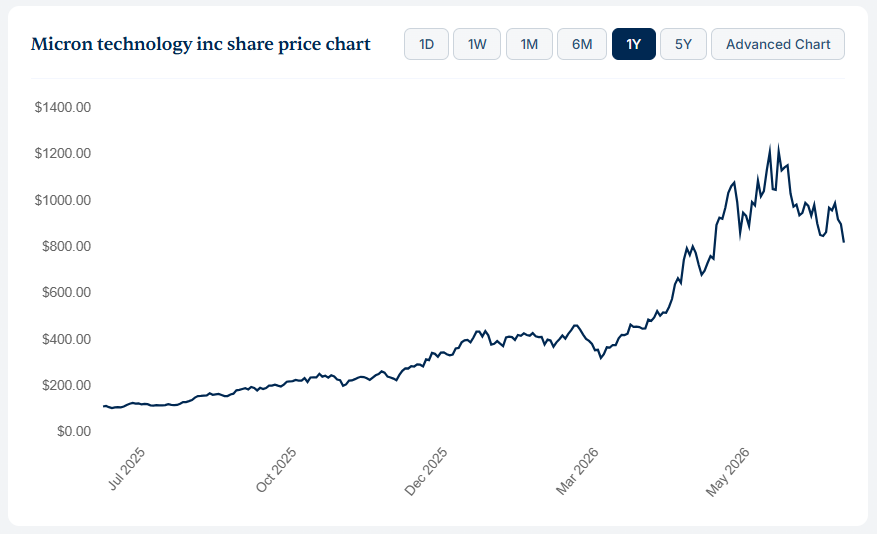
Source: Micron Technology (MU) on Vested
Analysts piled on, with some price targets above $1,500, and 29 of 30 rating it a buy.
Then, on Tuesday, 28 July, Micron fell 9% in a single day.
The drop reportedly mixed three worries at once:
Firstly, CXMT, a new Chinese rival that just went public. We wrote about it as well. Read the article.
Secondly, fresh doubt about whether AI spending can keep growing, and third, nerves before this week’s US interest-rate decision.
Not everyone was surprised.
One investor, Paul Franke, who once called Micron a bargain, now says it sits in the “exact opposite investment position.”
It’s a reminder: a boom and a fair price are two different questions.
There’s a neat symmetry here. Micron rose because memory prices went up. This week, it fell partly on the fear that memory prices might soon come down, as CXMT floods the market and AI spending faces doubts.
The same force that lifted the stock is the one investors now worry about.
Rising prices made Micron. Falling prices could unmake it.
A brutally cyclical business
Here is the thing seasoned investors know about memory that newcomers learn the hard way: it is one of the most brutally cyclical businesses in technology.
The pattern is almost mechanical. Demand spikes, prices soar, and the three big makers, Micron, SK Hynix, and Samsung, race to build new capacity.
That capacity takes two to three years to come online. By the time it does, the shortage has often become a glut, and prices that doubled on the way up can halve on the way down.
This has happened again and again.
Memory boomed in 2017-18, then crashed in 2019. It boomed in 2021, then crashed hard in 2022-23, when Samsung’s memory division briefly lost money.
Each time, the stocks soared, then gave much of it back.
What makes 2026 different, in the bulls’ telling, is that AI demand is structural rather than a passing upgrade cycle, which is why some analysts argue “this time is different.”
The bears point out that “this time is different” is the most expensive sentence in investing.
Which side is right decides whether today’s memory prices are a new normal or the top of another cycle.
And that is the same question sitting underneath Micron’s 9% fall, just asked with real money.
The bottom line
Come back to the two numbers we started with. An AI query that cost $30 now costs pennies. A memory kit that cost $90 now costs $350.
Neither is wrong. AI’s software side is genuinely getting cheaper. AI’s hardware side is genuinely getting pricier.
The bill for the AI boom didn’t vanish. It moved, from the software you use for free, to the memory chip inside the device you paid for.
Whether that lasts may get clearer this week, as the US rate decision and the last of the big tech earnings show how much room AI spending has left.
Stay tuned!