





Welcome back to a new edition.
Marc Andreessen, the tech investor who helped build Mosaic, one of the first popular web browsers, once said:
| “The spread of computers and the internet will put jobs in two categories: people who tell computers what to do, and people who are told by computers what to do.” |
This week, three stories made that line feel very real, very fast.
This week, three stories made that line feel very real, very fast.
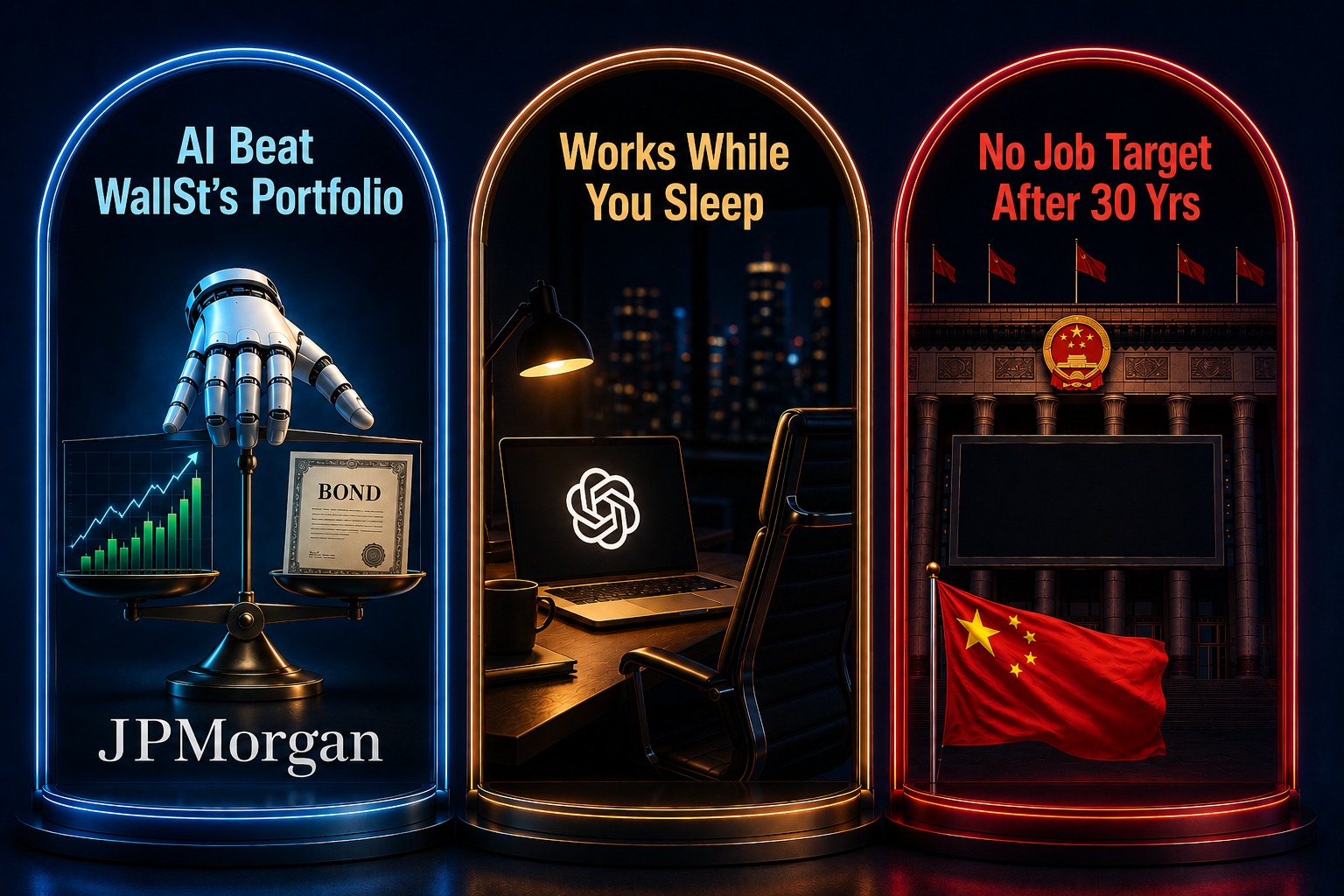
JPMorgan handed an AI the actual money decisions, and it beat the classic stocks-and-bonds portfolio for 20 straight years.
OpenAI released a version of ChatGPT that does not answer your question and stop, it takes the whole job and works on it for hours.
China, the country famous for planning everything down to the decimal, dropped its urban job target for the first time in three decades.
The interesting part in these stories isn’t that AI showed up. Rather what it started doing once it did.
But, first things first, let’s see how the rest of the world held up this week.
The World in a Week: How Major Markets Moved
Wall Street spent the first half of the week dumping AI stocks, then spent the second half buying them right back. Chips led both moves.
Nvidia rose about 4% on Friday alone, and Meta closed out its best week since early 2024, up nearly 15%.
Everywhere else, the mood never recovered. Only the US finished green.


News Summaries
AI beat WallSt’s favourite portfolio mix
On Thursday, July 9, JPMorgan put out a research note that should make every DIY investor pause.
Its strategists, led by Thomas Salopek, built a set of AI agents using OpenAI and Anthropic.
They gave it a real job: not to pick stocks, but to decide how much money goes into stocks versus bonds as conditions change.
The classic benchmark here is the 60/40 portfolio, 60% in stocks and 40% in bonds. It is the plain-vanilla starting point taught in every finance course.
| Over 20+ years of backtests, the best AI setup beat the 60/40 mix by 0.7 percentage points a year, with lesser volatility. All 8 agents tested beat the benchmark on a risk-adjusted basis. |
Humans be saying to AI –

Anyways, one caveat matters.
This was a backtest on historical data, not real money in a live market. JPMorgan itself warned against treating it as proof AI can always win.
Anyways, here is the part worth sitting with.
The AI was not doing magic maths. It sorted the world into four moods:
- Goldilocks: growth steady, prices calm
- Reflation: economy heating back up
- Stagflation: prices rising while growth slows
- Risk-off: everyone scared, running for safety
Then it switched between stocks and bonds to match. Lean into stocks when growth looks strong, lean into bonds when the outlook sours.
That is not a secret formula. Any decent advisor would tell you the same thing.
The difference is:
| The machine did it without flinching, without getting greedy at the top, and without freezing when things looked scary. |
Think of it like your gym trainer’s advice. Everybody knows you should show up four times a week and skip junk. Knowing is easy. Doing it every single week, without excuses, is the hard part. The AI’s edge was discipline, plain and simple.
AI did not predict the market. It just refused to panic when everyone else did.
The market’s most boring winners work exactly like this. We made a video on one unglamorous stock that beat market’s favourite Nvidia by 5x in five years.
Watch on YouTube
ChatGPT can now work while you sleep
On Thursday, July 9, OpenAI launched ChatGPT Work, and it is a different kind of thing from the chatbot you know.
This one does not just answer and stop. It takes a full task and works on it for hours.
It runs on GPT-5.6, OpenAI’s newest model, released the same day, after an earlier delay tied to US government clearance.
The idea itself is not new. Rival tools have done agent-style work that runs for hours for a while now. What is new is the biggest chatbot on earth bringing it to everyday users.

Give ChatGPT Work a goal and it builds the whole thing: documents, spreadsheets, presentations, even working web apps.
It plugs into the tools people actually use at work, Slack, Google Drive, Gmail, calendars, and more. You can watch it work, redirect it midway, or approve steps as it goes.
One example OpenAI gave: take raw customer research, turn it into a marketing brief, generate the campaign assets, and adapt them for different markets, all from a single prompt.
| For two years, the pitch was that AI helps you work faster. Now the pitch is that AI does the work itself. |
OpenAI is not the first one here, Anthropic and others were already doing agent-style work, but OpenAI just brought its huge user base along.
Picture the difference between a calculator and an accountant. A calculator waits for you to press the buttons. An accountant takes the shoebox of receipts and hands back finished books. ChatGPT Work is trying to be the second one.
That is thrilling if the task is your boring Monday report. It is unsettling if the task is your job.
You did not hire an assistant, rather a worker who does not clock out.
China plans everything, except jobs this time
Beijing plans everything. Growth, factories, life expectancy, all get five-year targets. So this stood out.

On Thursday, China’s new five-year plan for 2026 to 2030 left out a numeric target for creating new urban jobs.
According to its Ministry of Human Resources and Social Security, this is the first time in at least three decades it has done so.
Instead of a hard number, the plan says China will keep new urban jobs at a “considerable scale”, with yearly targets set flexibly based on conditions.
The reason, per the reporting, is uncertainty over jobs as AI spreads through the economy.
The plan even calls for setting up mechanisms to study and respond to AI’s impact on employment.
When the government that loves numbers stops giving one, the silence says something. It is not that China cannot count.
Here is what is actually happening.
| A target is a promise. China does not want to promise a figure it may not be able to hit as machines take over work. |
And this is the country pushing AI the hardest into its own economy. The same bet that promises growth also scrambles the job math.
When a country stops promising jobs, it is telling you it no longer knows for sure.
To avoid country-specific risks like these, you should look for a more globally-diversified portfolio. Global Funds on Vested, like the Franklin Templeton Global Technology UCITS Fund, let you spread across global markets and themes without picking single stocks or countries by yourself.
Invest in Global Funds
Private Markets Pulse
This whole edition is about AI that acts. Two companies building exactly that are still private, and both are open right now on Vested’s Private Markets:
1.Reflection AI
Started in 2024 by two ex-Google DeepMind researchers, one a co-creator of AlphaGo. It is building an American open-source answer to OpenAI and Anthropic. Its valuation ran from about $545 Mn to a reported $25 Bn in roughly a year, roughly a 46x jump. It just signed a compute deal with SpaceX worth up to $6.3 Bn, and is working with the US Government too. The likes of JPMorgan & Nvidia are investing in it.
Explore Reflection AI
2. Figure AI
uilds humanoid robots that already run real shifts at a BMW plant, working daily 10-hour shifts over 11 months and handling 90,000+ parts. The company says it now runs more robots than humans internally. Last valued at $39 Bn, it is backed by NVIDIA, Microsoft, OpenAI’s startup fund, Jeff Bezos, and many more.
Explore Figure AI
This week’s pick from GlobEd
The biggest listing this week came from a company most Indians have never bought directly.
South Korea’s SK Hynix, the world’s second-largest memory chipmaker, opened its US debut about 14% above its price on July 10, in a deal reportedly more than 7 times oversubscribed.
US investors bought it through an ADR, an American Depositary Receipt, which lets you own a slice of a foreign company on a US exchange, in dollars without a foreign brokerage account.
It is the backbone of a huge chunk of global investing, and most people never learn how it works.
Fix that in five minutes.
Understand ADRs
Conclusion
Now step back and look at all three together.
A machine that invests, a machine that works, and a government that stopped promising jobs.
AI has stopped helping and started acting. Markets spent the week arguing about whether AI stocks are worth the money, while AI quietly got on with allocating it, doing the work, and changing who does the work at all.
Nobody knows where this lands. When machines can invest for you, work for you, and reshape work around you in one week, which reaches your life first?
You cannot time that shift, and you do not need to.
You already know the habit from your SIPs. Invest regularly, spread your bets, and let time do what timing cannot.
Thanks for reading!