




Before we start, our new video is live: how Ozempic rewired the American economy. Watch it here for the numbers behind it.
Now, coming to this week’s stories. Three companies gave the market good news and got punished for it.
On Tuesday, the co-founder of a Swiss running shoe company told analysts he had deliberately shipped fewer shoes than he could have.
You have seen those shoes. “Clouds” in the sole, worn far more often to brunch than to a race, which is precisely the point. The Co-CEO of On Holding David Allemann said –
“We are not sprinting for short-term volume. We are deliberately engineering for the multi-decade value of a premium brand.”
By the close, its stock had fallen in a single day more than at any point since it listed in 2021.
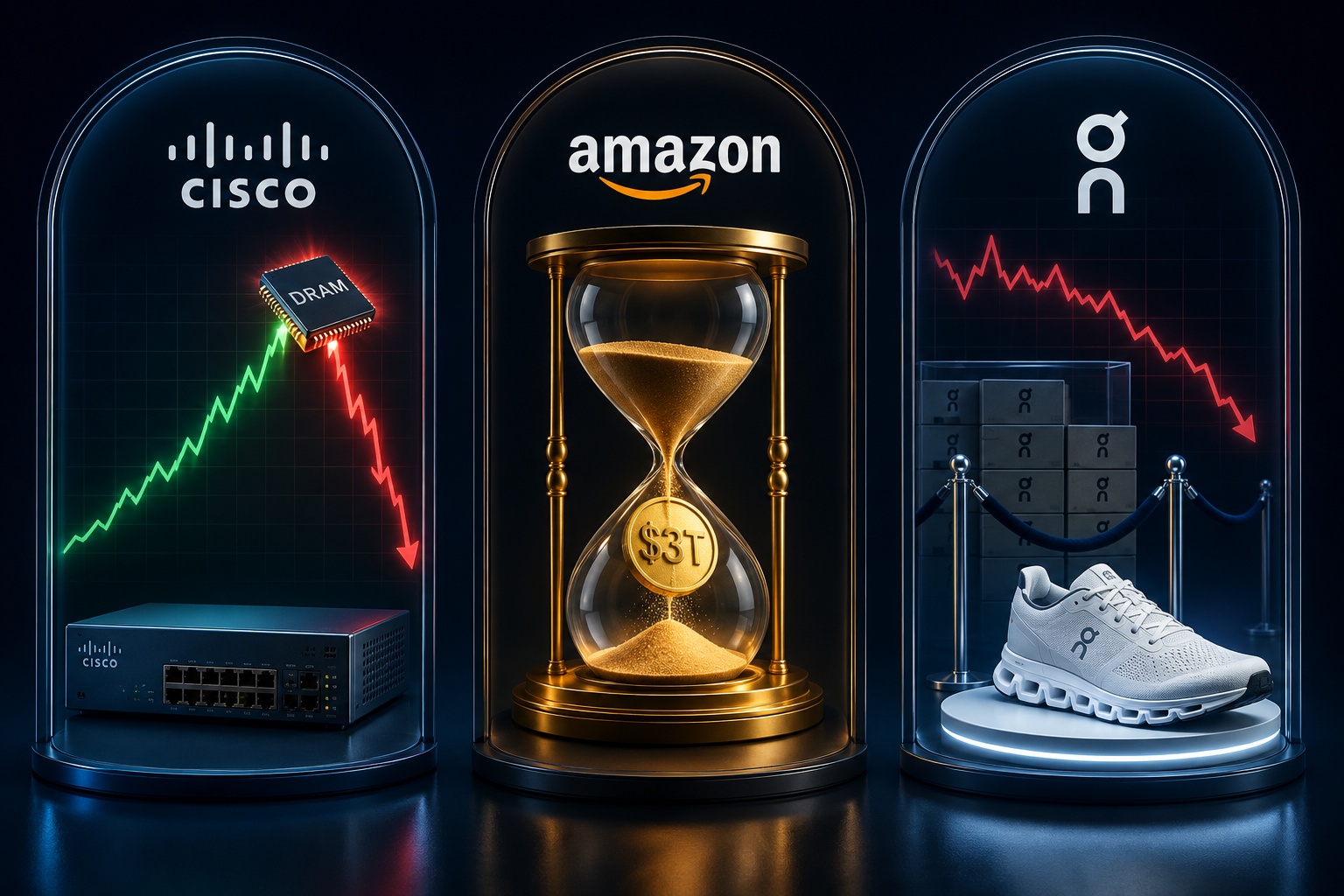
In tech, Cisco had its best year in thirty years and lost more than 8% the next day. Amazon crossed $3 trillion and was back under it inside two weeks.
We will get to the interesting bits.
But before that, we built an interesting challenge to feed your competitive spirit.
Click on the image below to take the challenge and prove that you are a smarter global investor than most.

Coming back to the week’s updates, let’s start with how the global markets fared this week.
The World in a Week: How Major Markets Moved
US inflation came in soft. Both price prints missed expectations, September rate-hike odds fell below 40%, and the S&P 500 hit a record 7,798.99 on Thursday.
Friday came in to undo some of it. Retail sales fell 0.6%, the steepest since May 2025, consumer sentiment dropped 8%, and the index closed the week at 7,785.10.
So the Fed will likely hold. Because demand is cooling, not because things are fine.
Oil is the bigger problem. Hormuz is still shut, US-Iran talks have stalled, and Washington is preparing more sanctions. Crude rose all week, and the EIA now sees supply disrupted through end-2027.
Gold ended near a 2-month high, up 0.84%. Bitcoin fell 2.85%.
Asia did better. Japan’s Nikkei jumped 4.74%, and Korea’s KOSPI was led by Samsung and SK Hynix, each up over 14%. Hong Kong raised its 2026 growth forecast to 3.5-4.5%, after Q2 goods exports jumped 28.8% on AI demand.
India went the other way. The Nifty fell 0.83%, and costlier crude means a bigger import bill from here.

Finally, let’s dive into this week’s stories.
News Stories
Cisco’s best year in 3 decades ended with an 8% fall
Cisco (CSCO) reported after Wednesday’s close. Record quarterly revenue of $17.25 billion, up 18%. Full-year revenue of $63.3 billion. Product orders up 35%.
By the company’s own account, its best year since the mid-1990s.
The guidance was better still. Cisco put fiscal 2027 revenue at $72.2 billion to $73.4 billion, roughly $4 billion above what analysts had modelled.
The engine is AI. Hyperscalers, meaning the handful of giant cloud platforms building data centres, placed $9.3 billion of orders across the year.
Chuck Robbins, CEO of Cisco Systems, had this to say –
“We believe the accelerating adoption of agentic AI is fueling a networking super cycle.”
Robbins has argued for two years that AI needs networking gear as much as it needs chips. These orders are the first hard evidence he was right.
The next day the stock fell 8.4%, to $113.47.

Source: CSCO on Vested
So where did it go wrong?
One line below revenue.
Gross margin came in at 66.3%, down 210 basis points from a year earlier.
Gross margin is a simple idea. Take what you sold something for, subtract what the physical thing cost you to make, and the gap is what pays for everything else. Salaries, research, buildings, profit.
When that gap narrows, every dollar of sales does slightly less work.
Cisco named two causes. More of its revenue now comes from hardware, which is inherently lower-margin than software. And memory chips have gotten expensive.
The CFO Mark Patterson was candid about it –
“You should expect a slight gross margin headwind as we move through FY 2027 as we address these very high growth opportunities.”
That sentence is a strategy, not an apology.
Cisco is choosing to sell more of a thinner-margin product because the total profit dollars are bigger. A 60% margin on a large number beats a 70% margin on a small one.
Patterson pointed investors to operating margin instead, guided at about 35%, which would be a company record.
It is a defensible trade. And with the stock already up nearly 49% this year, the market repriced it the moment it was named out loud.
Now the part worth learning.
The memory problem is not Cisco’s. DRAM spot prices are up roughly 700% over the past year.
Here is why. Samsung, SK Hynix and Micron control more than 95% of DRAM production, and AI demand pulled their capacity toward the specialised memory accelerators need.
Ordinary memory, the kind inside Cisco’s routers, got squeezed out. New capacity does not arrive before 2027.
So Cisco fell the same week Micron (MU) and SanDisk (SNDK) rose. In a shortage, the seller sets the price.
One footnote, fitting for Independence week. For most of our seventy-nine years, every chip in every device here arrived on a ship. Since February, not quite all of them do. Micron’s $2.75 billion plant at Sanand now ships made-in-India memory modules to Dell.
Packaging rather than fabrication, so a foothold rather than a fix. But part of the answer to Cisco’s problem is being built here, in India, now.
Amazon joined the $3T club, lasted for a week
Earlier this month, on August 3, Amazon (AMZN) closed at $284.02 and became the fifth company in history worth $3 trillion. Apple, Microsoft, Nvidia and Alphabet were already inside.
Ten days later, it closed at $265.13. Roughly $2.86 trillion.

Source: AMZN on Vested
Nothing broke. That is what makes this instructive.
The results were excellent. Revenue up 20% to $200.6 billion, with AWS growing 37% to $42.2 billion, its fastest in eighteen quarters.
A caution on the headline number. Analysts expected Amazon to earn $1.82 per share. It reported $5.75.
But about $53.4 billion of that came from Amazon’s stake in the AI company Anthropic being marked up in value. Nothing was sold, no cash arrived, and accounting rules push that increase through the profit line anyway.
The quarter was still very good. The headline number was just measuring an investment gain, not the business.
Then came the spending. Hear it from the CEO Andy Jassy –
“We now believe we will spend approximately $220 billion in cash CapEx in 2026. Even at that amount, we will not have enough capacity to meet all the demand we have in 2026.”
That is $20 billion more than Amazon had guided since February. Jassy’s stated reason was higher memory costs.
Similar story to Cisco, but entirely different symptoms. Cisco absorbed it as a thinner margin, Amazon as a bigger cheque.
Why does the cheque matter more than the profit, you ask?
Capital expenditure was $54.2 billion in the quarter, against $32.1 billion a year earlier. Trailing free cash flow swung to an outflow of $7.6 billion, from an inflow of $18.2 billion.
Free cash flow is the honest number. Profit tells you what the accountants concluded; free cash flow tells you what was left after the company paid for the assets it bought.
Amazon is currently highly profitable and cash-negative at once. That is fine if the spending earns its return, and expensive if it does not.
And on milestone day, Jeff Bezos filed to sell 15 million shares worth about $4.07 billion.
CNBC’s Jim Cramer summed up the optics –
“Cant begrudge Bezos for selling $4 billion shares…but what a buzzkill.”
Well, before you think Bezos timed the top…
He set this sale up in November, under a plan that fixes the timing and size in advance and then executes on schedule no matter what the stock does.
Make of it what you will.
On Holding’s worst day since listing, or a choice?
Back to the shoes.
On Holding (ONON) has spent a decade turning a Swiss running shoe into something people read as a signal. Its own co-CEO calls the customers the “movement class,” people for whom fitness is not a hobby but a piece of identity.
Nobody buys a luxury watch to essentially check the time. Increasingly, nobody buys these shoes to run either.
That premium positioning is the entire business model. Hold on to it, because it explains everything that happened next.
On Tuesday the stock closed at $31.48, down $7.30, after trading as much as 22% lower. Its steepest single-day fall since listing in 2021.

Source: ONON on Vested
The trigger looks tiny. Revenue grew 21.6% to CHF 850.3 million, against the CHF 881.4 million analysts wanted. More than a fifth of growth, and still about CHF 31 million short.
That growth figure is in constant currency, meaning exchange rates are held still so you see how much the business actually grew rather than how much the franc moved.
Profit was fine. Earnings came in at CHF 0.31 a share against the CHF 0.29 expected, because the sales On gave up were its least profitable ones.
A small miss, a profit beat. Neither of those is a 22% fall. The sentence that followed was.
On cut its full-year growth forecast to the “low-20% range,” down from “at least 23%.”
Sit with those two numbers, because this is the whole story.
The company will still grow more than 20% this year. It just promised slightly more, slightly earlier.
A share price is not a scorecard for the past. It is a live estimate of everything a business will earn from here. Move the guidance down a notch and every future year moves with it, all at once.
Which is how a company can beat on earnings and still lose a fifth of its value in a day.
The miss was also a choice.
The company deliberately limited how much stock it shipped to American wholesale partners, slowing wholesale growth to 12.7%, to keep its shoes out of a discount-heavy retail environment.
Meanwhile direct sales to customers grew 34.3% to a record CHF 388.4 million, and the company raised its full-year gross margin forecast to at least 65%.
The idea: sell less through discounters, more at full price yourself… earn a better margin, report a smaller top line.
On’s Co-CEO explains it –
“We are proving that a brand can achieve global scale without compromising its premium brand positioning.”
Whether you agree depends on your horizon. Citi had modelled 24.7% growth and never disputed the logic, only the price of it –
“The 2Q sales miss and lowering of F26 sales guidance will likely put significant pressure on the stock today.”
And that came out true. William Blair went further and downgraded On to Hold, citing less predictable earnings and rising discounting across footwear.
Right call, wrong week, you could say.
The bottom line
Cisco traded margin for scale. Amazon traded cash for capacity. On traded revenue for pricing power. Every one of those bets needs years to pay off. The market marked all three within a week.
So what are you buying when you buy a company: the plan, or the print?
Thanks for reading!