




Welcome back to a new edition.
Before the stories, a quick question. Nvidia’s CEO said this week that it will sell twice as many chips next year as it is selling this year.
Where is the electricity for running these chips coming from?
That answer alone decides whether the rest of the AI buildout happens.
We tried breaking it down for you in a video, watch it here: The Invisible Grid Powering the Entire AI Boom at Global Markets by Vested.
Anyways, this was quite an interesting week for global investors.
On Wednesday, the Federal Reserve raised US interest rates for the first time since 2023, and investors are divided over the decision.
A day later, investors were reportedly asking OpenAI to let them buy in at $1.2 trillion, roughly double what the company was worth in March.
And on Thursday evening, five days after the head of Anthropic asked the industry to slow down, Nvidia’s CEO said it expects to sell twice as many chips next year as it is selling this year.
The World in a Week
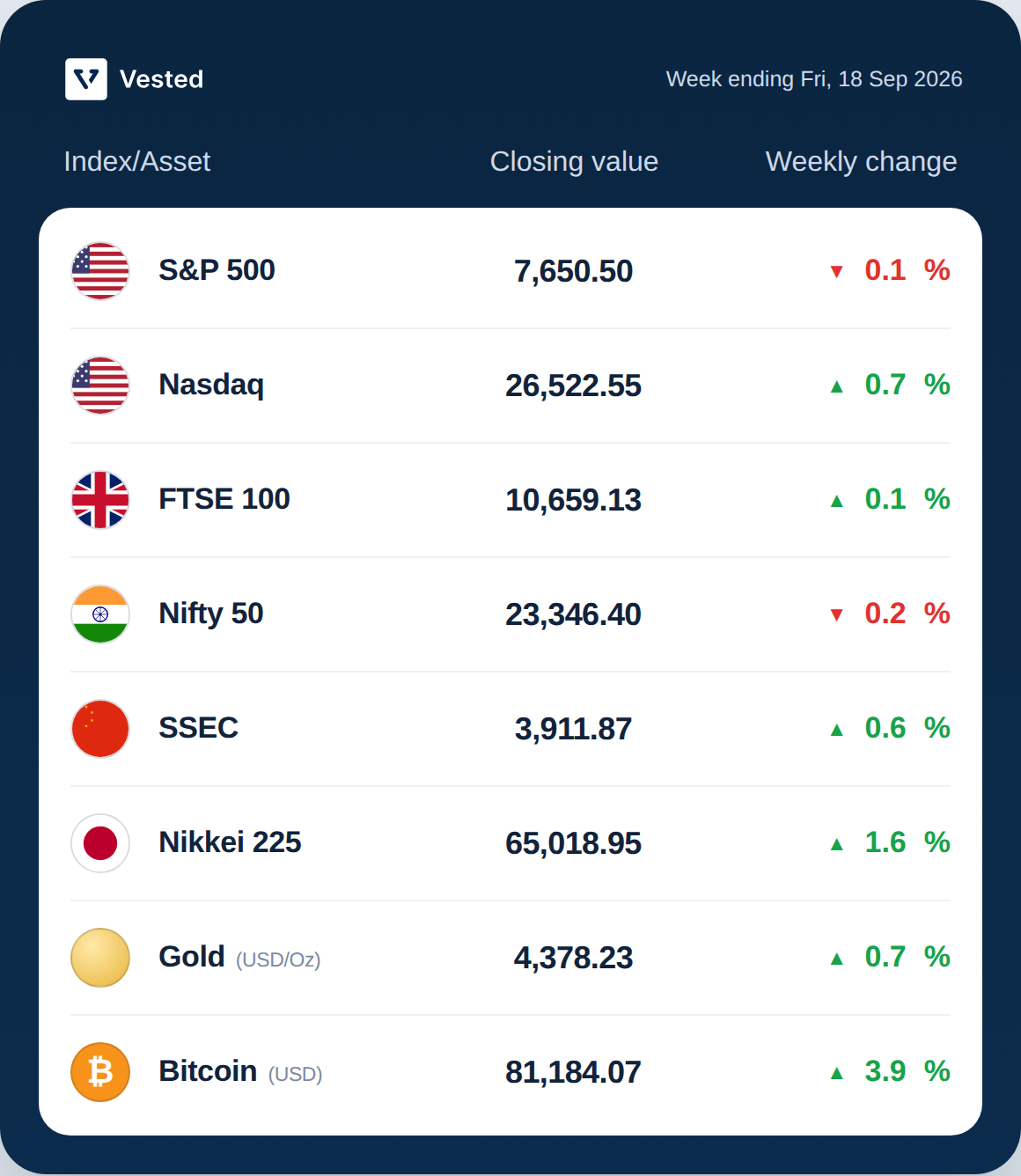
The Fed raised rates this week for the first time since 2023 and signalled at least one more to come, which set the tone for everything else. Treasury yields climbed with it, the US 10-year reaching its highest level since 2007, and oil stayed above $100 a barrel.
Rising borrowing costs and rising fuel costs land on the same companies first, so banks, industrials and smaller names took the worst of it while big tech held up. You can see that split in the week’s closes: the S&P 500 finished 0.1% lower while the Nasdaq added 0.7%. Chip stocks fell on Monday after AI lab chiefs called for slowing down new models, and had recovered by Thursday.
More on all this in the news stories.
Other central banks moved the same way. Japan raised rates to a 31-year high and the Bank of England held, but warned on inflation. India felt the squeeze from both sides, with costly crude and higher global rates pushing the Sensex to a sixth straight weekly loss, its longest run since 2020. The Nifty 50 closed the week 0.2% down.
News Stories
Markets fall & then rise on the Fed’s rate hike
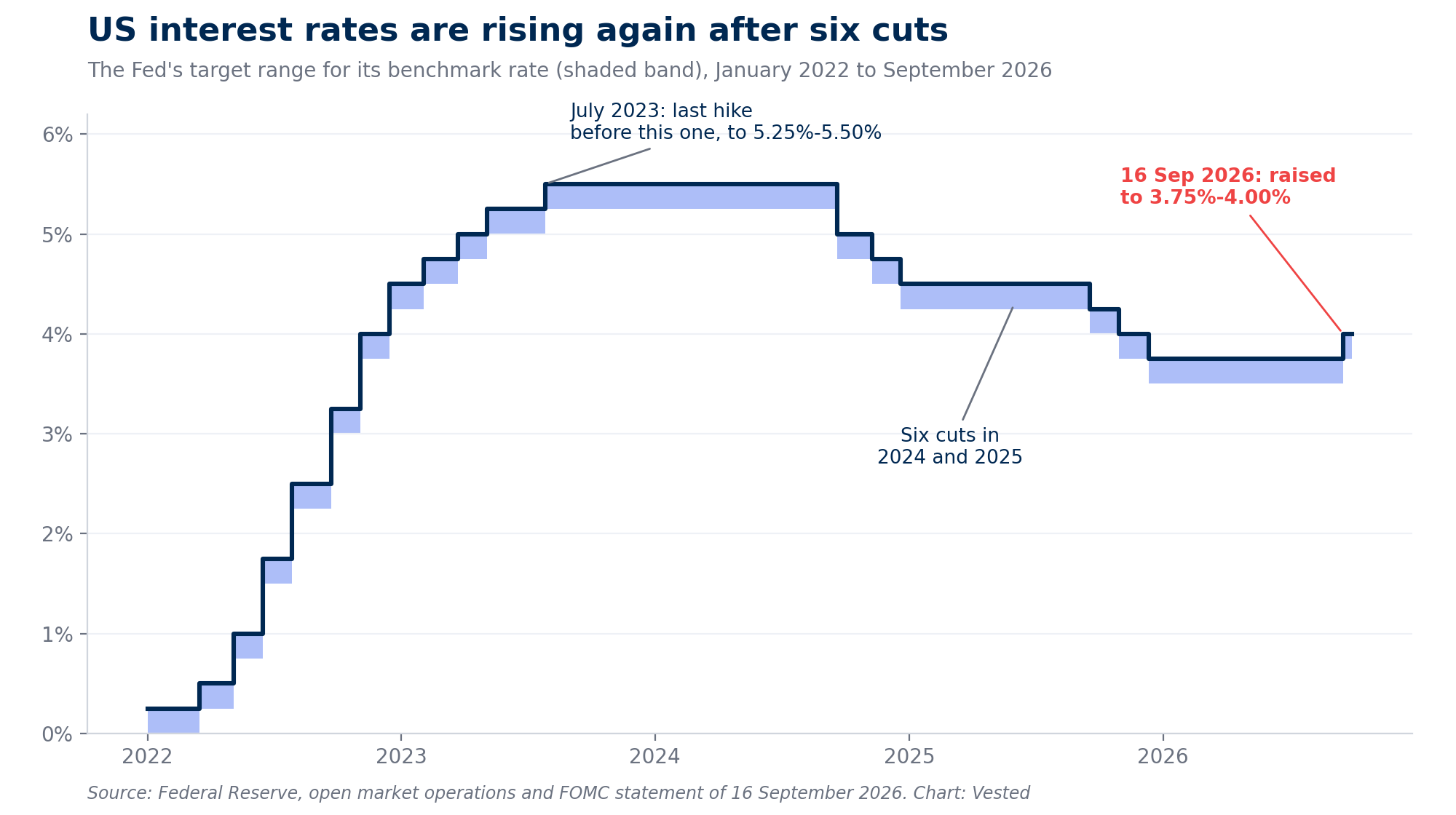
The Federal Reserve raised its benchmark interest rate by a quarter of a percentage point on 16 September, to a range of 3.75% to 4%.
It is the first increase since 2023, and it ends a cutting cycle that had been running for two years.
The reason is written plainly in the statement: inflation will not come down. US consumer prices rose 3.4% in the year to August. The Fed’s preferred measure, PCE, was likely running near 3.6% that month. Crude oil above $100 a barrel has been feeding into everything that has to be shipped, refined or driven. In the words of the Fed chairman Kevin Warsh –
“The plain fact is that inflation is too high and has been for too long.”
Warsh has been in the job since February and this was his first vote to raise. He also said something you rarely hear a central banker say out loud –
“Inflation is a choice, and today we took a step in delivering it.”
The hike itself surprised nobody, because futures markets had put the odds near 87% going in. What moved money was the forecast that came with it.
Every quarter, each official marks down where they think rates will end up, and those marks are published as a chart the market calls the dot plot.
This time, 16 of 18 officials pencilled in at least one more increase before the end of 2026, and the median moved to 4.1% from the 3.8% they had projected in June. Their own projections do not show inflation back at the 2% target until 2029.
| Projections | 2026-end (projected) | 2027-end (projected) | 2028-end (projected) |
|---|---|---|---|
| Fed’s main interest rate | 4.1% | 4.1% | 3.9% |
| PCE inflation | 3.7% | 2.3% | 2.1% |
| Unemployment rate | 4.1% | 4.1% | 4.1% |
Source: Federal Reserve
That is what stocks reacted to. The S&P 500 closed Wednesday at 7,551, down 0.5%, and the Dow fell 1.2% to 51,461. The ten year Treasury yield climbed to 4.965% and the thirty year reached 5.346%.
President Trump, who has spent months arguing for cheaper borrowing, made his view known again –
Interest rates in the US “should be 1%, or less.”
Then Thursday happened.
Oil slipped as Saudi Arabia restored pipeline capacity, the ten year yield fell nine basis points to 4.93% and ended an eight day climb, and buyers came straight back.
The S&P 500 rose 1.14% to 7,637.72 and the Nasdaq gained 1.69% to 26,418.30, the strongest session in about six weeks. Friday was quiet, with the S&P easing 0.12% and the Nasdaq adding 0.39%.
The swing in the market’s reaction was about what borrowing will cost for the next two years.
For an Indian investor, the chain runs longer. A stronger dollar lifts the rupee value of anything you hold in the US, and it raises the cost of the crude India imports as India buys 88.7% of its crude from abroad.
We mapped out five questions, including what a weaker rupee does to a US portfolio you already hold, why a rate rise hurts a fast growing tech company more, and what it means for your portfolio.
How well do you think you understood the essentials of this rate hike? Test for yourself in this week’s Global Investing Challenge at GlobEd Quiz.
Investors offered OpenAI $1.2T, but it wants more
On 15 September, the Financial Times reported that a group of investors had approached OpenAI about a new funding round that would value it at $1.2 trillion.
OpenAI, according to that reporting and follow ups from the New York Times, Bloomberg and CNBC, would prefer $1.5 trillion.
The detail worth holding onto is who started it. The talks are early, and they were opened by investors themselves, OpenAI was not out raising.
Here is the scale of the jump. In March 2026, OpenAI closed a $122 billion round backed by Amazon, Nvidia and SoftBank, which valued it at $852 billion. Before that round it was worth $730 billion. A $1.5 trillion price would be roughly double the March number, agreed six months later.
Against that sits the revenue. OpenAI made $5.7 billion in the first quarter of 2026 and $6.7 billion in the second, and by August its annualised revenue had crossed $40 billion.
Divide $1.5 trillion by $40 billion and you know that the price is 37 times revenue.
That multiple is not by itself an argument against the price. Fast growing software companies have been worth many times their sales before, and OpenAI’s revenue has roughly doubled inside a year. It does tell you how much of the value sits in what the company is expected to earn later.
At $1.5 trillion OpenAI would be the most valuable private company in the world, ahead of Anthropic, which raised at $965 billion in May.
OpenAI has raised more than $180 billion since 2015, and two thirds of that arrived in the single round it closed in March. The pace at which it needs outside money is itself accelerating.
The public listing, meanwhile, keeps moving further away. It is now expected in 2027, and Sam Altman says this –
“Right now would be an ill-advised moment to go public.”
That sentence is doing a lot of work. A listed company files quarterly accounts, and every promise it has made about compute, revenue and safety becomes something auditors and short sellers get to examine on a schedule.
Staying private lets OpenAI raise at a price investors are offering without having to defend that price in public every ninety days.
Also, a listed share is repriced every second by whoever wants to sell, so a company that misses a target finds out immediately. A private valuation is agreed in a room and then holds until the next round.
Which is the odd shape of this story. The company that most wants to stay private is the one with the most money being pushed at it, and the people doing the pushing have accepted a price that nobody outside the negotiation gets to vote on.
Make of that what you will.
If you want to see how buying into a private company actually works, Databricks sits at the same intersection of data, analytics and AI, and is still private. Our live session covers what to evaluate before investing, click below to apply –

Anthropic warned to slow down AI, Nvidia expects to double
On 12 September, Dario Amodei, who runs Anthropic, published an essay called “We Must Pace the Frontier”. He did not ask for AI development to stop, rather for labs building the most capable models to agree to grow those capabilities more slowly.
And under three conditions: outside evaluators with permanent staff level access to the labs, agreed capability limits across the US and allied democracies, and eventually a wider agreement including China covering the worst uses.
What made it news was who all agreed.
Sam Altman of OpenAI, who competes with Anthropic for the same customers, said this –
“I agree with Dario that we need to pace the frontier.”
Elon Musk called Amodei right. Demis Hassabis of Google DeepMind said the essay pointed towards the right path. Satya Nadella of Microsoft backed deliberate pacing and outside evaluators too, while arguing that both open and closed models still matter.
The objections came mostly from Washington rather than from the labs. President Trump and House Speaker Mike Johnson have both argued that slowing down hands the lead to China.
David Sacks, who advises the White House on AI, said he supports labs choosing to go slower but opposes building a new regulatory process to make them.
For a few days, it looked like the industry had agreed to ease off. Then the man who sells them the hardware spoke.
On Thursday 17 September, at a summit in Scotland hosted by King Charles, Nvidia CEO Jensen Huang was asked about demand and gave a number.
“I expect Nvidia to sell twice as many chips this next year as we do this year.”
Note that it is a claim about units and Nvidia does not publish how many chips it sells. There is no baseline you can check it against.
What Nvidia has published is a revenue expectation, and in August it guided to roughly 70% growth in the financial year ending January 2028, which works out to about $673 billion.
Huang has not accepted the premise of the slowdown argument either. On safety, he has made the point that worries about AI being misused create demand for the tools that defend against it, which is a commercial answer to a safety question.
It is also worth being clear about where he sits.
Amodei, Altman, Hassabis and Nadella all run labs that buy Nvidia’s chips. If those four slow down the rate at which they push model capability, the buying does not necessarily slow with it, because serving existing models to more people also takes hardware.
Huang’s number and their essay are not strictly in conflict. They just point in very different directions.
Markets took his side. Nvidia rose 2.62% to $219.51 on Thursday.
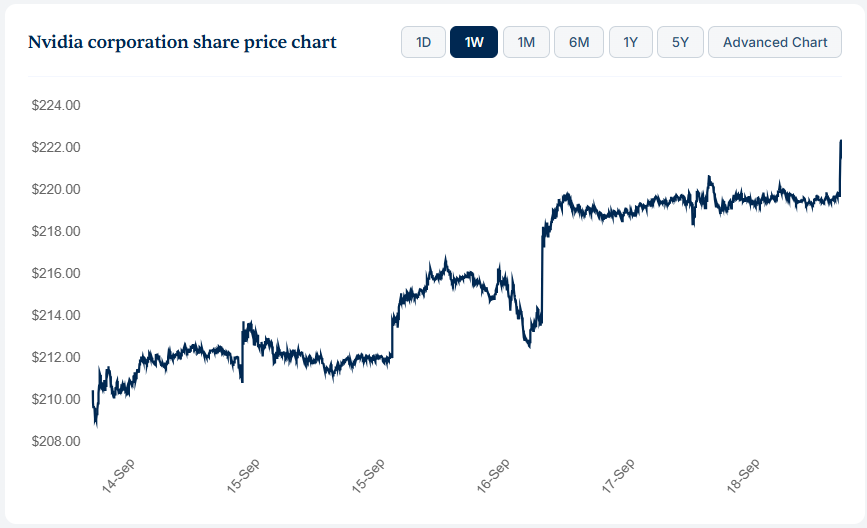
Source: NVDA on Vested
That is the gap worth noticing. Four of the most powerful people in AI said the frontier should be paced. One supplier said his shipments will double.
And the market priced the one that came with a number.
The bottom line
One question underneath all three stories of the week: what is the future worth today, and who gets to set that price?
None of this week’s big numbers were facts. Each one was a claim about a year that has not happened yet, and money moved on all of them anyway.
The only difference is how soon each claim gets tested.
That is a story for a future Vested Shorts. We will be here when it turns up.
Thanks for reading!