





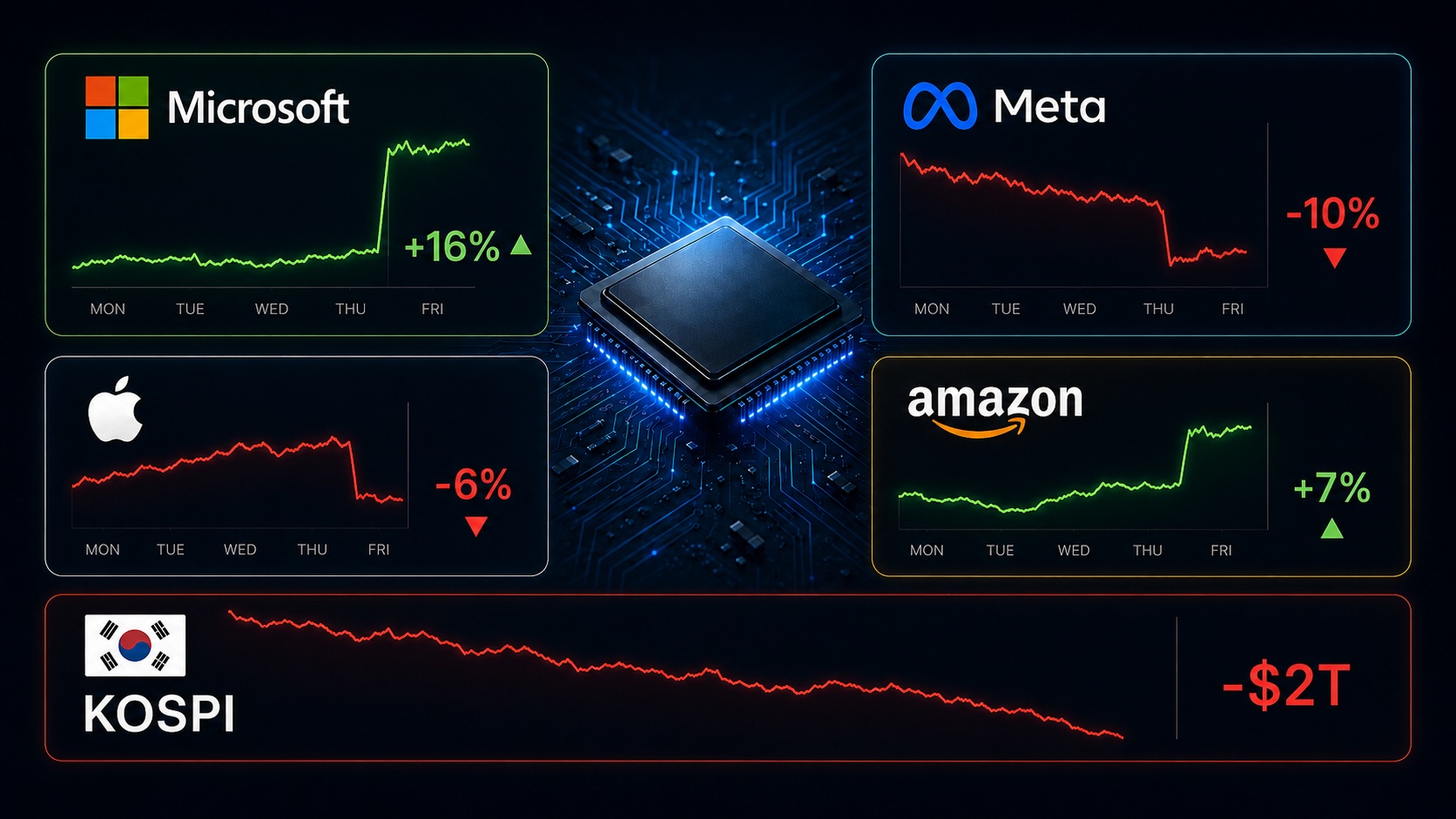
The World in a Week: How Major Markets Moved
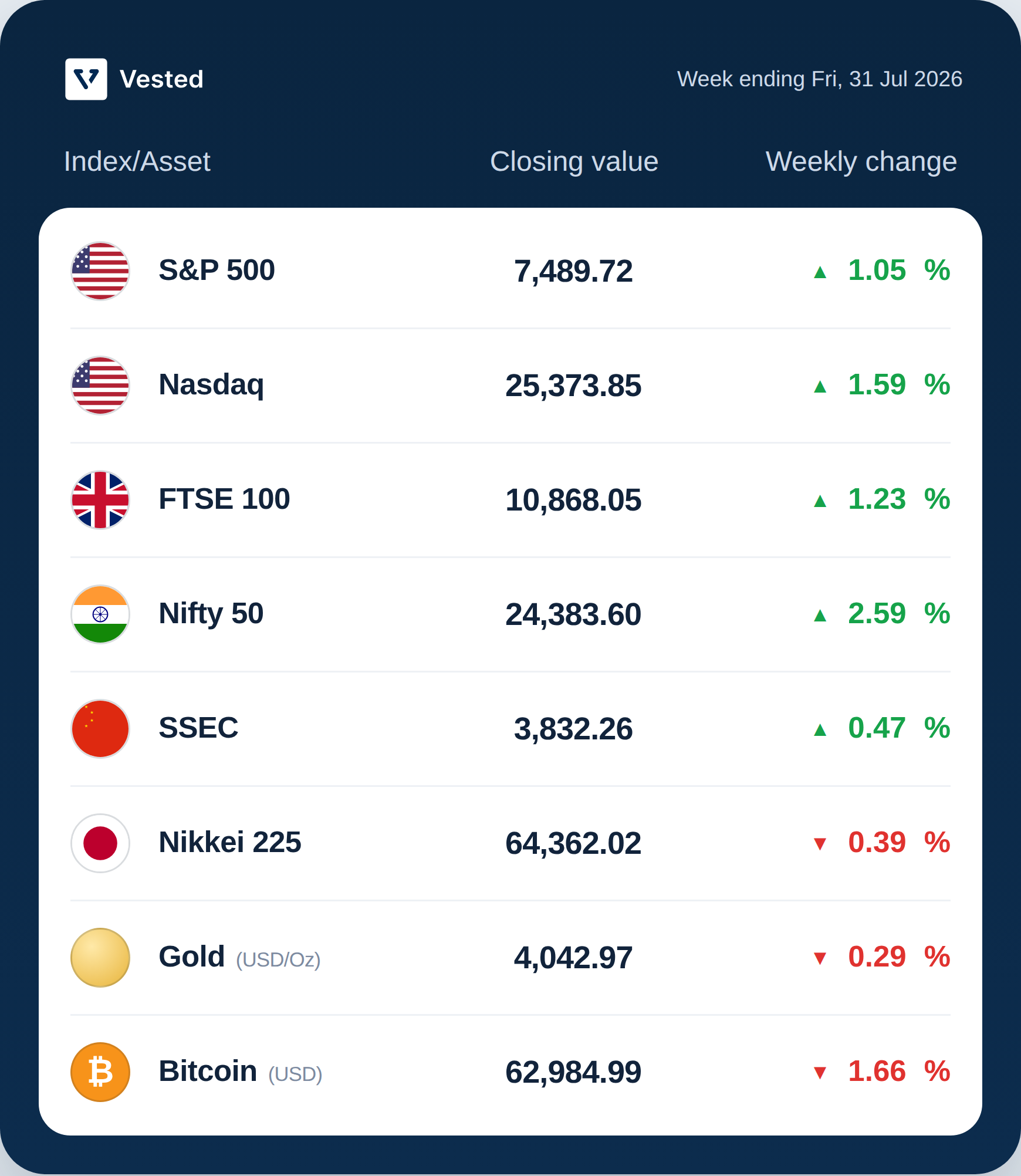
The Fed held rates but gave no forward guidance, and bond markets took that badly as the 30-year yield spiked to its highest since 2007 and the 10-year topped 4.7%, the most since January 2025, as investors questioned Kevin Warsh’s commitment to curbing inflation.
Oil didn’t help: renewed hostilities disrupted traffic through the Strait of Hormuz, pushing WTI back to $85 and Brent to $90.
Equities shrugged it off anyway, powered by a split-screen earnings week with Amazon’s cloud growth was its fastest in 18 quarters while Apple sank on soft Services and China numbers.
The four hyperscalers now guide to $720 to 745 billion of 2026 capex, and the market’s verdict is clear: reward the chipmakers, punish the spenders.
In Asia, Tokyo likely intervened to defend the yen after a 3.3% weekly slide against the dollar.

News Stories
Big Tech Earnings Week: Microsoft, Meta, Apple, Amazon
This was the biggest earnings week of 2026.
Four of the five largest companies on the planet reported results between Tuesday and Thursday. And markets treated them like four completely different species.
- Microsoft (MSFT) –
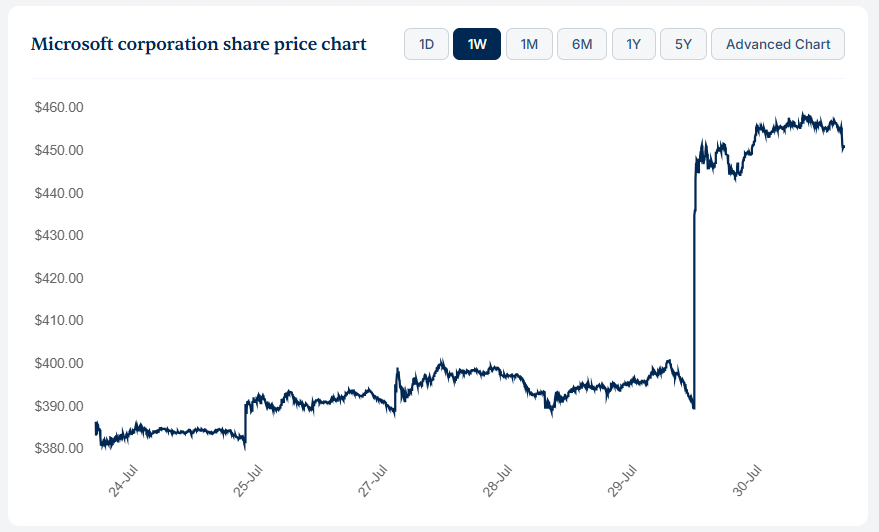
Microsoft reported on Wednesday evening, July 29. Revenue: $90 billion, up 18%. Azure, its cloud business, grew 43%, the fastest rate since early 2022.
The stock jumped 16% on Thursday.
That 16% move added $450 billion to Microsoft’s market cap, according to LSEG data. It is the largest single-day gain for any stock in history, beating Nvidia’s $441 billion day in April 2025.
Source: Vested
Jake Behan, head of capital markets at Direxion, summed up why.
“The key question was whether it could shift the conversation from how much it is spending on AI to what it is earning from those investments, and the results suggested meaningful progress.”
Microsoft shifted it. Meta, reporting the same evening, did not.
- Meta (META)
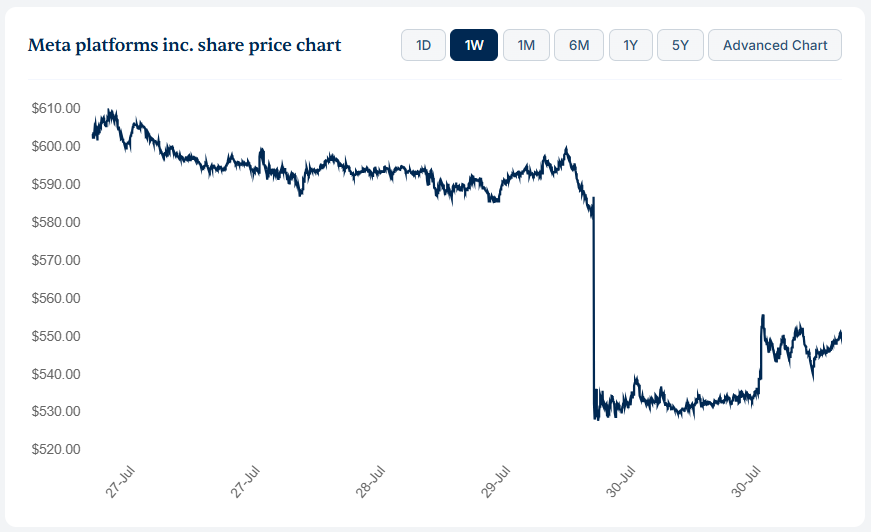
Meta posted revenue of $60.8 billion, up 28%.
But EPS came in at $6.18, badly missing the $7.22 Wall Street expected. And all the more, free cash flow collapsed 91% to just $784 million, down from $8.55 billion a year ago.
The stock fell 10%.
Source: Vested
Capex guidance climbed to $130-145 billion, Reality Labs lost another $4.62 billion, and Zuckerberg’s WSJ op-ed pitching ‘personalized super-intelligence’ did nothing to help.
Revenue is keeping pace, cash flow is not. And Wall Street evidently cares more about cash.
Anyways, Thursday evening brought Apple and Amazon together.
- Apple (AAPL)
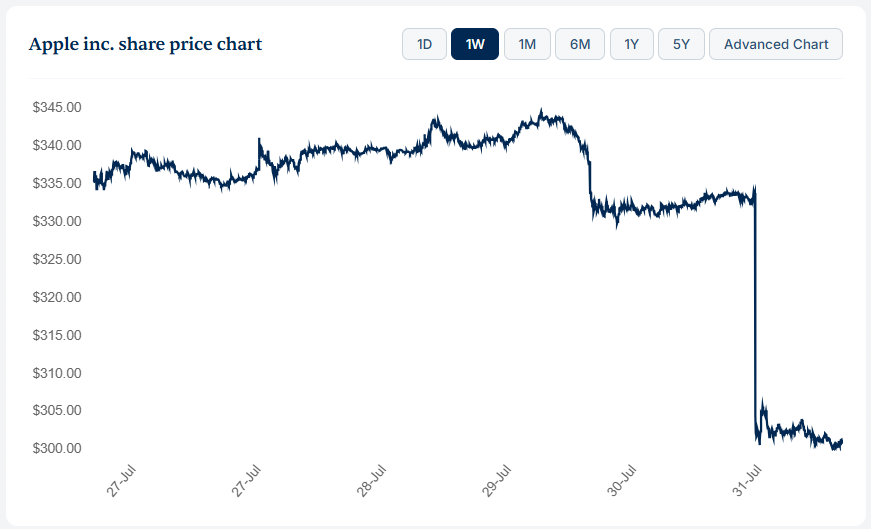
Apple reported its strongest June quarter ever: $109.4 billion in revenue, up 16%. iPhone grew 22%. Mac grew 29%. EPS was $2.02, up 29%, comfortably beating estimates.
The stock fell 4% to 6% after hours. Why?
Source: Vested
September quarter guidance came in at 9% to 11% revenue growth, below the 12% consensus. The reason: memory chip prices. Cook’s words on the call were unusually stark for a CEO known for understatement:
“A 100-year flood on the memory pricing with exponential increases in memory prices.”
That is not corporate hedging, rather a CEO telling you the cost structure has broken.
Apple’s inventory doubled to $11.1 billion. For a company famous for keeping shelves empty, that is a stockpile probably built out of fear, not strategy.
- Amazon (AMZN)
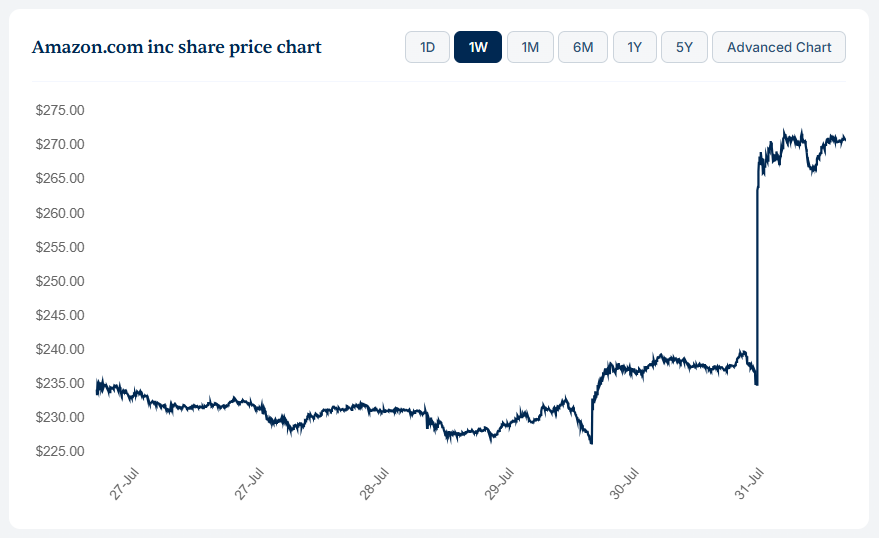
Amazon posted $200.6 billion in revenue, up 20%. AWS grew 36.7% to $42.2 billion, the fastest in eighteen quarters.
The stock rose 7% after hours.
Source: Vested
But trailing free cash flow was negative $7.6 billion, and capex guidance rose to $220 billion.
Amazon’s CEO Andy Jassy was candid about the cost pressure on his earnings call.
“There are inflated prices right now on some of the components like memory and hard drives.”
To sum up, all four companies are fighting over the same chips, the same servers, and the same AI future. The market just told you who it thinks is winning, and the answer changes every quarter.
And evidently, it lies in who shows returns from the spending, not the spending alone.
We cover these earnings in more detail on Vested Blogs. If you are interested in getting to the nitty-gritty of these stories, read them here.
Korean markets lost $2T in a month, worst since 2008
Previously on June 19, South Korea’s KOSPI index hit an all-time high of 9,385.
On July 29, it closed at 5,663. A 40% fall, or roughly $2 trillion gone in just six weeks.
July was the index’s worst month since 2008.
On July 28 and 29, circuit breakers fired on back-to-back days, the first time that had ever happened in the KOSPI’s history.
Three things hit at once.
China’s CXMT completed Asia’s largest IPO of 2026, raising $8.6 billion for DRAM expansion.
Reports emerged that China had begun making the lithography equipment that export controls were designed to block.
And the broader AI spending rout raised doubts about whether memory demand would hold.
But the crash is only half the story. The other half is what made it so much worse: leverage.
Korean retail investors had been placing leveraged bets on chip stocks through products listed in Hong Kong. To bring that money back home, Korean regulators launched similar products domestically in May.
The idea was simple: bet 2x on a single stock. If the stock goes up 10%, you make 20%. If it falls 10%, you lose 20%.
The products worked. Too well, in fact.
Retail investors poured $9.7 billion into these funds, according to KB Financial Group. Not because they were greedy, rather they were afraid of being left behind.
Then the stocks turned. And investors –

The KODEX 2x leveraged fund on SK Hynix is down roughly 70% from its June peak. At 2x, there was no time to react.
By the time the damage was done, the government stepped in with a 20 trillion won ($13.9 billion) sovereign wealth fund for AI and semiconductors.
A $14 billion fix for a $2 trillion problem. Only time will tell.
Worth noting: the KOSPI is still up about 2x in a year even after the crash. The story did not break, rather the leverage did.
The question worth asking: is this a correction that has further to go, or are Korea’s chip giants now priced at levels that will not last? That is for each investor to decide.
For those watching Korean chip stocks at these levels, SK Hynix is available via its US ADR (SKHY), and Korea ETFs like EWY and FLKR hold Samsung and SK Hynix as top positions. Both available on Vested from India.
To sum up, the tiny chip did something remarkable this week.
It handed Microsoft the biggest single-day stock gain in history, crashed an entire country’s market, and turned record-beating earnings into a selloff.
The market is no longer rewarding who spends the most on AI, rather who can prove it is working. That filter just got switched on, and not everyone passed.
What happens when even the ones passing today stop doing so is a question for coming quarters.
That is a story for a future Vested Shorts. We will be here when it drops.
Thanks for reading!