




Welcome back to a new edition.
Before the stories, a question about this week: If every company that actually makes AI chips says it cannot keep up with the orders in front of it, what was being sold? Chips or just the idea of it?
Our video on whether semiconductor shares are worth owning right now sits on exactly that question: Should you buy semiconductor stocks now? at Global Markets by Vested.
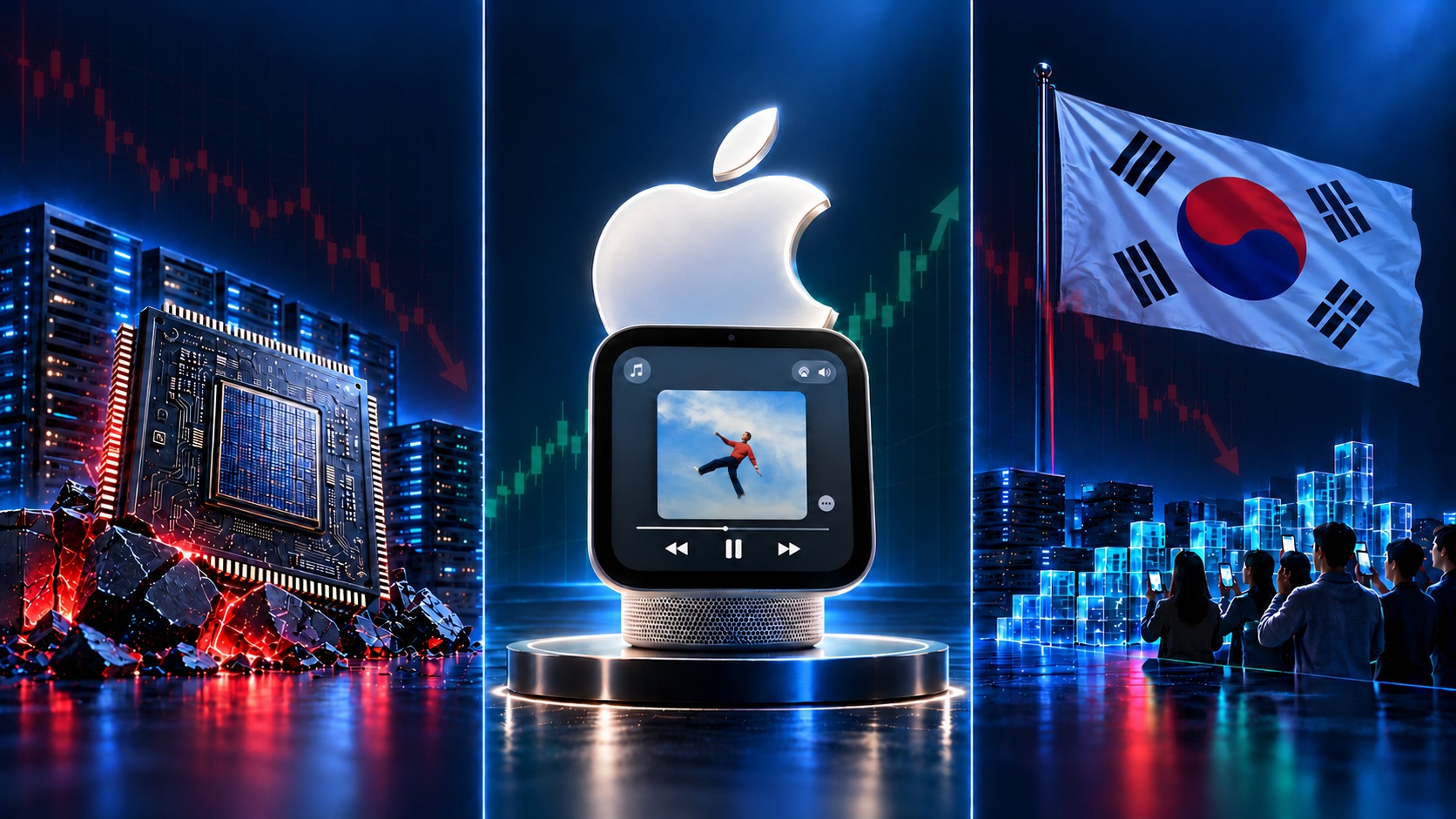
Chip stocks lost $1.64 trillion of market value in six sessions. On the last of those days TSMC reported the biggest quarter in its history and said demand is still far above what it can supply.
Korea’s main index fell 7.57% on Thursday and shed close to 400 trillion won in a day. The sellers were foreign funds, for the eighth session running, and the buyers were Korean households.
Apple finished Wednesday worth $5.005 trillion, only the second company ever to close above that line, on the back of a $299 speaker with a screen in it.
Money left the companies that have to borrow in order to grow, and went to the one that does not.
One thing from us before the stories. If you wish to test the waters, check your understanding of the AI sell-off in this week’s edition of the Global Investing Challenge by GlobEd.
Now, let’s see how the world’s markets held up this week.
The World in a Week

AI debt set the tone. Investors fear the companies building AI data centres have borrowed more than they can repay in time. CoreWeave, a heavily indebted data centre operator, lost about a quarter of its value.
Chip stocks followed it down. The Nasdaq fell 4.5% to 26,140.03, its worst week since June, and the S&P 500 slipped 1.9% to 7,659.44.
Hot US inflation added to it. Producer prices rose 6.3% from a year ago, and traders now expect a Fed rate rise in December. Gold, which pays nothing to hold, fell 0.7%, and bitcoin slipped 0.3%.
Asia’s chip-heavy markets felt the same pain. Japan’s Nikkei 225 dropped 5.4% to 65,324.29. China’s SSEC fell 2.6% to 3,716.28, also hurt by a trade dispute with the EU.
Money moved into steadier companies. Tobacco, drinks and defence lifted the FTSE 100 3.1% to 10,881.90. Brent crude climbed near $110 after attacks around the Strait of Hormuz.
India went the other way. Strong results from Tech Mahindra and Wipro gave the Nifty IT index its best week since 2008, and the Nifty 50 rose 2.8% to 23,146.15.
The rupee gained about 2%. Foreign investors kept selling, though, and costlier oil means a bigger import bill for India.
Now, moving to the week’s stories.
News Stories
Chip stocks lost $1.64 trillion while TSMC posted its best quarter
Over six trading sessions to Thursday, the Philadelphia Semiconductor Index fell 11.6% and gave up more than $1.64 trillion of market value.
The Nasdaq Composite lost over 3% across the same stretch.
By Thursday afternoon, it was down a further 3.3%, which Reuters estimated would push the six-day figure towards $2 trillion. That was an intraday estimate, taken before the close.
TSMC published its results the same afternoon.
Revenue reached NT$1,494.24 billion, or $46.72 billion, up 41.2% in dollar terms on a year earlier, and net income rose 68.7% to NT$763.06 billion.
The gross margin came in at 66.4%, and TSMC held its 2026 capital budget at $60 billion to $64 billion.
TSMC’s chief executive C.C. Wei said this on the call –
“we still think the demand is higher than the supply, and we are working very hard to narrow the gap”
He added that the company saw no sign of a slowdown, and that close to 20 new fabs are under construction around the world.
TSMC’s 2nm process is in its first full quarter of production and already accounts for 8% of wafer revenue.
Wei expects that family’s annual capacity to more than double in 2027. Chief financial officer Wendell Huang told the call that spending from 2026 to 2028 will run –
“even more significantly higher than the past three years”.
The shares fell 1.8% anyway. So the selling was about the price of money, and the order book was never the problem.

Source: TSMC on Vested
The clearest place to watch that is CoreWeave, which rents out AI computing power. It has borrowed about $50 billion to build it.
Investors who lent CoreWeave that money are now selling out at a loss. They are getting 79 cents for every dollar they are owed, which is a 21-cent loss on each one.
There is also insurance you can buy against CoreWeave failing to repay. It now costs 10% of the amount covered, every year.
At that price the market is putting the odds of CoreWeave failing to repay within five years at nearly 63%. A year ago it put them at about 30%.
CoreWeave is forecast to make nearly $13 billion of revenue in 2026 and lose $2.13 billion doing it.
Its shares fell as much as 8.3% on Thursday to their lowest since May 2025.

Source: CRWV on Vested
One fact cuts the other way, and it is a large one. Nvidia has agreed to buy any CoreWeave capacity that goes unsold through to 13 April 2032, so that business has a demand backstop almost no borrower ever gets.
Which of those matters more is the thing nobody can price yet. CoreWeave’s chief executive Mike Intrator told staff that markets sometimes “misunderstand and act irrationally”.
Korea’s market fell 7.57% and Korean households bought it
Korea’s KOSPI closed Thursday at 5,554.22, down 7.57% from the previous day’s 6,008.81. The smaller Kosdaq index fell 7.65% to 760.82 on the same day.
Close to 400 trillion won (“won” is the official currency of South Korea) of market value, about $297.7 billion, disappeared in that single session. Across the seven sessions from 6 October the index gave up more than 1,100 trillion won.
The index had already broken briefly below 6,000 on Monday. By Thursday, it was 8.02% below the previous close and trading had been halted.
It was the KOSPI’s tenth circuit breaker this year, and the first in 51 trading sessions.
Samsung Electronics fell 9.48% and SK hynix fell 11.06%. Those two carry so much of the index that their losses explain most of its fall by themselves.
The flow data got far less attention. Foreign investors sold a net 3.6 trillion won on Thursday, their eighth consecutive session of selling.
Their share of the Korean market had already dropped to 38.65% by 13 October, the lowest since 4 May.
The buying came from inside Korea.
Domestic institutions bought a net 1.69 trillion won on Thursday and retail investors bought a net 1.29 trillion won.
Korean investors be like –

Basically, Korean savers were taking on what foreign funds were handing over. The reason those funds were leaving sat in Washington.
American consumer prices at 3.7% and a 10-year Treasury yield above 5.3% raise the cost of every loan behind an AI data centre.
Korea’s two largest listed companies sell the memory those data centres run on. Only three companies in the world make that memory at scale, and the third is Micron in the United States.
So a borrowing-cost problem in the United States arrives in Seoul as a share price. Korea’s losses on Thursday went well beyond what other major markets gave up.
Hwang Su-wook of Meritz Securities said –
“stock prices are being driven more by sentiment and market flows than by fundamentals”
Lee Kyoung-min of Daishin Securities gave the figure that puts the week in proportion:
“KOSPI is now down 40.4% from its June 19 peak of 9,385 points.”
Korea has been near this level before. It had already fallen about 40% from that peak by the end of July, then climbed back above 6,800 in September. Thursday’s close was its lowest since April.
On Friday, the index rose 2.05% to close at 5,668.05, ending the seven-session losing run. Foreign investors bought a net 342.8 billion won, which stopped their selling streak at eight sessions.
Samsung recovered 2.62% to 215,500 won and SK hynix added 0.79% to 1.272 million won.
One session of buying after a fall of this size tells you very little about the next month.
What it does show is that Korean households have committed a great deal of money to a view that foreign funds spent two weeks selling into.
Apple reached $5 trillion on the week AI stocks fell
Apple ended Wednesday with a market value of $5.005 trillion, the second company in history to finish a trading day above $5 trillion. Nvidia is the only other one to have managed it.
The shares rose about 0.5% that day while most large technology stocks fell. Apple had touched $5 trillion during trading hours several times since late July without ever holding it to the closing bell.
Its previous milestone gives a sense of the pace. Apple passed $4 trillion about a year earlier, in October 2025, so the last trillion took roughly twelve months.
What it put on sale that week was a speaker. HomeView was announced on Monday at $299, in a tabletop version and a wall-mounted one, arriving with buyers from 13 November.

Source: Apple
It has a seven-inch square display, a camera for video calls, and recognises up to six people in a household so each gets their own home screen.
Apple is not selling HomeView in the European Union, because the Siri AI features it is built around are unavailable there. The shares were up roughly 26% for the year and close to 40% over twelve months.

Source: AAPL on Vested
The more interesting number is the gap between Apple and Nvidia. Nvidia’s lead stood at about $903 billion on 6 October, and by Wednesday it had shrunk to $334 billion.
That is a narrowing of nearly $570 billion in six sessions. Apple did not add $570 billion in that time, so the gap closed from above, with Nvidia falling 3.16% on Wednesday alone.
Traders repriced the question within hours.
Polymarket lets people bet real money on outcomes, so its prices work as running probabilities.
Apple’s odds of ending October as the world’s largest company went from around 5% early Wednesday to 22% on Thursday. Nvidia’s odds over those same hours fell from 94% to 78%.
Nvidia is still the larger of the two today.
You see, Apple does not need to borrow to grow. It earns more cash each year than it spends, and since 2012 it has given more than $1 trillion of that surplus back to its shareholders. As dividends or buybacks.
So when borrowing gets more expensive, the pain lands on the companies building data centres with borrowed money, and barely touches Apple. Investors are paying a high price for that safety.
Apple now costs about 37 times what it is expected to earn next year. Alphabet, Amazon and Microsoft cost about 27 times, and the S&P 500 as a whole about 20.
And Apple’s profits still rest largely on one phone.
It is also reported to be planning price rises to cover higher chip costs. That is the same memory bill arriving at the far end of the chain.
The bottom line
What does a market do when it stops believing a story it cannot find a flaw in?
It keeps the story and changes who pays for it. Every figure that arrived this week said the orders are real, the queues are long and the capacity is short.
What moved was the cost of the money needed to build that capacity. So the money went looking for growth that does not require a loan.
There is a limit to how long that can hold, because the businesses being starved of cheap funding are the ones doing the building.
That is a story for a future Vested Shorts. We will be here to tell you when it comes.
Thanks for reading!