





Welcome back to a new edition.
Jack Welch, who ran General Electric for two decades, had a rule:
| “Change before you have to.” |
This week showed what happens when you don’t.
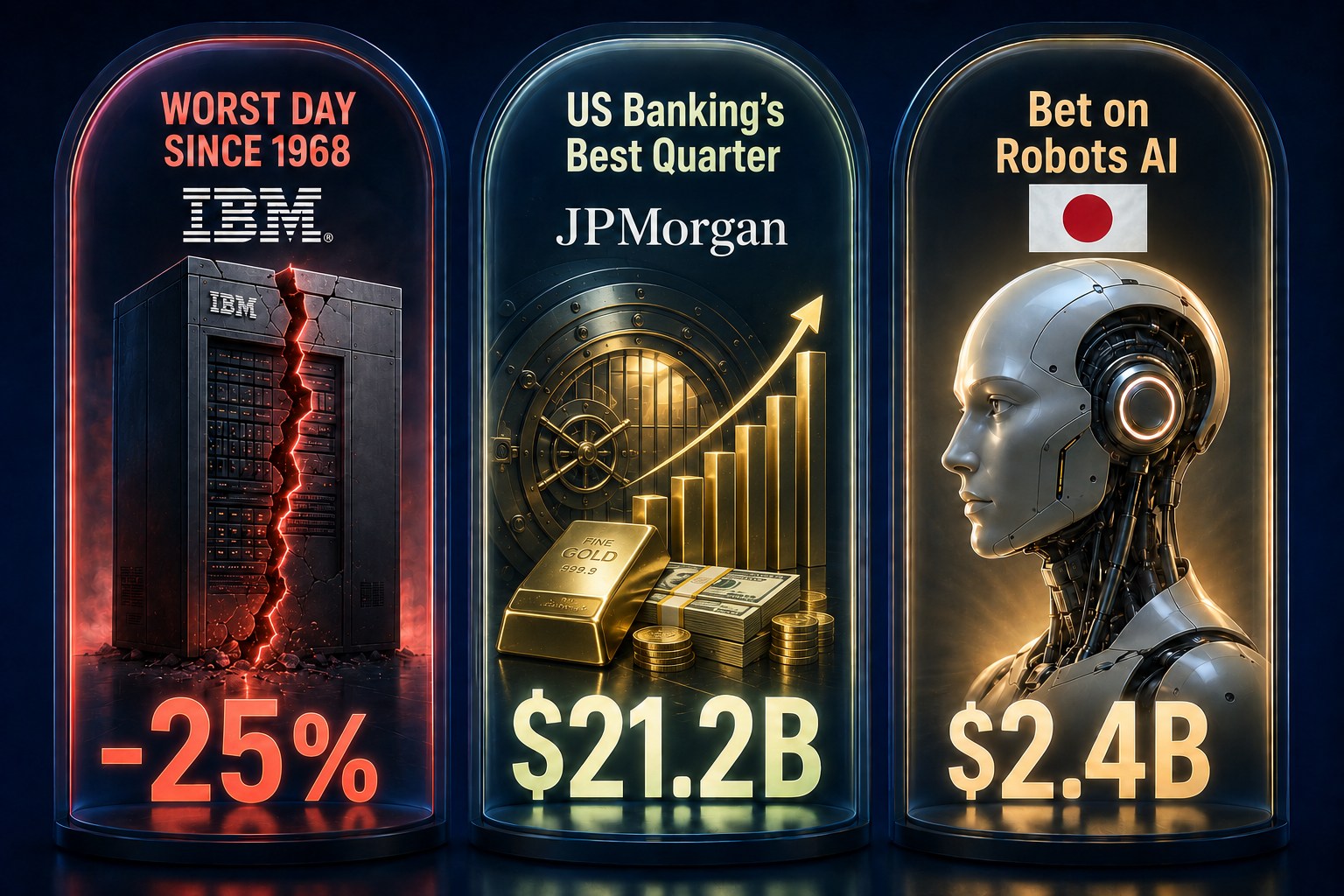
IBM lost a quarter of its value in a single day, its worst since 1968. Why? Blame AI.
JPMorgan made $21.2 billion in three months, the most any US bank ever has.
Far away in Japan, the country that basically invented the factory robot is now writing a $2.4 billion cheque to catch up on the AI that runs them.
We’ll get to these interesting bits.
But first, let’s see how the rest of the world held up this week.
The World in a Week: How Major Markets Moved
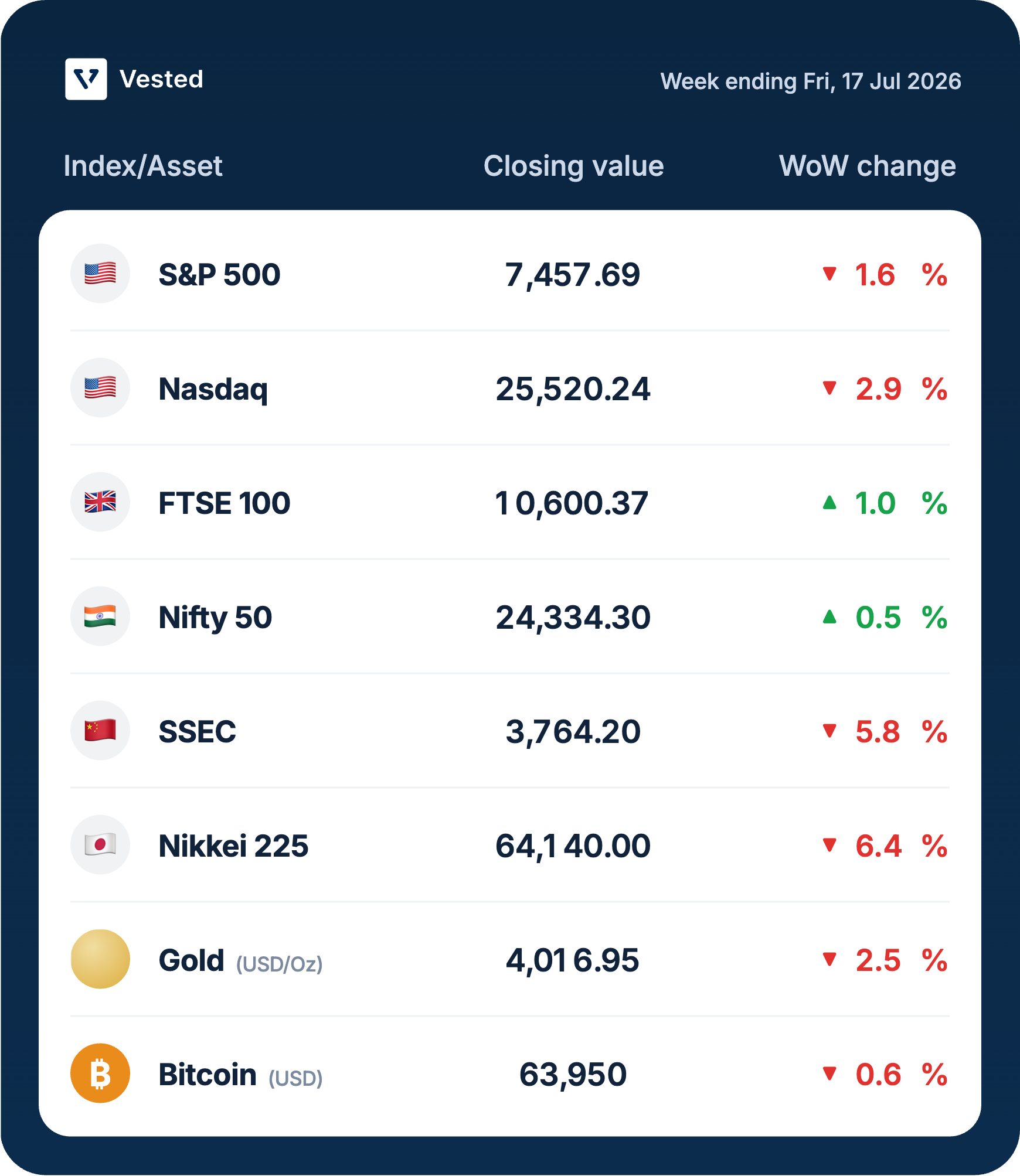
The AI-and-semiconductor trade finally buckled, and the damage tracked exposure with Tokyo and Shanghai were hammered, London and Mumbai barely moved.
Taiwan Semiconductor’s raised spending forecast revived capex-arms-race fears, a powerful new open AI model sharpened them, and Nvidia briefly lost its crown to Apple.
But then there is a real shock: fresh US–Iran strikes lifted oil and made energy and utilities the week’s true havens, not gold which slipped as hawkish Fed talk kept a September hike alive. Bitcoin swung and finished flat. India, low on chips and earnings-driven, quietly defied it all.

News Summaries
IBM’s worst day since 1968, thanks to AI
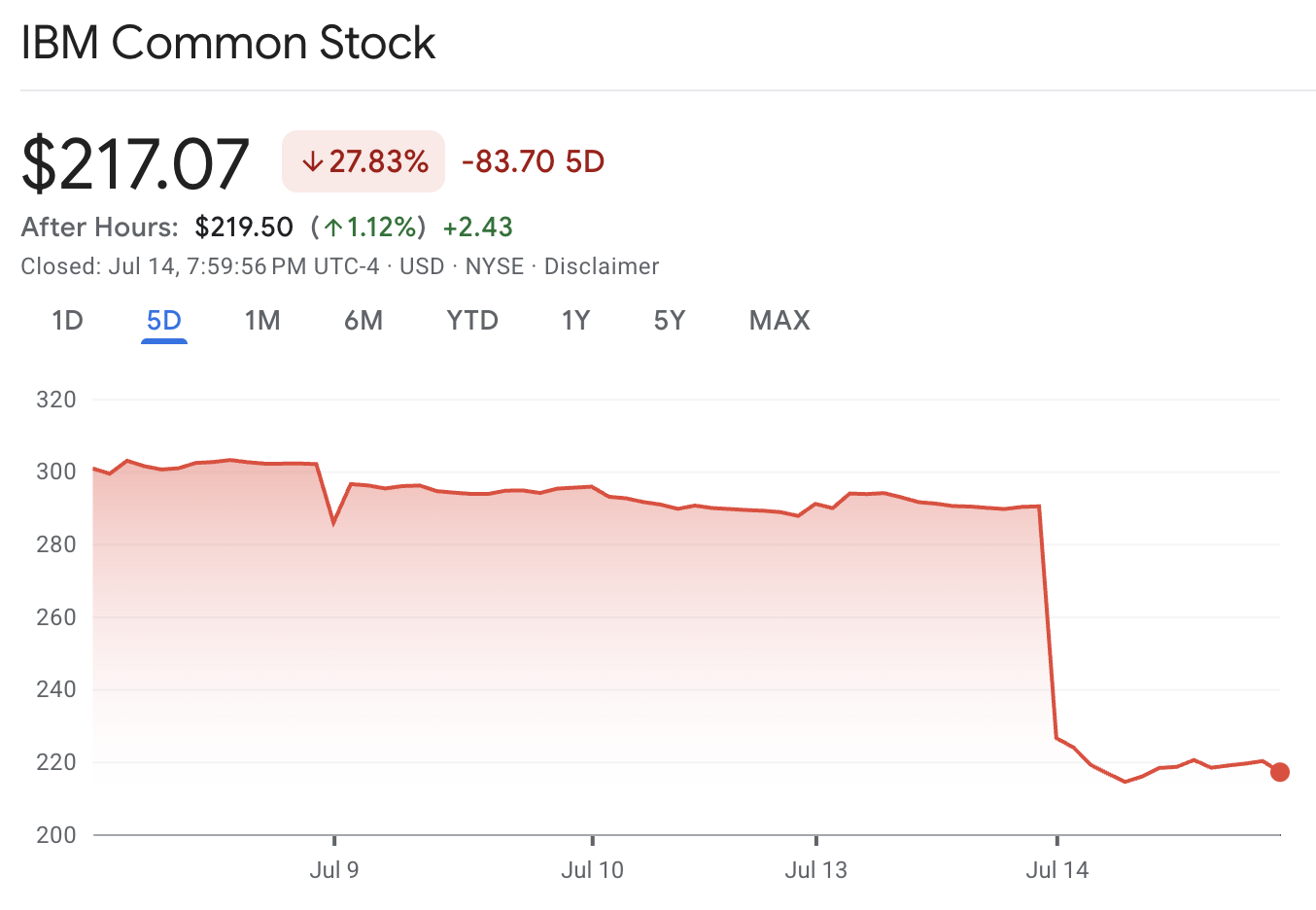
On July 14, IBM shares crashed 25% in a single day. That is the worst day in the company’s recorded history, going back to 1968. It’s even worse than Black Monday in 1987.
About $68 billion of IBM’s value vanished in a few hours. The stock closed at $217.07.
But, here is the strange part. IBM did not report a disaster. Revenue came in at $17.2 billion, only about $660 million short of what Wall Street wanted. Fairly good.
What spooked everyone was the reason.
Late in June, IBM’s customers rushed to buy AI hardware, like servers and memory chips, before prices went up. To pay for it, they cut back on IBM’s software and services.
IBM be like –

Well, as IBM’s CEO Arvind Krishna told investors plainly:
| “We did not adapt and move quickly enough, and numerous large deals failed to close on the timelines we expected, driving the majority of our shortfall.” |
Anyways, here is the part worth sitting with.
Think of a company’s tech budget like a family’s monthly grocery money. It is fixed. When the price of one essential shoots up, something else in the cart gets put back on the shelf.
That is what happened to IBM.
Companies didn’t stop spending, they just prioritised AI hardware purchases, and pushed IBM’s renewals for later.
However, the trouble was in IBM’s machines, not its software.
IBM’s software sales actually still grew 5%. The money went to the chip side of the aisle.
In the bigger picture, the divide is worth noticing.
The same AI wave that cracked IBM is exactly what has been lifting chipmakers and memory sellers, so on the day IBM fell, several hardware names quietly rose.
The shift caught IBM a step too slow.
Largest quarterly profit in US banking history
On July 14, JPMorgan reported a $21.2 billion profit for Q2 2026. That is the largest quarterly profit in US banking history.
All five big US banks beat expectations the same morning.
Together JPMorgan, Goldman Sachs, Bank of America, Citigroup and Wells Fargo cleared about $49 billion in profit, up 39% from a year ago.
A big chunk of the boom came from one event.
SpaceX went public on June 12 in the largest IPO ever, and the banks that helped run it, along with a wave of other AI-related deals, collected a lot in fees.
JPMorgan’s stock-trading revenue alone jumped 86% from a year earlier.

However, there’s a catch.
Strip out a one-time $4.6 billion gain from selling Visa shares, and JPMorgan’s “record” profit drops to $16.9 billion… still huge, though no longer a record.
In fact, CEO Jamie Dimon sounded cautious. On JPMorgan’s earnings call, he told analysts the moment was “close to as good as it gets.”
And in his results statement, he warned that risks are –
| “[…] shifting below the surface like tectonic plates.” |
Translation: enjoy the party, it will not always be this loud.
The best quarter in banking history came with the bank itself telling you to stay cautious.
The tricky part about a record quarter is that the bank winning today may not win the next one.
If you would like to get exposure to global themes instead of guessing the winner, Vested’s Managed Portfolios spread your bets across a basket instead of one name.
Invest in Managed Portfolios
The OG robot maker’s bet on AI
On July 16, Japan announced it is putting $2.4 billion into a new company called Noetra. Its job is to build a homegrown AI “brain” for robots.
Noetra pulls together some of Japan’s biggest names, including SoftBank, NEC, Sony and Fujitsu.
The plan is to release its first AI model by March next year, then a robot-focused version within a few years.
Japan has led the world in factory robots for decades.
Modern AI, the part that lets a robot see, learn and adapt instead of repeating a fixed motion, has been led by the US and China, while Japan watched from the sidelines.
There is also a very human reason behind the spending, which is all the more interesting.
Japan’s population is shrinking and it is short of workers, so a few million capable robot coworkers would really help.

Japan still makes the world’s best robot bodies, and now it is spending billions to stop importing the intelligence that goes inside them.
The catch is that no one knows yet which company wins this AI race, so putting everything on one country or company carries real risk.
If you wish to spread the exposure across many AI players worldwide, Global Funds on Vested, like the Fidelity Global Technology UCITS Fund, help you with just that.
Invest in Global Funds
Private Markets Pulse
Two stories of this edition were about AI and robots. Two companies building exactly that are still private, and both are open right now on Vested’s Private Markets:
1.Reflection AI
Started in 2024 by two ex-Google DeepMind researchers, one a co-creator of AlphaGo. It is building an American open-source answer to OpenAI and Anthropic. Its valuation ran from about $545 Mn to a reported $25 Bn in roughly a year, roughly a 46x jump. It just signed a compute deal with SpaceX worth up to $6.3 Bn, and is working with the US Government too. The likes of JPMorgan & Nvidia are investing in it.
Explore Reflection AI
2. Figure AI
Builds humanoid robots that already run real shifts at a BMW plant, working daily 10-hour shifts over 11 months and handling 90,000+ parts. The company says it now runs more robots than humans internally. Last valued at $39 Bn, it is backed by NVIDIA, Microsoft, OpenAI’s startup fund, Jeff Bezos, and many more.
Explore Figure AI
This week’s pick from GlobEd
Here’s what IBM’s crash quietly showed. On the day IBM fell 25%, several chip and memory names rose instead. The same AI wave is steering the whole US market through a handful of names.
That concentration runs deeper than most people realise, and when a few giants move, the entire index moves with them.
Understand how it works, whether in your favour or otherwise, and how to navigate this. All of this at GlobEd by Vested.
Understand market concentration
Thanks for reading!