





Welcome back to a new edition.
Before we start, our video on why Adobe and Salesforce stocks crashed is worth ten minutes of your weekend. Check out: The Software Massacre at Global Markets by Vested.
Interestingly, one of those companies is the subject matter of this week’s edition as well.
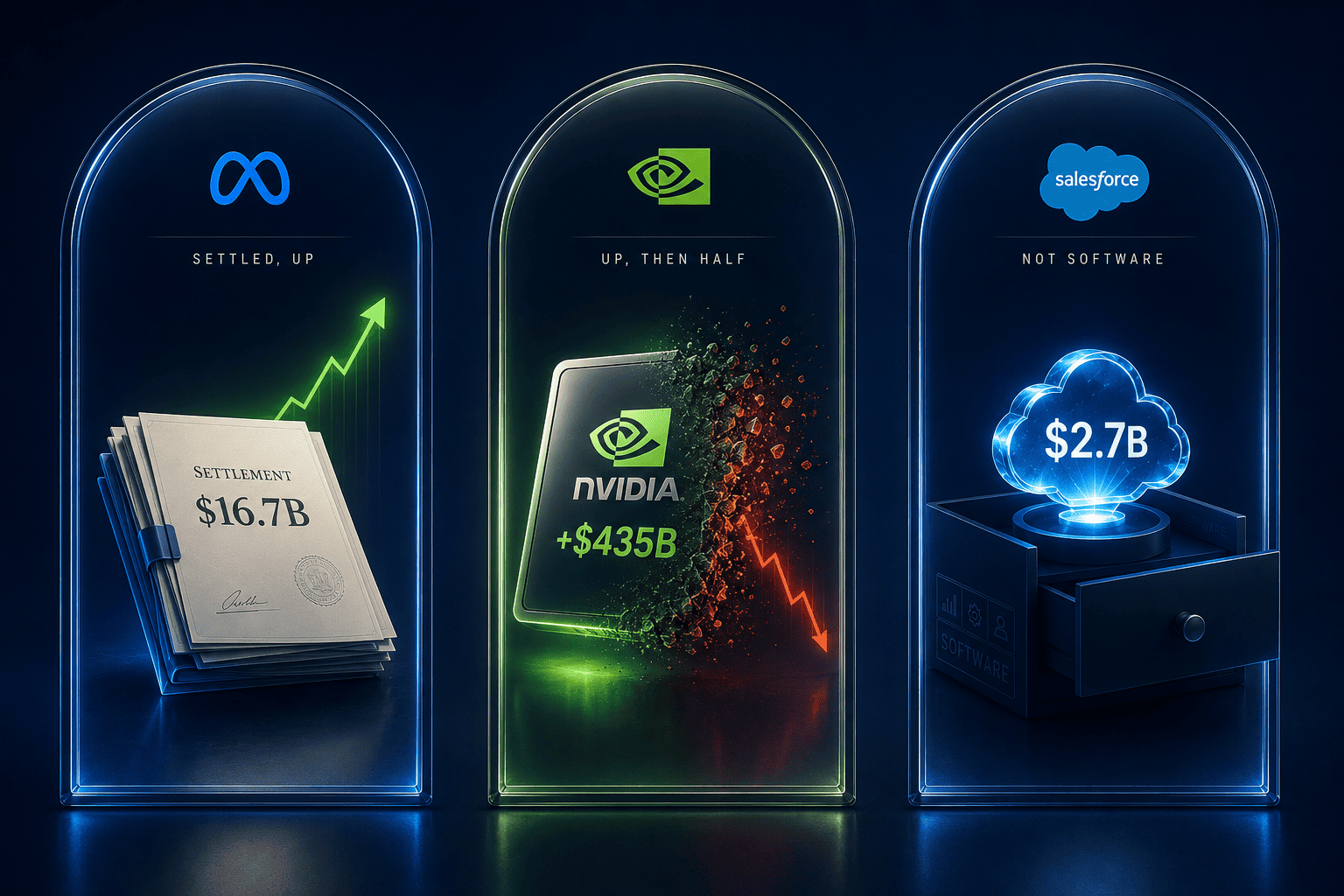
Salesforce reported earnings of $5.90 a share against the $3.27 expected and had its second-best day ever, except $2.53 of that did not come from selling software.
Meta agreed to pay up to $16.7 billion as settlement and its stock went up.
Nvidia added $435 billion in a single session, on a day the average American company lost money, then gave back half of it.
And on a side note, Amazon hiked the price of an Echo Dot up from $49.99 to $79.99 and nobody blinked, because everyone already knew memory chips had got expensive.
The Indiana attorney general, announcing the Meta settlement on Wednesday, put the whole week in one line:
“[…] it’s about changing how these platforms operate so they stop exploiting […]”
We’ll get to the interesting bits.
But before that, we built an interesting challenge to feed your competitive spirit.
Each week, we bring out a new edition of the “Global Investing Challenge.”
This week’s edition aimed at testing your knowledge on global market fundamentals.
Click (Quiz) or on the image below to take the challenge and prove that you are a smarter global investor than most.
Coming back to the week’s updates, let’s start with how the global markets fared this week.
The World in a Week

The big event this week was the Fed’s Jackson Hole meeting. Chair Kevin Warsh said the summer inflation numbers looked better, but he is not convinced the problem is fixed, which puts a September rate hike back on the table. You would expect stocks to fall on that. They did not. Investors seemed relieved to get a straight answer, and US markets ended the week higher.
Nvidia did most of the lifting before that. Its strong sales forecast pushed chip and tech stocks up across the US and Asia, though some of those gains faded by Friday.
US and China tension picked up again, with talk of sanctions on Chinese banks and new tariffs, weeks before Xi’s US visit.
In India, the Nifty finished slightly lower on Fed worries, with IT stocks the one bright spot on the Nvidia news. Gold fell hard after five straight weeks of gains.
Now, let’s move to the interesting news stories of the week.
News Stories
Meta’s $16.7B settlement made its stock go up
On Wednesday, in the middle of a trial in California, Meta (META) filed papers agreeing to settle the case brought against it.
The case was about the effect of Facebook and Instagram on teenagers.
The structure has two parts. Around $12.7 billion goes to the participating states over ten years, earmarked for youth mental health programming, crisis intervention services, after school programs and outdoor activities.
A further $5.3 billion is contingent, and this is the part worth reading twice: Meta only pays it if YouTube and TikTok agree to adopt equivalent limits on teenage users.
Meta will book a $10 billion legal charge in the current quarter, roughly 53% of what it earned in operating profit in the previous one.
The settlement is not only money. Meta agreed to a list of product changes it would never have proposed voluntarily:
- Under-18 accounts get a two-hour daily cap by default
- The apps are blocked between midnight and 6am
- Notifications go quiet during school hours
- A chronological feed becomes available, and parents can set it as the default
- Like counts and reaction counts are hidden
- Stronger age verification, with teens unable to switch off certain safety settings without a parent
Todd Rokita, the Indiana attorney general, was blunt about which half mattered more, in the line that opened this edition.
Then Meta published an open letter to its competitors.
“We want to ensure teens benefit from this new industry standard, but we cannot do it alone.”
Read that next to the $5.3 billion contingency and the shape becomes clear. Meta has a direct financial incentive, worth $5.3 billion, for TikTok and YouTube to accept the same restrictions. A company that has just been forced to make its own product less engaging has every reason to want its rivals held to the same rule.
Anyways, here is the part worth sitting with.
Meta’s stock closed at $576.14 on Wednesday, up 1.07%. That added roughly $13.5 billion in market value, about 80% of the maximum settlement figure, on the day the company agreed to pay it.

Source: META on Vested
That is not investors ignoring the news. It is investors deciding that a capped, known, ten-year payment schedule is worth more than an open-ended trial with no ceiling on it.
The number being judged was the one nobody could calculate, which is what an unbounded verdict might have cost.
For scale, $16.7 billion sits in the same territory as Volkswagen’s diesel emissions settlement and BP’s Deepwater Horizon payments, and nowhere near the 1998 tobacco Master Settlement, which ran past $200 billion.
In the same week, Pennsylvania’s attorney general David Sunday sued Snap (SNAP) in the Philadelphia Court of Common Pleas over disappearing messages, infinite scroll, autoplay, push notifications, Snapscore and Snapstreaks.
Snap said the accusations,
“[…] fundamentally misrepresent our platform and our approach to teen safety.”
Its shares closed at $5.42, down 8.45%, wiping out about $791 million.

Source: SNAP on Vested
Meta agreed to pay $16.7 billion for certainty. Snap now has to argue for its own.
Nvidia added $435B in a day while average stocks fell
We went through Nvidia’s (NVDA) quarter properly in Thursday’s newsletter, so the short version: $96.2 billion of revenue, up 106% from a year ago, $108 billion guided for the current quarter, roughly 70% growth guided for all of next year, and an order book above $2 trillion.
The market’s reaction is the part that happened after we published.
On Thursday, Nvidia rose 8.74% to close at $227.98, its biggest single-day gain since April 2025, adding roughly $435 billion of market value in one session. That one day’s gain is larger than the entire market value of all but about twenty companies on earth.

Source: NVDA on Vested
Now look at what the rest of the market did on the same day.
The S&P 500 rose about 0.6%. The equal-weighted version of that index fell 0.16%. The difference between the two is worth understanding, because it explains a lot about this market:
The normal S&P 500 weights companies by size, so a giant like Nvidia moves it far more than a small one does. The equal-weighted version counts all 500 companies the same, which makes it a better picture of how the typical American company is actually doing.
On Thursday, technology rose 2.55%. Healthcare and utilities fell. Micron, the American company that makes the memory chips Nvidia buys, dropped 2.76%.
So an investor holding the index made money that day, and an investor holding an equal slice of all 500 companies in it did not. And the difference was almost entirely one stock: Nvidia.
Then Friday happened. Nvidia fell 4.70% to close at $217.26, handing back roughly $250 billion, more than half of Thursday’s gain, in the following session.
Anyways, here is the part worth understanding.
Nvidia’s finance chief spent a section of the call talking about her costs, which is not a thing CFOs volunteer to do.
“We are experiencing extreme pricing conditions in memory.”
Memory chips have become so expensive that Nvidia guided its gross margin down from 75% to a low of 71 to 72% over the next two quarters. High bandwidth memory now accounts for 30 to 40% of what it costs to build an AI accelerator, up from under 20% in earlier generations, and only three companies in the world make it: Samsung, SK Hynix and Micron.
Kress then explained why she was not especially bothered.
“Unlike a component that simply raises our cost with no offset benefit, tighter memory supply is a symptom of the same demand surge that is driving our own growth.”
That single sentence connects this story to the Echo Dot at the top of this email. The same shortage squeezing the most valuable company in the world is the one Amazon named when it put $30 on the price of a smart speaker.
Nvidia can absorb it, because the cost arrives attached to a demand surge that doubled its revenue. Amazon’s customers cannot, because they are just buying a speaker.
Salesforce’s 2nd-best day ever wasn’t from selling softwares
For two years a single fear has hung over every enterprise software company, and it has a name.
“The SaaSpocalypse”
The idea that once AI models get good enough at doing work directly, nobody needs the software that used to organise that work.
It has already done real damage.
Adobe (ADBE) and Salesforce (CRM) both de-rated hard on it earlier this year. And it was still doing damage on Wednesday, when Intuit (INTU) fell around 10% after guiding TurboTax unit growth down to 2 to 3%. JPMorgan cut its price target from $605 to $331 in a single move.
The argument circulating that day was arithmetic: an AI agent can process a tax return for roughly $0.12 of compute against the $162 of revenue TurboTax collects for one.
Then on Thursday, Salesforce reported.
Revenue of $11.35 billion, up 11%. Adjusted earnings of $5.90 a share against the $3.27 analysts had penciled in. Agentforce, its AI product line, running at $1.5 billion of annualised revenue, up 240% in a year. Raised full-year guidance. The stock closed up about 22% at $251.88, which CNBC reported as its second-best day ever.

Source: CRM on Vested
Salesforce CEO Marc Benioff, who has fielded this question on every call since early 2026, was not gracious about it:
“This is not the SaaSpocalypse. We have been hearing about this for the last two quarters, these dire predictions about the end of software and how the models eat everything. But none of them have come true for us.”
His argument is that a model needs somewhere to get its facts, and that somewhere is a customer database with permissions and rules attached to it.
“We are told the frontier models would eliminate the need for CRM. Instead, they depend on it, and we’re showing how 1 plus 1 can equal 3.”
He backed it the same day by announcing Claudeforce with Anthropic.
Two pieces: a plugin that puts Salesforce data inside Claude with 37 prebuilt sales tasks, so a salesperson can ask questions and update records without opening Salesforce at all; and Claude running underneath Agentforce as its reasoning engine, which is the part of an AI system that decides what steps to take.
Salesforce’s president Patrick Stokes described work that used to take “10,000 clicks inside of Salesforce” now finishing in about 30 seconds.
Which is a strange thing for a software company to be proud of, until you hear how Stokes frames it.
“The value of Salesforce is not in our UI itself. The value of Salesforce is in the data and the metadata.”
If he is right, Salesforce becomes the plumbing and Claude becomes the tap. That is a fine position while customers keep paying for plumbing. It is a worse one if they decide the tap is the product.
Anyways, here is the part worth understanding.
Of that $5.90 in adjusted earnings, about $2.53 did not come from selling software to anyone.
Salesforce runs an $11.3 billion portfolio of stakes in other companies, and one of those stakes is in Anthropic. Anthropic raised money in May at a valuation of $965 billion, and Salesforce marked its holding up to match: a $2.7 billion unrealised gain in the quarter, taking the stake to roughly $5.1 billion.
That one holding went from about 22% of the portfolio in January to 45% by July.
Unrealised is the word doing the heavy lifting. Salesforce has not sold anything and has not received a rupee of it. It is the accounting value of a private stake, written up because somebody else paid a higher price for a piece of the same company.
Take it out and Salesforce earned about $3.37 a share, up roughly 16% from $2.91 a year ago. A good quarter, not a $5.90 quarter.
So the company that spent two years arguing AI would not eat its business had more than 40% of its quarterly profit delivered by an AI company it happens to own a slice of.
The bottom line
Four large numbers landed in five days, and not one of them described what actually happened.
Amazon put 60% on the price of a speaker and its stock did not move, because the shortage behind it was old news.
Meta agreed to pay $16.7 billion and gained market value, because the number it escaped was the one nobody could calculate.
Nvidia added $435 billion on a day the average American company lost money, then gave back half of it before the week was out.
And Salesforce reported $5.90 a share, of which $2.53 was the price somebody else paid for a piece of a company Salesforce merely happens to own.
Which leaves an uncomfortable question about how much of any given week is actually being read by the people reading it, and how much is a round number doing the work of an explanation.
That is a story for a future Vested Shorts. We will be here to tell you when it comes.
Thanks for reading!

