


Welcome back to a new edition.
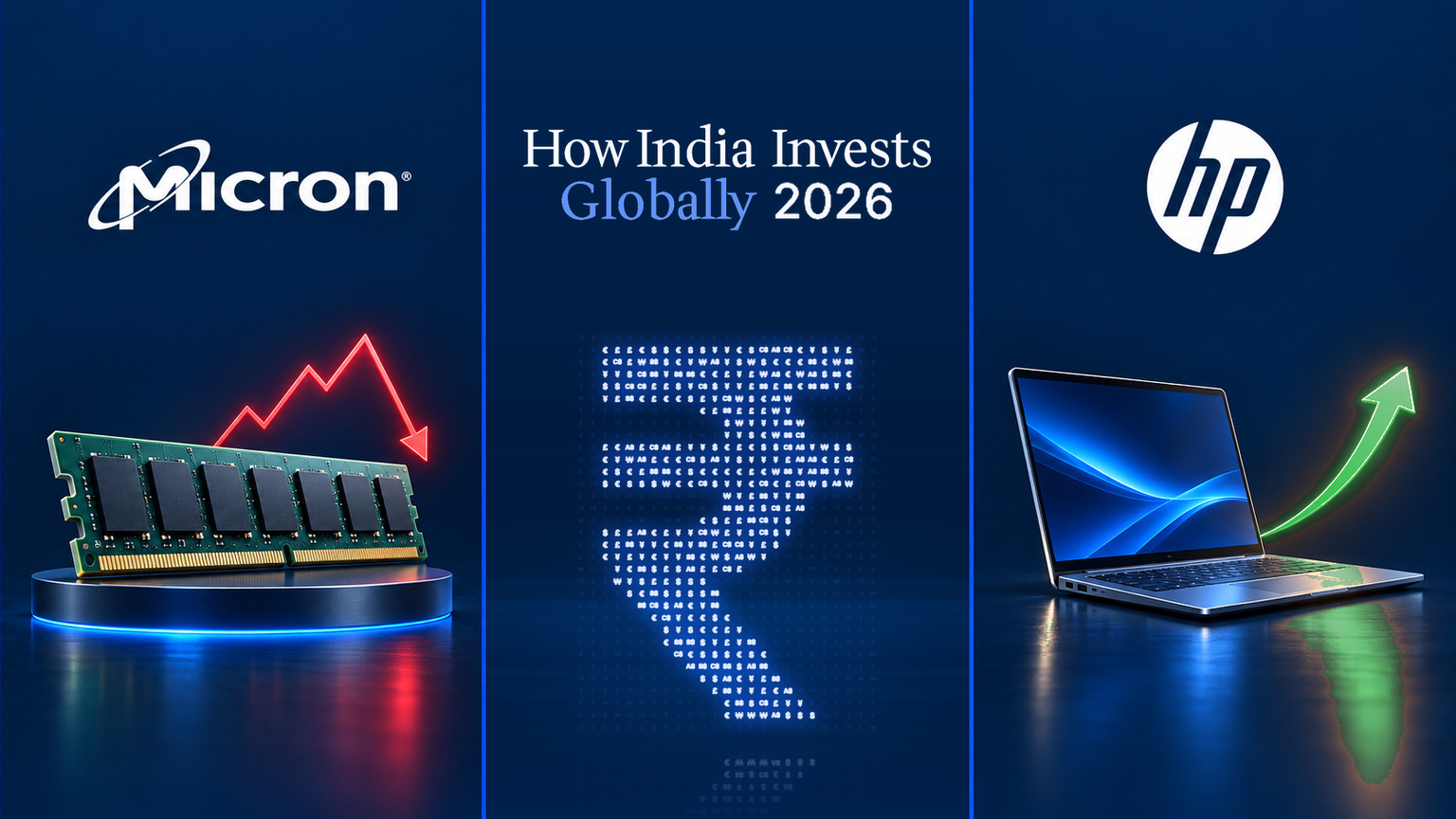
On Thursday, we published our annual mega report: How India Invests Globally 2026.
One of the findings is that 40% of all assets Indians hold on Vested are in AI stocks.
The stock our investors traded most this year was Micron, a maker of memory chips.
Those chips now take up a growing share of what every phone and laptop costs to make, and our video shows who ends up paying for that.
Watch it first to better understand this week’s stories: Apple vs Samsung! How DRAM prices are impacting smartphone giants? at Global Markets by Vested.
Micron gained about $113 a share on Monday, then lost almost all of it by Wednesday.
And HP’s profit per share fell from a year ago, yet it was the best stock in the S&P 500 on Wednesday, up 11.5%.
All these stories run through one small chip.
But one interesting thing from us before the stories.
Think about it… Vinyl over Spotify. Digicams over phone cameras. Casio watches over smartwatches.
Why are old-school products making such a big comeback, and what does it mean for the companies selling them?
Our latest Vested Interests episode investigates the business of nostalgia, with a few unexpected detours.
Now before we dive into the stories, let’s see how the world’s markets held up this week.
The World in a Week

Source: Reuters, Trading Economics and others
Nvidia set the tone. On Monday, its board brought back Jensen Huang as chief executive, 11 days after he resigned.
Nvidia’s shares jumped 31% that day, and the relief spread to AI and chip stocks after last week’s sell-off.
US stocks had their best week in 19 months. The S&P 500 rose 5.6% to 7,297.49 and the Nasdaq gained 6.7% to 24,129.50.
The ride was bumpy, though. Wednesday’s inflation data came in hotter than expected, and markets now expect the Fed to raise rates in December.
The 10-year Treasury yield, what the US government pays to borrow, ended near 4.94%.
The AI bounce reached Asia. Japan’s Nikkei 225 climbed 4.0% to 58,711.
China’s SSEC rose 2.1% to 3,606.49 after Beijing promised state-backed buying of shares.
That lifted copper and miners, and the FTSE 100 gained 3.4% to 10,698.81.
Gold rose 3.4% from its lowest level in over a year, while Bitcoin slipped 0.4%.
India missed out. The Nifty 50 fell 0.7% to 25,607.20, ending a four-week winning run.
Foreign investors still bought about ₹17,630 crore of Indian shares, but banks and metals saw profit-taking.
Attacks on Saudi oil sites pushed Brent crude up about 3% to $95.44.
India imports most of its oil, so dearer crude means a bigger import bill.
So, the rupee weakened to 92.98 per dollar.
Now, moving to the week’s stories.
News Stories
Indians’ most traded US stock this year wasn’t Nvidia
On Thursday, we released How India Invests Globally 2026, our second yearly mega report on how Indians invest abroad.
It is built on aggregated, anonymised data from Vested, so it shows what investors actually did with their money.
51% more investors traded on Vested this year than last year.
AI is now the biggest theme. 40% of all assets held on Vested are in AI stocks, and more than half of investors own at least one.
Trading in AI stocks from January to October was already 87% higher than in all of 2025.
The stock they traded most was Micron, a maker of memory chips used in AI, ahead of Nvidia in second place.
SanDisk, which makes chips that store data, came third, followed by Meta and Microsoft.

Source: How India Invests Globally 2026 by Vested
The most traded ETF was SGOV, which holds short-term US government bonds, ahead of VOO, which tracks the S&P 500.
FYI, investors use SGOV as a place to park dollars and earn interest between investments.
Besides, Bengaluru has 8% of our global investors, 1.5 times as many as Mumbai.

Source: How India Invests Globally 2026 by Vested
And investors come back. 70% of funded investors added money more than once, and a repeat deposit is about 2.5 times the first.
The full report has the top stocks and ETFs, city-wise data and the five trends we expect next, so it is a must-read: How India Invests Globally 2026.
Two of the top three stocks make memory chips, and this week both had a wild ride.
Micron gained $113 a share in a day, then lost it
Micron makes DRAM, the chips that hold data while a computer works. SanDisk makes NAND, the chips that store it.
AI data centres need huge amounts of both, and this year demand ran far ahead of supply.
In February, research firm TrendForce expected DRAM contract prices to rise 90% to 95% in the January to March quarter alone.
That made both stocks stars. As of Tuesday, Micron was up about 147% this year and SanDisk about 209%.
On Monday, Micron jumped 19% to $707.70, as Nvidia’s chief executive’s return calmed fears about AI spending.
On Tuesday, it fell 11%.
The reason was reportedly because memory supply could catch up with demand by mid-2027, so prices could start falling sooner than he expected.
On Wednesday, it fell another 4.5% to $601.25, barely above where it started the week.
SanDisk followed the same path, up about 11% on Monday and down about 11% on Tuesday.
Both bounced back in Friday’s shorter session. Micron rose 7.6% to $646.95 and SanDisk jumped 16% to $85.36.

Source: MU on Vested
That left both stocks slightly higher for the week, and what a roller-coaster that was.
On Friday, TrendForce said price rises will narrow through 2027, and in its base case, DRAM prices start falling across all products from early 2028.
In reality, nobody knows when the shortage ends.
HP’s profit fell, yet it led the S&P 500
For a company that sells laptops and printers, memory chips are now one of the biggest costs.
On Tuesday, after the market closed, HP reported its results for August to October.
Revenue rose 9.3% to $16 billion, ahead of the $15.3 billion analysts expected.
However, its adjusted profit per share fell to 83 cents from 93 cents a year earlier. Analysts had expected about 74 cents.
About 15 cents of that came from refunds of tariffs HP had paid, which it does not expect to repeat.
| HP (Aug to Oct 2026) | Amount | Change |
| Revenue | $16.0B | ▲ 9.3% |
| PC revenue | $11.8B | ▲ 14% |
| PCs shipped | _ | ▼ 29% |
| Adjusted profit, per share | $0.83 | ▼ 11% |
Source: HP Q4 FY2026 results
The memory problem shows up in one number.
At the start of the year, memory and storage made up 15% to 18% of what HP paid for a PC’s parts.
By this quarter, that was closer to 40%, according to chief financial officer Karen Parkhill, who said she expects those costs –
“[…] to continue to increase, but at a lesser rate.”
HP also shipped 29% fewer PCs than a year ago, yet its PC revenue rose 14% to $11.8 billion, so it made far more from each one it sold.
The stock had fallen 3.3% on Tuesday before the results. On Wednesday, it jumped 11.5% to $31.15, the best move in the S&P 500 that day, and well above where it started the week.

Source: HPQ on Vested app
There’s one caveat though. HP’s profit forecast for next year, $3.15 to $3.45 a share, only starts where analysts already were, at about $3.15.
Make of it what you will.
The bottom line
All three stories narrow down to one lesson.
As per our findings, Indian investors traded Micron more than any other US stock this year.
Micron gained about $113 a share in a day, and lost nearly all of it in two.
HP’s profit fell, and its stock had the best day in the S&P 500.
The difference? Micron sells memory chips and HP buys them. When memory prices rise, one wins and the other pays.
Nobody knows when the shortage ends. TrendForce sees prices levelling off in late 2027, while HPE expects supply to stay tight.
So before buying the next hot AI stock, ask one question:
Does it sell the scarce thing, or does it have to buy it?
That is a story for a future Vested Shorts. We will be here to tell you when it comes.
Thanks for reading!